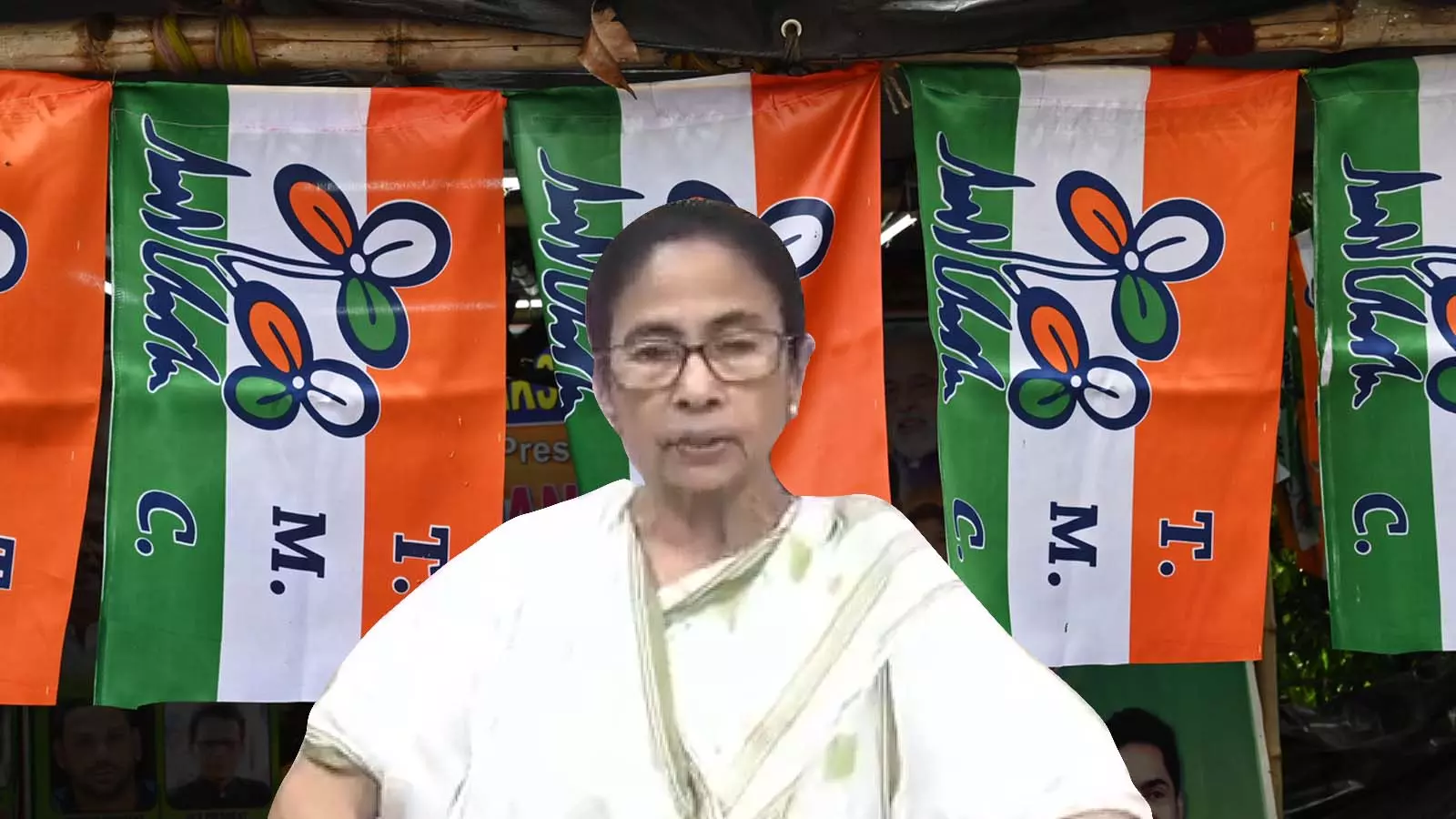
Trinamool Congress leader Mamata Banerjee has taken a defensive strategy to save her fortress after yet another aide deserted her on July 4, 2026. Photos: X/@AITCofficial, iStock
What Mamata's direct takeover of Bengal Trinamool unit signals after Chandrima exit
Taking direct command of a fracturing state unit, the veteran prepares workers for an unfavorable EC ruling by anchoring the party's future in grassroots 'people power'

Former West Bengal chief minister Mamata Banerjee on Saturday (July 4) assumed direct control of the divided Trinamool Congress (TMC), signalling she was preparing the party for a prolonged battle over its organisation, election symbol and identity after another close aide defected.
Also read: Mamata speaks on TMC crisis: Key takeaways from her address after Chandrima’s exit
In a combative Facebook Live address, the firebrand 71-year-old announced that she would herself take over as the party's West Bengal state president following the resignation of Chandrima Bhattacharya, while appointing Kunal Ghosh and Madan Mitra as state general secretaries.
Reshuffle with Mamata running out of aides
The organisational reshuffle came hours after Chandrima, one of Banerjee's long-time associates who had been made interim state president in June after Subrata Bakshi stepped aside because of ill health, quit and met leaders of the rival faction headed by Ritabrata Banerjee, the Leader of Opposition.
The developments came as the TMC faces its gravest organisational crisis since its formation in 1998.
The Ritabrata-led faction claims to be the "real" TMC and is seeking recognition from the Election Commission (EC). The dispute now extends beyond the legislature to the party's organisation, offices and, crucially, its election symbol, "Jora Ghas Phool" (two flowers with grass).
Mamata spent much of her address attacking the rebels as "traitors" acting on behalf of the Bharatiya Janata Party (BJP), accusing the saffron outfit of attempting to engineer a split in her party through constitutional institutions.
But beyond the political rhetoric, her remarks suggested a subtle yet significant shift in strategy.
'Symbol doesn't matter'
Instead of projecting confidence that her faction would inevitably retain control of the party's organisation and symbol, the former CM repeatedly argued that neither ultimately mattered if the party retained its grassroots workers and public support.
Also read: Courts or streets? What will Mamata choose after rebels 'seize' TMC HQ | Capital Beat
"They may take away the symbol, but it does not matter," she said. "The real symbol is the one accepted by the people and by TMC workers."
She went further, saying that even if the EC were to award the party's symbol to the rival camp, she would continue the political fight. "If necessary, I will hang the symbol around my neck and go among the people," she said.
The undivided TMC saw its seat count plummet to only 80 in the Bengal Assembly elections held in April, but its vote-share remained around 41 per cent, five per cent less than the BJP, which won 207 seats.
Mamata concedes loss of symbol?
“The repeated references to the possibility of losing the symbol appeared designed less as a prediction of the commission's decision than an attempt to prepare party workers for an outcome that, until recently, Mamata had publicly dismissed,” observed political commentator and author Debasish Chakrabarti.
Her remarks suggested she was trying to separate the party's political legitimacy from its institutional assets, arguing that its strength lay with its workers rather than its elected representatives, offices or symbol.
"My real assets are not the leaders. They are the workers," she said, thanking party activists who had stayed with her despite the rebellion.
She also appeared to acknowledge the depth of the organisational crisis by taking direct charge of the state unit herself instead of appointing another president after Chandrima's departure.
The decision points to a shrinking circle of trusted lieutenants at a time when several senior leaders have crossed over to the rival faction following the party’s defeat in the Assembly election.
Mamata also sought to reassure supporters that the party's institutions remained intact despite Friday's (July 3) dramatic confrontation between the two camps over the party office in Kolkata.
The rebel Ritabrata Banerjee faction took control of the party office, with Mamata loyalists accusing it of locking the premises before leaving, triggering a political stand-off.
Also read: What went wrong for Mamata Banerjee and what lies ahead for TMC? | Capital Beat
Mamata responded by arguing that while individuals could leave a political party, they could not take over its institutions.
"An individual may leave, but an institution does not," she said, while also referring to the office's lease agreement and disputing claims over its control.
For now, the immediate contest over control of the TMC rests with the poll panel and, potentially, the courts.
But Mamata's repeated insistence that "symbols can be taken away, not people's support" suggested she was preparing for a prolonged political battle.
Any organisational setback, if it came, would be presented not as the end of the party but as the beginning of its reconstruction under her leadership.
Saturday's message is perceived as a departure from Mamata's earlier insistence that the rebels posed little threat.
After the May 4 electoral defeat and a series of high-profile defections, her rhetoric suggested a more defensive strategy.
She repeatedly argued that the party's future would depend on its workers rather than its organisational assets.
Although she said she harboured no personal resentment towards the defectors, she hinted that some of them may have acted under pressure.
Also read: Bengal's Didi shield cracks: How Mamata Banerjee lost the state she dominated
"Some people may have burdens to carry. But I will not bow my head. I will continue to fight," she said in a bid to project the split as a moral rather than numerical contest.
Mamata heads back to people power?
The rival camp has sought to establish its legitimacy through its support among lawmakers. Mamata, however, said the rebels were driven by power, while her faction remained committed to the TMC's founding slogan of "Maa, Mati, Manush" (Mother, Motherland and People).
"They have property, families, wealth, luggage and baggage," she said.
"But we too have a family. The TMC family is the family of Maa, Mati, Manush."
The comments appeared aimed at convincing party workers that the movement's identity remained with Mamata, regardless of the outcome of the legal and organisational battles now unfolding.
She also confirmed that the party would go ahead with its annual July 21 Martyrs' Day rally, which commemorates the 13 Youth Congress workers killed in the 1993 police firing when the Left Front was in power in Bengal.
The announcement came days after police imposed prohibitory orders under Section 163 of the Bharatiya Nyaya Sanhita in and around central Kolkata, where the TMC has traditionally held its annual rally.
Mamata's supporters have described the move as an attempt by the state's BJP government to prevent her from organising the flagship annual event.