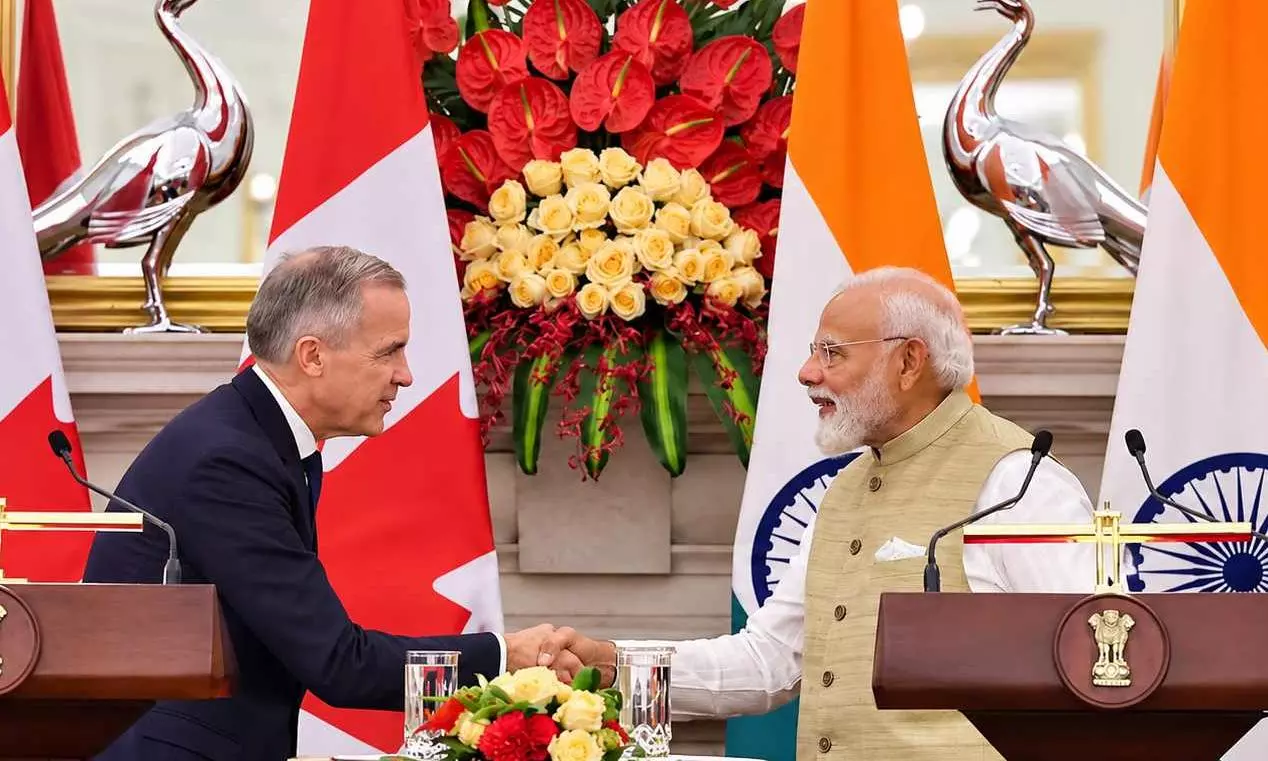
For Carney, India plays a central role in his strategy to reach out to the ‘middle powers’ and align approaches towards the crucial Indo-Pacific region. Photo: @narendramodi
Beyond Nijjar and Khalistan: Geopolitics and trade fuel reset in India-Canada ties
India and Canada seek to rebuild strained ties amid shifting geopolitics, with trade, energy security and strategic interests driving the reset

“We have no eternal allies, and we have no perpetual enemies. Our interests are eternal and perpetual, and those interests it is our duty to follow.” This oft-quoted maxim of international diplomacy, articulated by British statesman Lord Palmerston in the House of Commons in 1848, encapsulates the recent dramatic thaw in India-Canada relations after a period of deep freeze.
India and Canada move to reset strained ties
Driven by pragmatism and strategic interests, New Delhi and Ottawa are now embracing realpolitik to recalibrate and rebuild their bilateral partnership. Prime Minister Narendra Modi is all set to visit Canada next month, following a visit to New Delhi by his Canadian counterpart Mark Carney, which provided the necessary impetus for the much-needed reset in bilateral relations.
A measure of the two sides' endeavour to rebuild robust relations can be gauged from the fact that discussions are also underway for Carney to be invited as the chief guest for the Republic Day parade next year.
Also Read: Modi, Carney agree to ‘build on positive momentum’ in India-Canada ties
Eager to maintain momentum, India recently hosted Canadian Foreign Affairs Minister Anita Anand and Minister of International Trade Maninder Sidhu. Their overlapping visits underscored the concerted efforts being made by both sides to move ahead on the diplomatic and economic fronts.
Reflecting this sense of urgency, the two PMs spoke on the phone during Sidhu’s visit to New Delhi. Among other things, they reaffirmed their commitment to conclude negotiations for a Comprehensive Economic Partnership Agreement (CEPA) to deepen trade and investment ties by the year-end. The two sides have set an ambitious bilateral trade target of USD 50 billion by 2030.
Security concerns and the Khalistan issue
The remarkable turnaround comes after a period of prolonged estrangement under the previous Justin Trudeau-led government. As far back as 2018, Trudeau was given the diplomatic cold shoulder by a bristling New Delhi for what it perceived as his government’s pandering to Khalistani elements in Canada. Canadian Sikhs, incidentally, are an important vote-bank for Trudeau’s Liberal Party.
Also Read: India, Canada step up trade talks, fifth CEPA round set for October 5
Under Carney, however, Ottawa appears to be managing New Delhi’s security sensitivities and concerns about the activities of Khalistan supporters in a more mature manner. The NSA-level Security Dialogue held thrice since September last year, with the latest one being held in early October in New Delhi, and has provided a constructive forum to discuss their respective security concerns without allowing them to derail the overall relationship.
Driven by shifting geopolitics and economic imperatives, both sides have committed to building a “strong, resilient, and forward-looking partnership”. This is possible only if Ottawa is mindful of New Delhi's core concerns on security and sovereignty, which the latter feels are impacted by Khalistani activities.
Carney looks beyond Washington to strengthen trade
For Carney, India plays a central role in his strategy to reach out to the ‘middle powers’ and align approaches towards the crucial Indo-Pacific region. An economist-turned-politician, Carney is leading Canada through a challenging period marked by a historic low in Ottawa-Washington relations. Their ongoing spat over trade tariffs has prompted Canada to look for strong economic partnerships with India and the European Union (EU) to reduce its reliance on the US. At present, Canada is the second largest trading partner of the US after Mexico.
Also Read: No evidence of Indian govt-linked activities in Canada, says RCMP chief
Riding roughshod over a traditionally close ally, US President Donald Trump unleashed a trade war against Canada, which has seen the latter respond in equal measure. Trump’s repeated threats to make Canada the 51st state of the US have further strained ties and raised hackles in Ottawa.
Canada, consequently, is looking to diversify its trade and economic ties. In India, Canada sees a vast export market and significant investment opportunities. Reflecting this push, its Trade Minister Sidhu led a 300-member Team Canada Trade Mission to India, the largest in three decades.
CEPA talks face deadline and domestic industry concerns
While a deep and broad-based economic partnership will be one of the cornerstones of future ties, the two sides are racing to meet the December deadline to finalise the CEPA, discussions for which were intensified in March this year. The pact has been under discussion for over a decade.
Negotiations for CEPA suffered a huge setback following India-Canada tensions over Khalistan elements operating from Canadian soil, with New Delhi believing the Trudeau government was turning a blind eye to their activities. Bilateral ties hit their lowest point after Ottawa said the Indian government was linked to the killing of Khalistan activist Hardeep Singh Nijjar in Canada in 2023.
With CEPA negotiations now resumed, India will need to protect the interests of its own domestic industry. A fine balance will need to be struck between India’s desire to build strong economic ties with Canada while protecting those sectors of the industry that are not as competitive.
Energy and uranium supply offer scope for cooperation
India sees vital economic gains from its partnership with Canada. Canada can be a valuable partner in diversifying India’s sources of energy and securing critical minerals. Under the India-Canada Strategic Energy Partnership, the two sides are looking to collaborate in areas such as conventional energy, civil nuclear energy, and critical minerals.
Also Read: India, Canada finalise national work plan on security, law enforcement
Crucially, Canada will help meet India’s nuclear power needs, with the two having signed a long-term uranium supply agreement during Carney’s March visit. Under the USD 1.8 billion pact, Canada will supply uranium for India’s nuclear reactors for the next 10 years. India is also seeking to import more LNG, LPG, and crude oil from Canada.
Ultimately, both sides have much to gain from one another. Maintaining this trajectory will require deft diplomacy to ensure strategic interests remain paramount and bilateral relations stay on an even keel.