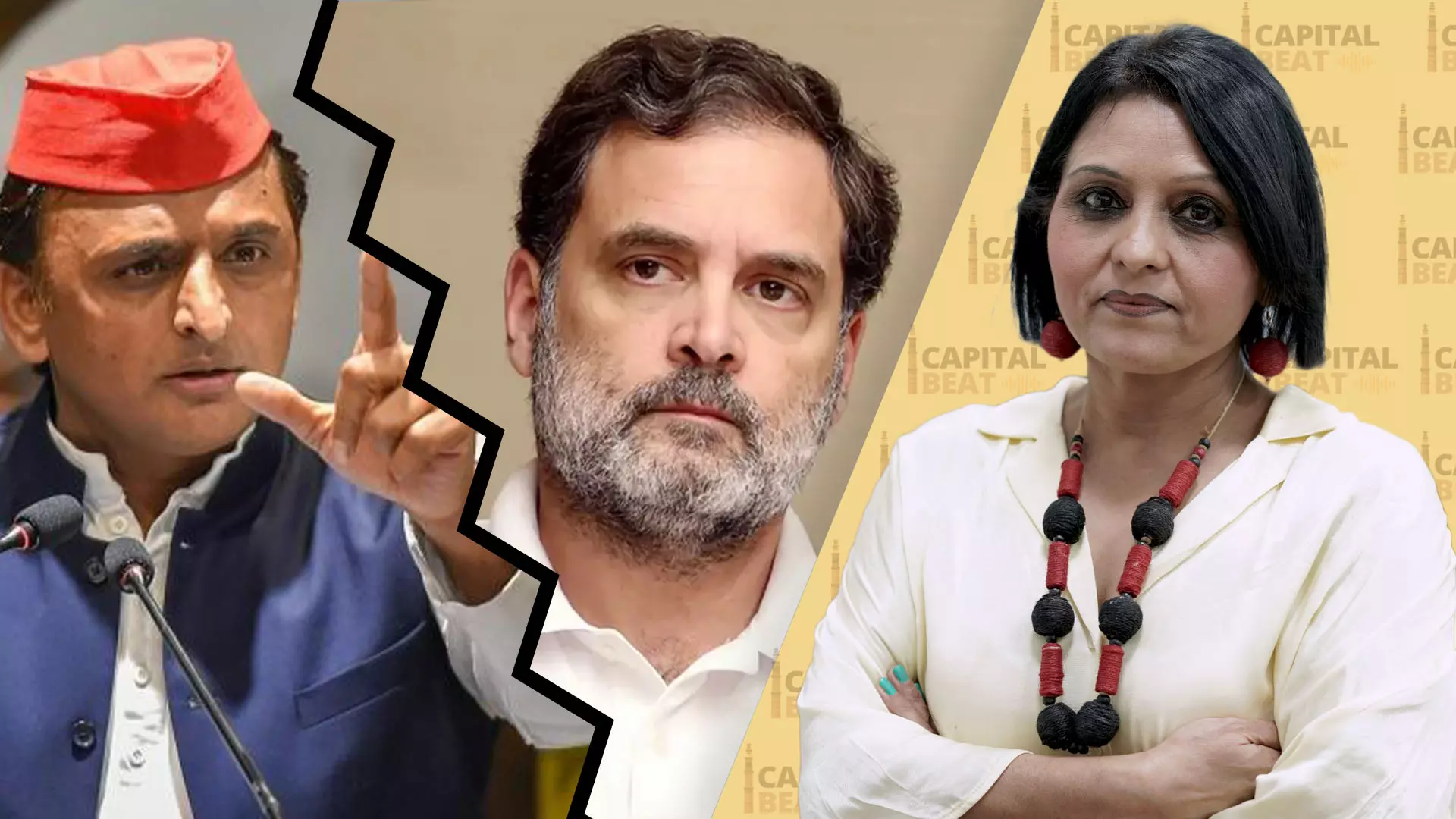
Is it the end of INDIA Bloc? Akhilesh's dig at Congress triggers debate
Akhilesh Yadav’s tweet after Congress backed Vijay’s TVK in Tamil Nadu sparks debate over INDIA bloc unity and the future of the SP-Congress alliance in Uttar Pradesh

The Federal spoke to Shahira Naim, Sharat Pradhan, and T K Rajalakshmi on Capital Beat about the implications of Akhilesh’s remarks, Congress’s Tamil Nadu decision, and what it could mean for opposition unity ahead of the Uttar Pradesh Assembly elections next year.
Also read: 'Congress hurried, and looked power-hungry in Tamil Nadu'
The discussion revolved around whether Akhilesh Yadav’s message was merely symbolic political positioning or an indication of deeper unease within the opposition alliance.
Akhilesh’s message
Shahira Naim argued that Akhilesh Yadav's message was deliberate and politically loaded. According to her, the Samajwadi Party chief deliberately made his Kolkata meeting with Mamata Banerjee highly visible by bringing a camera crew and ensuring the optics reached television screens.
She said the message was clear: at a moment when regional allies were facing political setbacks, Congress appeared to be distancing itself instead of standing united. She pointed out that Akhilesh not only met Mamata Banerjee after the Trinamool Congress defeat but also included Stalin’s photograph in his social media post to underline solidarity with allies under pressure.
Naim criticised Congress for what she described as “double standards” in opposition politics. She said parties cannot attack each other during Assembly elections and then expect seamless unity during Lok Sabha elections.
Also read: Eyeing 2027, Akhilesh bets on women voters to breach BJP’s ‘beneficiary’ bastion
According to her, ideology and consistency are necessary for alliances to survive. She argued that Akhilesh’s remarks were significant because Uttar Pradesh is heading into elections next year, where opposition unity will again be tested.
Congress dependence
Shahira Naim also stressed that Congress’s revival in Uttar Pradesh during the 2024 Lok Sabha election depended heavily on the Samajwadi Party’s organisational structure.
She recalled extensive ground reporting during the campaign and argued that wherever Congress performed well, the SP machinery was working behind the scenes. According to her, Congress lacked the grassroots strength in Uttar Pradesh to independently mount a significant electoral challenge.
However, she stopped short of predicting a break between SP and Congress. She said it was still “too early” to talk about a divorce between the two parties.
Naim nevertheless warned that if Congress continued behaving inconsistently and failed to commit to alliance politics, Akhilesh Yadav might eventually have little choice but to go alone. Such a split, she said, would only benefit the BJP by dividing secular votes.
Also read: Assembly poll results: How BJP-Modi domination impacts INDIA bloc nationally
She argued that ideological coherence mattered, particularly when Akhilesh Yadav was trying to build politics around the PDA plank and constitutional issues.
Tactical tweet
Sharat Pradhan took a more cautious view of Akhilesh Yadav’s remarks. He described the tweet as a “well-thought-out” political signal aimed primarily at keeping the DMK in good humour rather than a real indication of separation from Congress.
Pradhan argued that Akhilesh Yadav fully understood the political risks of distancing himself from Congress in Uttar Pradesh. He pointed out that the SP’s strong performance in 2024 was aided significantly by Dalit support, which, according to him, shifted because of Rahul Gandhi’s campaign around protecting the Constitution and reservation.
Also read: BJP slams Congress for ‘betrayal’ after DMK split, TVK support
He said Rahul Gandhi’s messaging against alleged threats to the Constitution resonated deeply among Dalit communities and helped consolidate anti-BJP sentiment.
According to Pradhan, Akhilesh Yadav knew that without Congress and Rahul Gandhi alongside him, replicating that social coalition would be difficult.
He therefore dismissed the possibility of Akhilesh actively pursuing a third front or exiting the INDIA bloc at this stage.
Opposition pressures
Pradhan also cautioned that the BJP remained in permanent election mode and would aggressively target the Samajwadi Party in Uttar Pradesh. He argued that Akhilesh Yadav could not afford political experimentation under such circumstances.
He referred to voter list revision controversies and alleged institutional pressures, saying opposition parties were already facing enormous challenges before the next elections.
Asked directly whether SP and Congress could afford a separation in Uttar Pradesh, Pradhan replied firmly that such a move would be politically disastrous for Akhilesh Yadav.
Also read: BJP claims Bengal, Assam surge shows ‘INDI Alliance’ has no future
He described the tweet as political posturing rather than a sign of imminent rupture. At one point, he even suggested that Akhilesh may already realise the controversy generated by the tweet was politically risky.
Congress under fire
T. K. Rajalakshmi focused on the Congress decision to support TVK in Tamil Nadu and its implications for alliance politics.
She argued that it was too early to sound the “death knell” for the INDIA bloc, but admitted the developments in Tamil Nadu had complicated opposition equations.
Rajalakshmi stressed that Congress should ideally have discussed its Tamil Nadu strategy with INDIA bloc partners before extending support to Vijay.
She reminded viewers that Congress and other allies had fought the 2024 Lok Sabha elections in Tamil Nadu under the Secular Progressive Alliance led by the DMK and had benefited enormously from that arrangement.
According to her, the Congress victory in several Lok Sabha seats in Tamil Nadu would not have been possible without DMK support.
Also read: Is the game up for INDIA bloc?
She criticised Congress for taking a unilateral decision that unsettled other opposition parties and allowed rivals to question alliance coherence.
Alliance contradictions
The panel also discussed broader contradictions inside the INDIA bloc.
Rajalakshmi noted that despite repeated meetings and public appearances, the alliance still lacked institutional structure, common programmes, or a coordinated mechanism for decision-making.
Shahira Naim echoed similar concerns, arguing that the Congress leadership still carried a “sense of entitlement” that weakened alliance management.
She said opposition parties needed regular coordination, common political messaging, and ideological consistency if they hoped to effectively challenge the BJP.
The panelists repeatedly stressed that internal disagreements and public contradictions only strengthened the BJP politically.
At the same time, both Rajalakshmi and Pradhan agreed that despite tensions, opposition parties remained aware of the risks of fragmentation, especially in electorally crucial states like Uttar Pradesh.
Future questions
The discussion concluded with concerns over whether the INDIA bloc could survive without stronger internal coordination and trust among allies.
Also read: INDIA bloc offers hard-to-accept truce to Speaker Birla amid no-confidence talk
While none of the panelists predicted an immediate collapse of the alliance, all three acknowledged that recent events in West Bengal and Tamil Nadu had exposed serious fault lines.
For now, Akhilesh Yadav’s tweet remains open to interpretation — part warning, part political messaging, and part pressure tactic within a fragile opposition coalition still trying to define itself before the next major electoral battle.The content above has been transcribed from video using a fine-tuned AI model. To ensure accuracy, quality, and editorial integrity, we employ a Human-In-The-Loop (HITL) process. While AI assists in creating the initial draft, our experienced editorial team carefully reviews, edits, and refines the content before publication. At The Federal, we combine the efficiency of AI with the expertise of human editors to deliver reliable and insightful journalism.