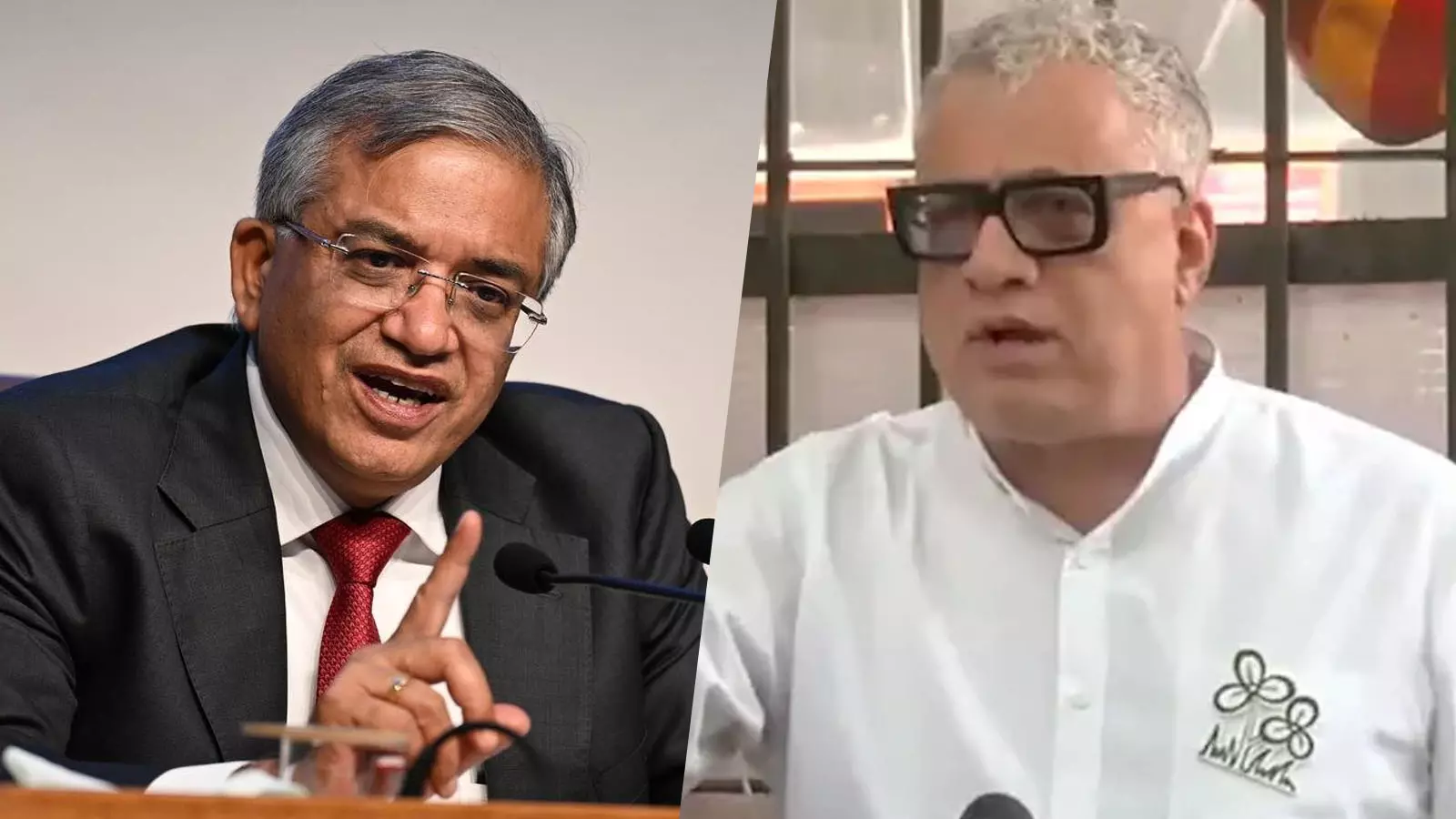
On April 8, a delegation of Trinamool Congress leaders called upon Chief Election Commissioner (CEC) Gyanesh Kumar to raise grievances their party had with the conduct of the Election Commission and its officials in poll-bound West Bengal, including the deletion of over 89 lakh voters during the Special Intensive Revision (SIR) of the state’s voter rolls.
What should have ordinarily been the kind of meeting that is rather ‘routine’ in poll season, however, escalated quickly into a bitter feud. Trinamool Congress MP Derek O’Brien alleged that the meeting ended abruptly “within seven minutes” after Kumar told the leaders to “get out”.
Moments later, the poll panel threw away all pretence of fairness, directly targeting the Trinamool Congress through a post on X that read: “ECI's Straight-talk to Trinamool Congress. This time, the Elections in West Bengal would surely be: Fear-free, Violence-free, Intimidation-free, Inducement-free and without any Chappa, Booth Jamming and Source Jamming. (sic)”
Crossing a Rubicon
The poll panel targeting a political party and practically accusing it of various misdemeanours was unprecedented. Trinamool MP Sagarika Ghose, who had accompanied O’Brien, newly-elected party MP Menaka Guruswamy and former MP Saket Gokhale to meet Kumar, alleged that the EC’s ‘straight talk’ was a “blatant lie”. She claimed that while none of the things mentioned in the poll panel’s X post was actually said to the Trinamool delegation, what Kumar did tell the leaders was to “get lost”.
While the EC has not clarified whether Kumar indeed uttered those two words to the Trinamool leaders, what is for all to see is that the poll panel has, with its X post targeting Bengal chief minister Mamata Banerjee’s party, crossed a Rubicon no election commissioner had before.
What makes this public display of the EC’s bias against one political outfit all the more troublesome, both politically and constitutionally, is that it comes within two days of the Opposition’s notice for a motion to remove Kumar as CEC being rejected by Lok Sabha Speaker Om Birla and Rajya Sabha Chairman CP Radhakrishnan.
No debate in Parliament
On April 6, in similarly worded bulletins, Parliament secretariat informed that Birla and Radhakrishnan had refused to admit the notice against Kumar, which 193 Opposition MPs had jointly submitted on March 12.
The Trinamool Congress, which had taken the lead in getting Opposition parties to endorse the notice, had reacted with predictable scorn. Crying “shame”, Trinamool’s O’Brien blamed the rejection of the notice on the BJP; likening the lack of reasons being cited in the Rajya Sabha Chairman’s decision to not admit the Opposition’s notice with the ruling party “mocking our great Parliament”.
The Opposition was always aware that while it had the numbers required in either House of Parliament to move the motion, the likelihood of the impeachment proceedings actually being initiated was negligible. What the Opposition had, however, hoped for, as Trinamool Congress MP Abhishek Banerjee told The Federal was “to force a debate in Parliament on Kumar’s brazenly partisan attitude against Opposition parties and to expose how the BJP had completely compromised the Election Commission under Prime Minister Narendra Modi’s leadership.”
The order by Birla and Radhakrishnan has now robbed the Opposition of that chance.
In its notice seeking Kumar’s removal, the Opposition outlined seven reasons, which in its view, demonstrated the CEC’s “proven misbehaviour” and “partisan” steering of the poll panel.
No proof of 'misbehaviour'
The bulletins issued by the Lok Sabha and Rajya Sabha secretariats merely stated that the Opposition’s notices in both Houses had not been admitted “after due consideration” but offered no reasoning for the decision; a point highlighted by O’Brien.
Sources in the Rajya Sabha secretariat, however, said that Radhakrishnan’s order on the notice, running into over 15 pages, had detailed the reasons for his decision and that the “Opposition MPs should have read the order instead of reacting to the bulletin”.
While the Opposition had alleged that Kumar’s appointment as the CEC was tainted because the constitutional validity of the selection process was, at the time, under challenge before the Supreme Court, Radhakrishnan noted that the allegation, “even if presumed to be factually correct” do not prove “misbehaviour attributable to the CEC”.
The Rajya Sabha Chairman also rejected the Opposition’s charge that the EC’s constitutional fidelity had been compromised under Kumar’s watch by dubbing the allegation as one that was “couched in broad, generalised, and inferential terms” and rested “largely on the perception of a particular political formation”.
In conclusion, the Radhakrishnan noted that while the Opposition’s allegations “are relevant for political debate, they do not prima facie meet the high constitutional bar for removal proceedings” nor do they “demonstrate ‘misbehaviour’ as envisaged by Articles 324(5) and 124(4) of the Constitution.”
'Strangling democracy'
Opposition leaders like O’Brien may have jumped the gun in asserting that their notice was rejected with citing any reasons, but final outcome in the matter, said Congress MP Imran Masood, “does not wish away the one undeniable fact that the Narendra Modi government is holding every institution, from the Election Commission to even Parliament, hostage and all avenues for the Opposition to raise its grievances are being shut down one after another”.
“We do not agree with the reasoning given in the order but even the Rajya Sabha Chairman has agreed that issues we raised are relevant for political debate. Parliament is the highest forum for political debate in our democracy and I want to ask the Rajya Sabha Chairman and Lok Sabha Speaker how many debates sought by the Opposition have been allowed in the last 12 years of this government?” asked Masood.
Trinamool Congress’s Ritabrata Banerjee, who retired from the Rajya Sabha on April 2, said, “last year when we wanted to discuss the SIR, they allowed the entire monsoon session of Parliament to be washed out and finally when they agreed in the next session for a discussion they said they won’t discuss SIR but electoral reforms. Even to discuss the situation in Manipur, we had to move a no confidence motion against the government. If they had allowed us to discuss the way the EC has been compromised, the need for this notice would not have arisen.”
On Wednesday, hours after the war of words between the Trinamool Congress and the poll panel escalated, Opposition leaders led by the senior advocate and Congress veteran Abhishek Manu Singhvi slammed Parliament’s presiding officers for refusing to admit the impeachment notice against Kumar.
“You have done a mini-trial, you have strangulated the adjudication in the political process, you have mixed up subjudice, contempt and impeachment,” Singhvi told reporters during a press conference at Delhi’s Constitution Club.
“When accountability is adjourned intelligently, then democracy itself stands impeached. If the truth was on the CEC’s side, why was there fear in facing scrutiny?” Singhvi asked, adding that in rejecting the notice, Birla and Radhakrishnan had “strangulated” the impeachment process as envisaged in the Constitution.
'Ominous tidings'
For RJD MP Manoj Kumar Jha the manner in which Birla and Radhakrishnan decided on the Opposition’s notice against Kumar presages ominous tidings “not merely for how elections are conducted but for the functioning of parliamentary democracy at large”.
“What we are seeing is a strangulation of parliamentary democracy itself. Now, dissenting voices are being muzzled and disregarded not just by the government but also by constitutional authorities like the presiding officers of both Houses of Parliament. There is no scope left for any dialogue. Parliament has been reduced to a notice board where the government simply says and does whatever it wants to while the Opposition has no say. Not one motion for adjournment or suspension of business moved by the Opposition is admitted in either House. Instead, the government has come up with this new practice where it sends a minister to read out a statement, as we saw after Operation Sindoor and more recently in the current session on the West Asia crisis, but forget a full-fledged discussion, the Opposition is not even allowed to seek clarifications on that statement,” Jha told The Federal.
Opposition leaders also point out another “disturbing trend” that distinguishes Parliament’s functioning in the third term of the Modi regime from its previous two terms.
“If you observe carefully, you will realise how over the past two years any demand from the Opposition for discussing critical issues is derailed by the government by mischievously introducing certain motions and at times even Bills as red herrings. In this budget session, they suddenly brought a motion to discuss Left Wing Extremism for over four hours but said there was no time to discuss the impact of the West Asia war on India’s economic and energy security. Even the amendments to the women’s reservation law are being brought in surreptitiously without any discussion with the Opposition by extending the session in an unprecedented manner when the government had all the time during the normal course of the budget session to list these as part of the legislative business,” said a senior Lok Sabha MP from the Congress party who did not wish to be named.
The Congress MP added, “We saw the same thing happen in previous sessions when they had time to discuss Vande Mataram for three days but didn’t allot time for discussing the SIR. All of this is obviously happening with the complicity of the Speaker and Rajya Sabha Chairman, while the Opposition is expected to adhere strictly to the rulebook… any motion moved by the Treasury Benches is immediately admitted irrespective of its merit or urgency while Opposition’s demands to discuss matters directly concerning the people or the government’s policies are routinely brushed aside either on the absurd excuse of paucity of time or because the presiding officer doesn’t deem the discussion necessary. Even in the normal course of proceedings, while Opposition MPs are either not allowed to speak or are repeatedly interrupted by the presiding officers and Treasury Benches, MPs from the side are allowed to speak at length, and often in violation of Rules of Procedure, whenever they want.”
The impeachment motion brought against Kumar was a first in the history of Parliament.
Opposition leaders say it deserved to be treated with the seriousness and urgency it warranted but was “rejected in a casual and arbitrary manner”.
The “malaise”, however, runs much deeper said Jha, asserting that it “isn’t about one notice being rejected or one individual being protected… it is symptomatic of how Parliament is being gradually stripped off everything it is supposed to symbolise – fairness, dialogue, scrutiny, diversity of opinion and safeguarding the Constitution.”