Can Sánchez hold on to power in Spain, or will housing, migration crises spell his doom?
Spain goes to polls today; opinion polls give edge to Alberto Núñez Feijóo-led PP that promises ‘truth, decency, good governance,’ banks on anti-immigration Vox party’s support to form govt

By calling snap elections eight months ahead of schedule, Spanish Prime Minister Pedro Sánchez has taken a gamble that could either strengthen his hold on power or bring his government to an end. The outcome will be clear when 38.61 million voters go to the polls on Sunday (November 29). Opinion polls put the opposition conservative People’s Party (PP), led by Alberto Núñez Feijóo, marginally ahead of Sánchez’s ruling Spanish Socialist Workers’ Party (PSOE).
The election is attracting attention well beyond Spain. At a time when right-wing parties are gaining ground across Europe, Spain remains one of the continent’s major left-wing governments. Sánchez has also emerged as one of Europe’s most outspoken critics of Israel’s war in Gaza, condemning what he has described as genocide and calling for respect for human rights.
Sánchez
Can Sánchez govt’s virtues defeat its flaws?
But the prime minister faces mounting challenges at home. His government has come under pressure over corruption allegations involving people close to him, while immigration and the country’s acute housing crisis have become major election issues.
The election will test whether Sánchez can keep the Spanish Left in power or whether Spain will join the wider European shift to the Right. The result will also be closely watched in France, where elections are due in a few months.
Also read: Spain election: How far right weaponised public anxiety to expand its political reach
Sánchez is also among Europe’s most outspoken critics of US President Donald Trump. He has rejected Trump’s demand that European countries raise defence spending to 5 per cent of GDP and refused to allow US bases in Spain to be used for the war against Iran. He has also criticised US-Israeli attacks.
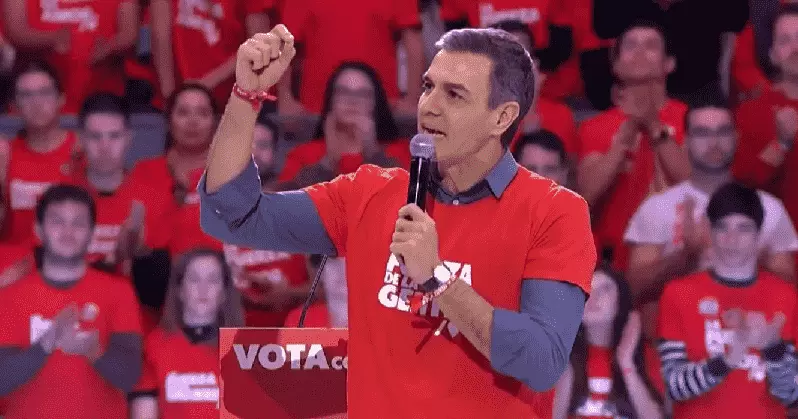
At a massive rally on the final day of campaigning, Sánchez exuded confidence, insisting that his party would prove the opinion polls wrong.
“I cannot imagine us losing,” he told supporters.
Sánchez expects Lula-style victory
More than 13,000 people packed Madrid’s Caja Mágica beyond capacity to hear the prime minister, who sought to turn the election into a contest over the future of Spain’s welfare state.
“They have tried to turn this election into a referendum against me, the evil Sánchez, and my family. But this election isn’t about me. It’s about your rights, your jobs, and your dignity. It’s about whether we want a government that keeps strengthening the welfare state or whether we hand it over to the government of scissors and chainsaws,” he said.
Also read: Who is Gadi Eisenkot, Israeli ex-military chief seeking to replace Netanyahu?
Sánchez is hoping to pull off a victory similar to that of Brazil’s left-wing leader Luiz Inácio Lula da Silva, who won a second-round victory against the odds and opinion poll predictions.
Feijóo upbeat about victory; Vox may play kingmaker
Feijóo, meanwhile, is equally confident that voters will reject the Socialists and give his party a mandate to govern. He has accused the government of failing to address the housing crisis and is seeking to capitalise on growing anti-immigration sentiment.
Promising “truth, decency and good governance,” Feijóo told supporters: “This time, yes, we’re going to do it.”
In the last election, three years ago, the PP won more seats in Parliament than the Socialists but failed to form a government. This time, Feijóo is counting on support from the far-right, anti-immigration Vox party, led by Santiago Abascal.
Vox is now polling at over 17 per cent, around five percentage points higher than in the 2023 election. Its growing support has made it a potential kingmaker, with Feijóo likely to need its backing to form a government.
Also read: Lula's Brazil victory checks rightward shift as Flávio Bolsonaro seeks annulment
Vox is demanding priority for Spanish citizens in jobs, education and housing, along with economic deregulation and a tougher immigration policy, including the deportation of migrants to their countries of origin.
The party’s growing influence could make it difficult for Feijóo to form a government without accepting at least some of its demands.
Can the Left retain its stronghold?
The latest poll predictions published by Spain’s El País newspaper put the PP at 32 per cent and the Socialists at 31 per cent, with Vox in third place at 17 per cent.
If the PP and Vox combine their seats, they could secure an absolute majority in Spain’s 350-member Congress of Deputies. A party or coalition needs 176 seats to command a majority.
The election is not just a contest between Sánchez and Feijóo. It is also a test of whether the Spanish right can translate its growing support into power, and whether the left can hold on to one of its last major strongholds in Europe.