Bangladesh's oath crisis clouds Tarique Rahman's swearing-in
BNP and Jamaat-e-Islami clash over a second pledge linked to constitutional reforms, as a writ petition challenges the referendum

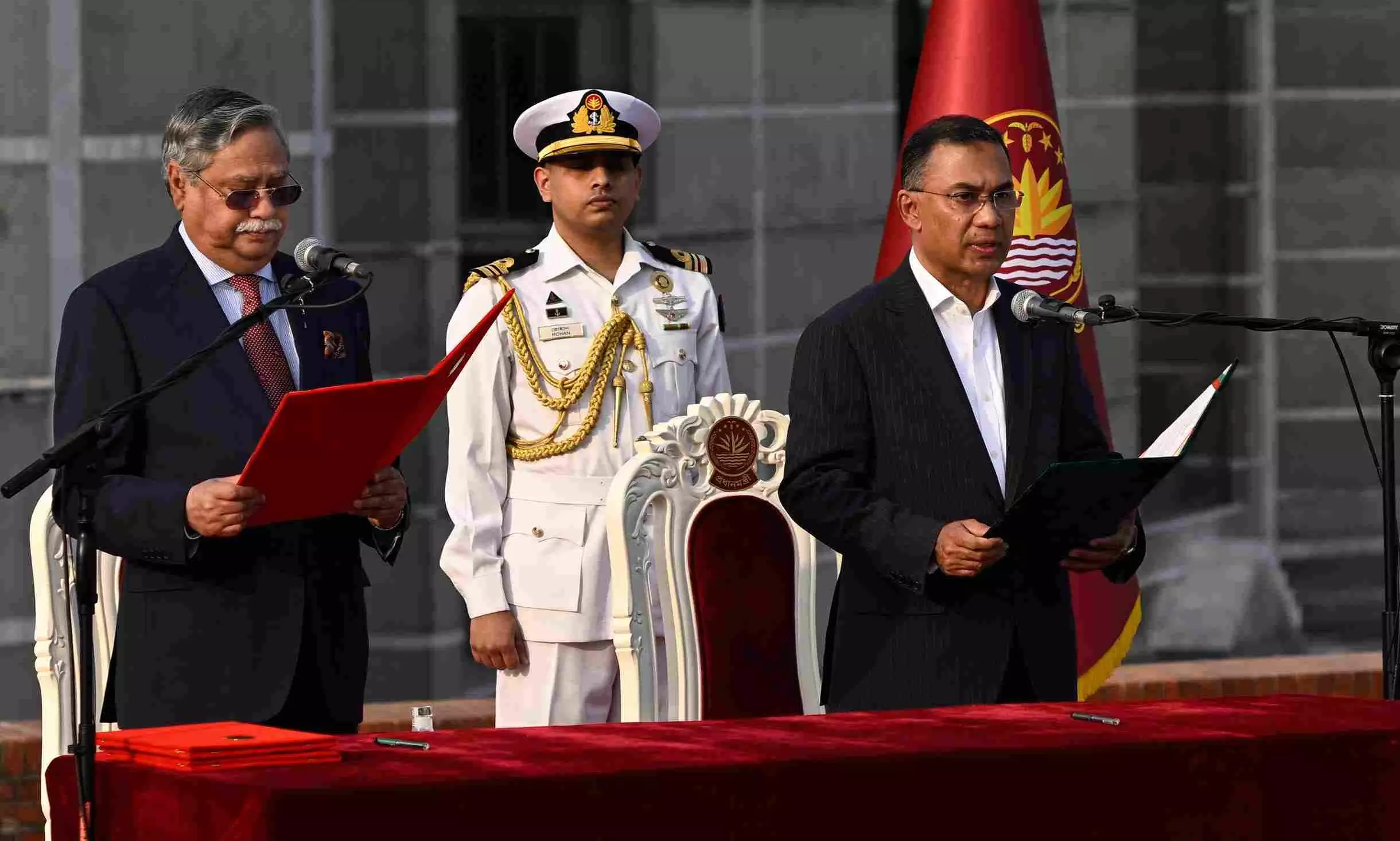
Tarique Rahman took oath as Bangladesh’s new Prime Minister on Tuesday (February 17) amid fierce political sabre-rattling over a controversial “second oath” imposed on new lawmakers by the nation's Election Commission.
Despite repeated promises to cooperate with the new BNP-led government and play the role of a responsible Opposition, the Jamaat-e-Islami and its allies now seem to be at loggerheads with Rahman’s government over the reforms agenda.
A crisis of sorts erupted on Tuesday when the BNP, which has secured a two-thirds majority, and the Jamaat-e-Islami, which has emerged as the principal Opposition, clashed over oath-taking on the controversial ‘referendum’.
Also read | Bangladesh election delivers a vote for 1971 values over Islamist agenda
The elected lawmakers of the BNP and its alliance partners opted out of the council pledge, saying they would only take the oath of office under the existing Bangladesh Constitution but not the second oath to join the Constitution Reforms Council.
The Jamaat-e-Islami and its ally, the NCP, were furious and initially indicated that they would refrain from taking any oath unless the BNP joined the reform council process. Then, realising that would cost them their seats, the Opposition lawmakers took both the oath of office and the pledge to join the Constitutional Reforms Council. But the BNP alliance MPs refused to take the second oath.
Why BNP opposed ‘second oath’?
Ahead of the ceremony, BNP Standing Committee member Salahuddin Ahmed publicly announced the party’s decision not to take the oath as members of the Constitutional Reform Council. Holding up the oath form, he said: “None of us has been elected as a member of the Constitutional Reform Council, nor has this been incorporated into the Constitution yet."
The divergence has ignited a fierce political and legal debate, with some arguing that inserting a second oath into the July Charter Implementation Order is “illegal”, while others described the BNP’s refusal to take the additional oath as an “unnecessary caution”.
The BNP's official line is that the party is committed to implementing the reforms under the July Charter after the referendum, held along with the parliamentary elections, returned a majority “Yes” vote.
But BNP's Election Committee chief Nazrul Islam Khan told this writer in a recent interview that his party had objected to many contents of the July Charter, though the Yunus government had not published them in the final document of the charter. "Those points on which we gave a note of dissent remain valid and we will oppose their inclusion in the reform package," Khan said.
Since the BNP is clearly unwilling to be rushed on the July Charter issue, it opposed the second oath as members of a “Constitutional Reform Council” for four reasons:
• Salahuddin argued that no such reform council has been formally incorporated into the Constitution yet, so making an oath for it is legally unauthorised.
• He argued that there is no constitutional, legally prescribed form for such an oath.
• He argued that the reforms should first be passed by Parliament after the referendum results, and the oath form should be included in the Third Schedule of the Constitution before lawmakers are asked to pledge to it.
• Salahuddin stated that the party is committed to taking the oath as members of parliament under the current constitutional procedure, but not a separate, extra-constitutional pledge.
Consequently, while the MPs of Jamaat-e-Islami and its partners eventually took both oaths, BNP MPs refused the second oath linked to the July Charter reform framework. Perhaps the BNP is understandably keen to avoid legal complications when on the verge of assuming power after a long two decades.
Writ petition challenges referendum
Even as the oath controversy was raging on Tuesday, a writ petition was filed with the High Court challenging the legality of the February 12 referendum and seeking annulment of its results.
On Tuesday, Supreme Court lawyer ABM Ataul Majid Touhid filed the writ in the public interest. The chief election commissioner, cabinet secretary, and law secretary have been named as respondents in the petition.
Touhid told mediapersons that the writ sought a rule asking why the referendum and the results announced on February 13 should not be declared unlawful.
Surprise inclusion in cabinet
While much of Tarique Rahman's cabinet was predictable, the inclusion of Khalilur Rahman was a clear surprise. Khalilur Rahman, a US citizen of Bangladesh origin, was the National Security Advisor in the outgoing interim government of Muhammad Yunus. Media reports suggest that he has been inducted as foreign minister.
Also read | Even in loss, why Jamaat-e-Islami is a key player in Bangladesh politics
His relations with army chief Gen Waker-u-Zaman were believed to be sour. Nor was he known to be close to Tarique Rahman or any of the BNP stalwarts. Some feel his inclusion was to please the US, the country widely believed to be responsible for the regime change operation that brought about Hasina's downfall in August 2024.
Like Yunus, Khalilur Rahman is believed to be close to bigwigs in Washington, and that may have influenced Tarique Rahman’s choice. Most were hoping Tarique would choose his trusted foreign affairs advisor Humayun Kabir for the job. But the USA’s recent warning, aimed at his government, to avoid closeness with China may have led to the inclusion of Khalilur, someone seen as “Washington’s man” in Dhaka.
India will be closely watching every move that Tarique Rahman makes, especially if he comes under much pressure from the Jamaat-e-Islami and its allies. But Rahman’s early signals appear to be positive.