Arc of India’s foreign policy reveals a loss of moral voice under Modi
India appears to be hedging its bets, rediscovering an old vocabulary of strategic autonomy, dressed up in the more contemporary language of multi-alignment

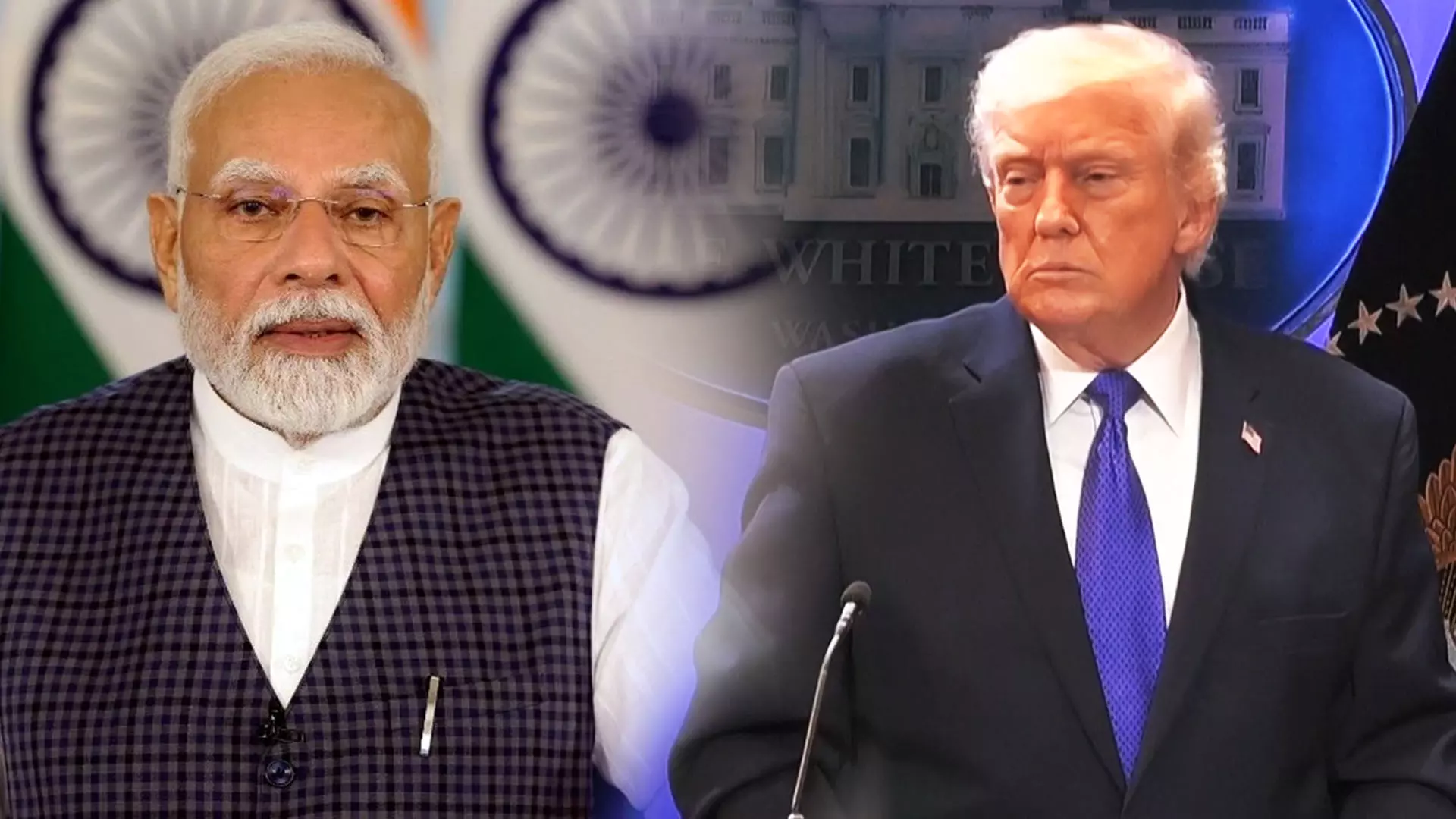
Is the Modi government’s love affair with America over? Many analysts say India is recalibrating its foreign policy and distancing itself from what they see as New Delhi’s pronounced tilt towards the US and its allies since Narendra Modi came to power in 2014.
Whether this is a tactical move to tide over the remaining years of Donald Trump’s presidency or a more permanent shield against Washington is uncertain. The picture remains fuzzy.
For now, however, India appears to be hedging its bets, rediscovering an old vocabulary of strategic autonomy, dressed up in the more contemporary language of multi-alignment and freedom of choice.
India-US relations at lowest point
The rethink comes after India-US relations hit their lowest point since Trump took office again. After a smooth ride during Trump’s first presidency, his second term sent shock waves through the government. The “Howdy Mody” and “Namaste Trump”, days were over, though the government was initially delighted that Trump was back.
Also read: Xi-Trump summit: Why thawing of US-China ties puts India on high alert
It began with 50 per cent tariffs on Indian imports (since reduced). The US President's claims about India-Pakistan mediation after Operation Sindoor, concerns over growing US relations with Pakistan, pressure on India over Russian oil, and the passage of the Lindsey Graham Act in the US Congress have created unease in New Delhi.
The question is whether Trump has merely exposed the limits of relying too heavily on Washington, or whether he has fundamentally altered India's assessment of the US.
Add to this the issue of H-1B visas and stricter immigration laws. The image of illegal migrants sent home on chains remains a stark reminder of how things could slide. Trump’s transactional approach to alliances and uncertainty over the durability of US commitments has rattled the Modi government. There is tremendous pressure on India to open up its agricultural sector as the India-US trade deal is being negotiated.
The question is whether Trump has merely exposed the limits of relying too heavily on Washington, or whether he has fundamentally altered India's assessment of the US.
All eggs in US basket
Several analysts, including former ambassadors like Talmiz Ahmad, believe that India has woken up to the folly of putting all its eggs in the US basket. They point to the Modi-Xi Jinping engagement and the thaw in India-China relations.
India’s close relationship with Russia despite intense US pressure. The rising importance of BRICS as India navigates a more fractured international system and India’s robust engagement with the SCO all point to a rejig.
“India’s ideal world order is a multipolar order including a closely aligned USA, a strong Russia and a weaker China. The dilemma facing the Indian state is that it faces a world with an unpredictable USA, a weaker Russia and a powerful China. India’s default strategy hence will be multi-alignment, multilateralism and strategic autonomy,” Aparna Pande of the Washington-based Hudson Institute, told The Federal.
Also read: Russian oil sanctions sword hangs over already-fraught India-US ties
“But India cannot turn its back on the US. The relationship with the US is too important, for economic, technological and strategic reasons. And in a world order where China is powerful and Russia is weaker, India needs to be close to the US,” she added.
The fact is, India is not abandoning the US, Quad, defence, co-operation in technology and critical minerals continue side by side.
“Generally speaking, India has fallen back on multilateralism (nonalignment 3.0 perhaps). But, bereft of clear ideals and grand strategy, India's approach appears incoherent and aimless,” Manu Bhagwan, New York-based historian and professor at Hunter College and Graduate Center of the City University, told The Federal.
“To take one example, rising far-right nationalism has relied on increasing xenophobia and jingoism, and this has now expanded to include migrant and migrated Indian/Indian-origin populations. Animosity towards PIOs, one would think, would raise alarm bells in Delhi. Has it? In what ways has India responded? Have they raised public and private concerns on the issue?” he asked.
Pragmatic voice
There is another dimension to this recalibration that goes beyond strategic moves. In the past, India’s voice counted in the world for reasons that went beyond its economic or military weight. Shaped by Gandhi’s philosophy of non-violence during the freedom struggle, Indian foreign policy carried a strong moral conviction that a newly independent nation had a responsibility to stand on the right side of history.
India spoke up for peoples still fighting colonialism and racial oppression in Africa, Asia and Latin America. It opposed apartheid, supported the Palestinian right to self-determination and backed struggles for freedom and independence.
India has fallen back on multilateralism — nonalignment 3.0 perhaps. But, bereft of clear ideals and grand strategy, India's approach appears incoherent and aimless: Manu Bhagwan
At home, this was a poor country, still scarred by Partition and struggling to find its feet. Yet it sought to keep its distance from the competing power blocs of the Cold War, insisting that its foreign policy would be guided by its own principles and interests rather than allegiance to a superpower.
Also read: Amid bonhomie with Xi, why Modi’s critical minerals caution is a reassurance to Trump
Strategic autonomy, in those days, was therefore about more than keeping one’s options open. It was also about having the freedom to speak in India's own voice.
That voice has steadily become more pragmatic as India's interests and ambitions have grown. For pragmatists, this is simply the natural evolution of foreign policy. Countries must make hard choices based on security and national interest, not moral postures. The shift became particularly visible after the 1991 economic reforms and, in India's neighbourhood, during the PV Narasimha Rao government.
India-Israel friendship
Realising that China was filling the vacuum left by India’s decision not to engage with Myanmar’s military junta, Rao reversed India’s earlier stand of not engaging with the anti-democratic forces. He reached out to the military rulers who refused to accept the results of the elections and arrested Aung San Suu Kyi, the daughter of the Burmese freedom fighter and leader of the democratic party.
Suu Kyi’s father Aung San was a close friend of Jawaharlal Nehru. She had spent her teenage years in Delhi and went to college here. When she visited India after she was freed, she publicly rebuked India, the world’s most populous democracy, for abandoning its principles.
She made these remarks while receiving the Rajiv Gandhi Foundation award, with Sonia Gandhi and senior Congress government ministers sitting in the front row. India continues its policy of engagement with the military government.
While Rao’s argument of national security has some basis, India’s dilution of support, some would say abandonment of the Palestinian cause, by the current government had nothing to do with security considerations. By 2014, Palestine had lost much of its resonance in India, as in the rest of the world, till Hamas brought it back to the centre.
India will wait out the second Trump presidential administration with the hope that the next President will be one who understands the importance of the India partnership: Aparna Pande
Since Rao upgraded diplomatic ties with Israel in 1992, relations were on the upswing. But under Prime Minister Narendra Modi, the friendship thrived. The personal equation between Modi and Israel’s Prime Minister Benjamin Netanyahu, as well as the larger Hindutva ecosystem's admiration for Israel's militarist, tough-nation approach in the region, led to a natural affinity between the two countries. Ties flourished as never before.
Like most Western governments, India too failed to condemn the genocide in Gaza. While Modi rightfully condemned the Hamas attack of October 7, 2023, within hours, India has, to date, not publicly spoken out against Israeli atrocities in Gaza. In this, India broke ranks with the Global South, where the majority backed Palestine. Modi’s India looked to be in lockstep with Israel and the US.
Omissions aplenty
This was evident even during the US-Israel attack on Iran. India did not bother to send a condolence message after the death of the Supreme Leader, Ayatollah Ali Khamenei. Nor did it condemn the attack on a school that killed over 200 children and staffers. The omissions were many. However, India’s strategic considerations, the need to get Indian tankers through the Strait of Hormuz, forced New Delhi to engage with the Iranian leadership.
An India that had refused to condemn Israel and America gradually changed its stance. At the SCO meeting this year at Bishkek, Kyrgyzstan, Israel-US action on Iran was roundly condemned as going against international law and the UN Charter.
The declaration also mentions that Israel’s attacks on Palestine have destabilised West Asia and calls for a two-state solution as the only viable solution. While much of this was also echoed in the BRICS Declaration, no country was named. It is these indicators that have led analysts to talk of a shift in India’s foreign policy. The real test of this recalibration will come after Trump.
“India will wait out the second Trump presidential administration with the hope that the next President will be one who understands the importance of the India partnership,” says Pande.
Indian elite wants better ties with US
The truth is that the Indian elite, including top officials and business leaders, want better ties with America, irrespective of whichever government is in power. The people-to-people links are strong, unlike with Russia or China.
If India continues deepening its relationship with China, Russia, BRICS, SCO and insists on greater room for manoeuvre even under a different US administration, that suggests structural change.
If the relationship with Washington rapidly returns to centre stage after Trump, the current recalibration may prove to have been largely tactical.