Why Supreme court refused to send Pawan Khera to custody
The top court corrected the Gauhati High Court’s errors and signalled that political vendettas cannot justify pre-trial detention

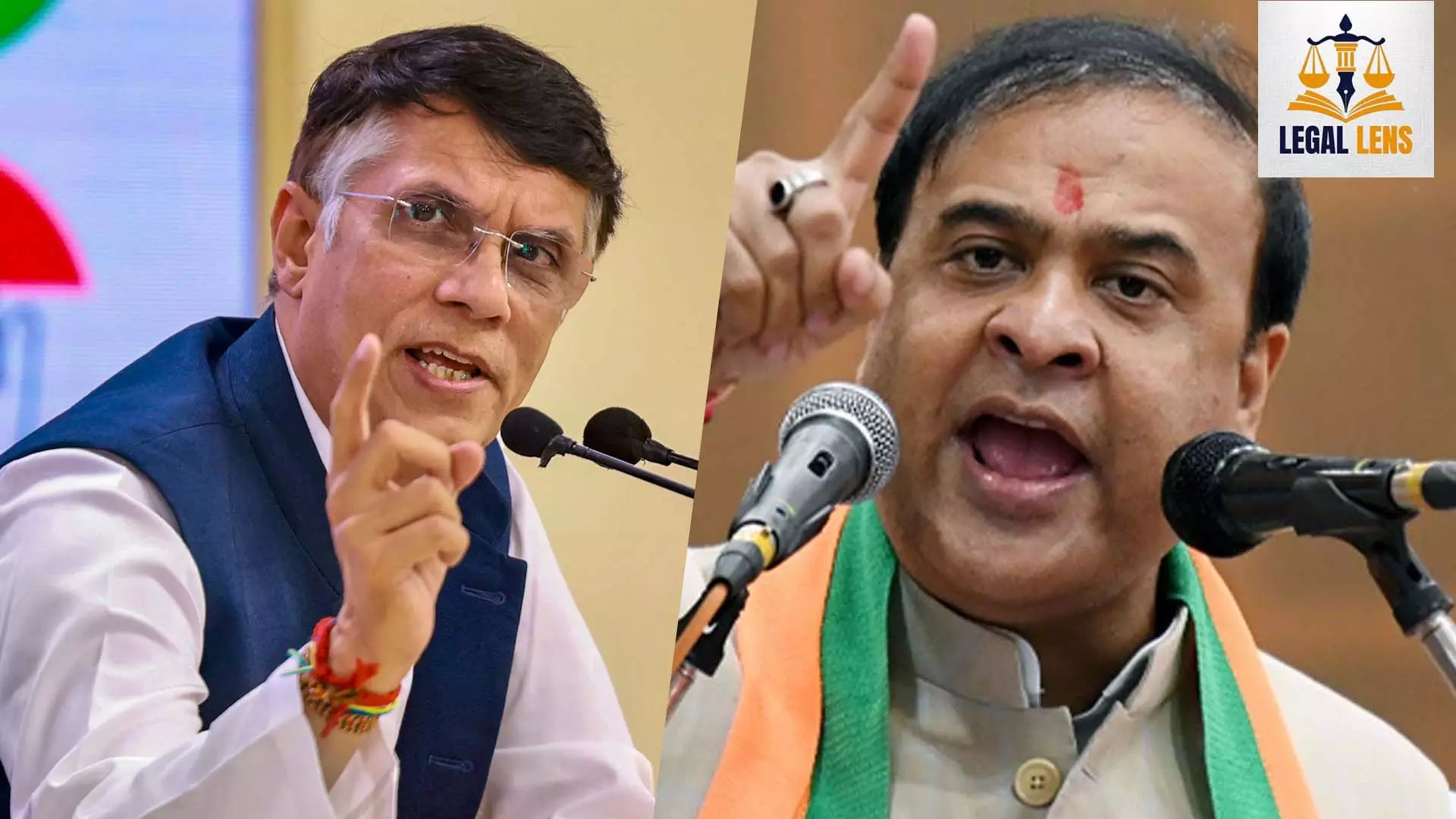
The controversy issue involving Congress leader Pawan Khera after his claims against Assam CM Himanta Biswa Sarma's wife has seen larger legal ramifications.
The Supreme Court did something unusual on April 30 when it allowed Congress leader Pawan Khera to walk free of the threat of arrest. It reproduced a string of press statements by Assam Chief Minister Himanta Biswa Sarma, made over nine days.
The bench then held that the prosecution carried political overtones and did not justify sending a person into a police lock-up.
Also read: How a 15-year-old's case has redrawn India’s late-term abortion doctrine
A bench of Justices J K Maheshwari and Atul S Chandurkar set aside the Gauhati High Court's refusal of pre-arrest protection. The top court granted Khera anticipatory bail, the protection a court gives in advance of arrest.
The order is short. Its reasoning is tightly knit and politically alive. At its centre is a 1980 Constitution Bench ruling, Gurbaksh Singh Sibbia v. State of Punjab, that continues to set the test for when a court grants such protection.
What was said, and what followed
On April 5, Khera held two press conferences, one each in Delhi and Guwahati. He displayed documents which, he said, showed Riniki Bhuyan Sarma, the chief minister's wife, holding passports of three countries, namely, Egypt, the United Arab Emirates and Antigua and Barbuda.
The same documents, he claimed, showed her owning a company registered in Wyoming, the USA. The Crime Branch in Guwahati registered a first-information report (FIR) within hours. The case was filed in the early morning of April 6 under 14 sections of the Bharatiya Nyaya Sanhita (BNS).
A critic will say Khera made unverified claims about a private citizen and must face the criminal process. The court did not pronounce on the merits. It said only that the threshold for taking a person into custody before trial was not crossed in this case.
The provisions invoked ran from forgery to public mischief to defamation. The Assam Police searched Khera's Delhi home the next day. They asked the chief judicial magistrate, Kamrup (Metro), for a non-bailable warrant. The magistrate refused.
Khera moved the Telangana High Court for what is called transit anticipatory bail and got it on April 10. The State of Assam took that order to the Supreme Court, which stayed it, and then asked Khera to approach the Gauhati High Court. The Gauhati High Court rejected his plea on April 24. He returned to the Supreme Court.
Explaining where the HC went wrong
The Supreme Court named two errors in the high court's reasoning, and a third follows from the framework laid down in its 1980 judgment in Gurbaksh Singh Sibbia.
First, the high court built much of its conclusion on a section of the BNS that the FIR did not invoke.
The advocate general had submitted in oral argument that the case fell within Section 339; the high court accepted that and reasoned from there. The Supreme Court called that step erroneous.
Second, the high court asked Khera to prove beyond doubt that the documents he had displayed were genuine. That is a trial standard.
Also read: Pawan Khera row: 'Assam Police search is fraud being played on public' | Capital Beat
At the bail stage, the accused is not called upon to disprove the prosecution's case. The Supreme Court called this burden shift erroneous as well. The third problem is implicit. The high court held that the prosecution's accusations stemmed from a motive of furthering the ends of justice. That conclusion is the precise opposite of what Gurbaksh Singh Sibbia asks the court to weigh.
Why Sibbia case mattered
The judgment in Gurbaksh Singh Sibbia is the load-bearing pillar of the law of anticipatory bail. The five-judge bench, sitting under then Chief Justice Y V Chandrachud, held that the relief was an instrument of personal liberty under Article 21 of the Constitution.
The Constitution Bench refused to allow the protection to be confined by judge-made limits absent from the statute. It laid down a list of factors. They include the seriousness of the charges, the context in which they arise, the apprehension of witness tampering, and the larger public interest.
But the bench also said something else. Where the prosecution appears driven by a desire to humiliate the accused through arrest, rather than to do justice, the protection should ordinarily issue.
The Maheshwari-Chandurkar Bench applied that framework with care. Article 21 sets a high threshold for taking liberty away. That threshold rises further where political rivalry is visible on the surface of the case.
CM Sarma's own words
This is where the order takes its most distinctive turn. The bench reproduced several statements that CM Sarma made between April 7 and April 15. They include the now-circulated taunt about turning “Pawan Khera into Pawan Peda” ("will show Khera his worth"). Sarma was also recorded promising that, if the BJP formed the next government, Khera would spend his last days in an Assam jail.
He further boasted that he would have had Khera deplaned mid-flight, had the election model code not tied his hands. The solicitor general, the order records, did not defend any of these statements, nor did he challenge their authenticity. The bench treated them as the public record they had become and called them unparliamentary.
Also read: Kharge, Himanta clash over corruption allegations amid Khera probe row
A bail court is not a court of public opinion. But on the precise question that mattered, that is, whether arrest would be used to humiliate, those statements were directly relevant. They came from the head of the very government whose police force would conduct any custodial questioning.
Two precedents, pulled in opposite directions
The State of Assam pressed Maruti Nivrutti Navale v. State of Maharashtra, a 2012 ruling. There, the Supreme Court refused anticipatory bail in a forgery case where the accused was alleged to have fabricated a long-lease deed. He had also been alleged to have used false papers to obtain official permission.
The Maheshwari-Chandurkar Bench distinguished that ruling. The documents in Navale had to be recovered from the accused. Here, the disputed documents were already with the prosecution. There was little for custodial questioning to add.
The bench leaned instead on Pradip N. Sharma v. State of Gujarat, a 2025 ruling. That case held that custodial questioning was not essential where the prosecution rested on documentary evidence. The accused there had also shown willingness to cooperate, which carried weight in the bail balance.
Also read: 8,630 complaints against Indian judges in 10 years, outcomes undisclosed
The thread between the two rulings is thin but real. Where physical recovery of the suspect is the object, custody helps. Where the documents are already in the police's hands, it does not.
A devil's advocate, briefly
A critic will say Khera made unverified claims about a private citizen and must face the criminal process. The objection misses the level at which the bench was operating. The court did not pronounce on the merits. It said only that the threshold for taking a person into custody before trial was not crossed in this case. The trial, when it comes, will weigh the documents on its own.
The order, properly read, does not weaken the criminal process. It restores it to its place.