TMC split and fight for symbol: Who gets the twin flowers?
Legal Lens | A party symbol is decided in the organisation, not the chamber. The Trinamool Congress split could put that principle to the test

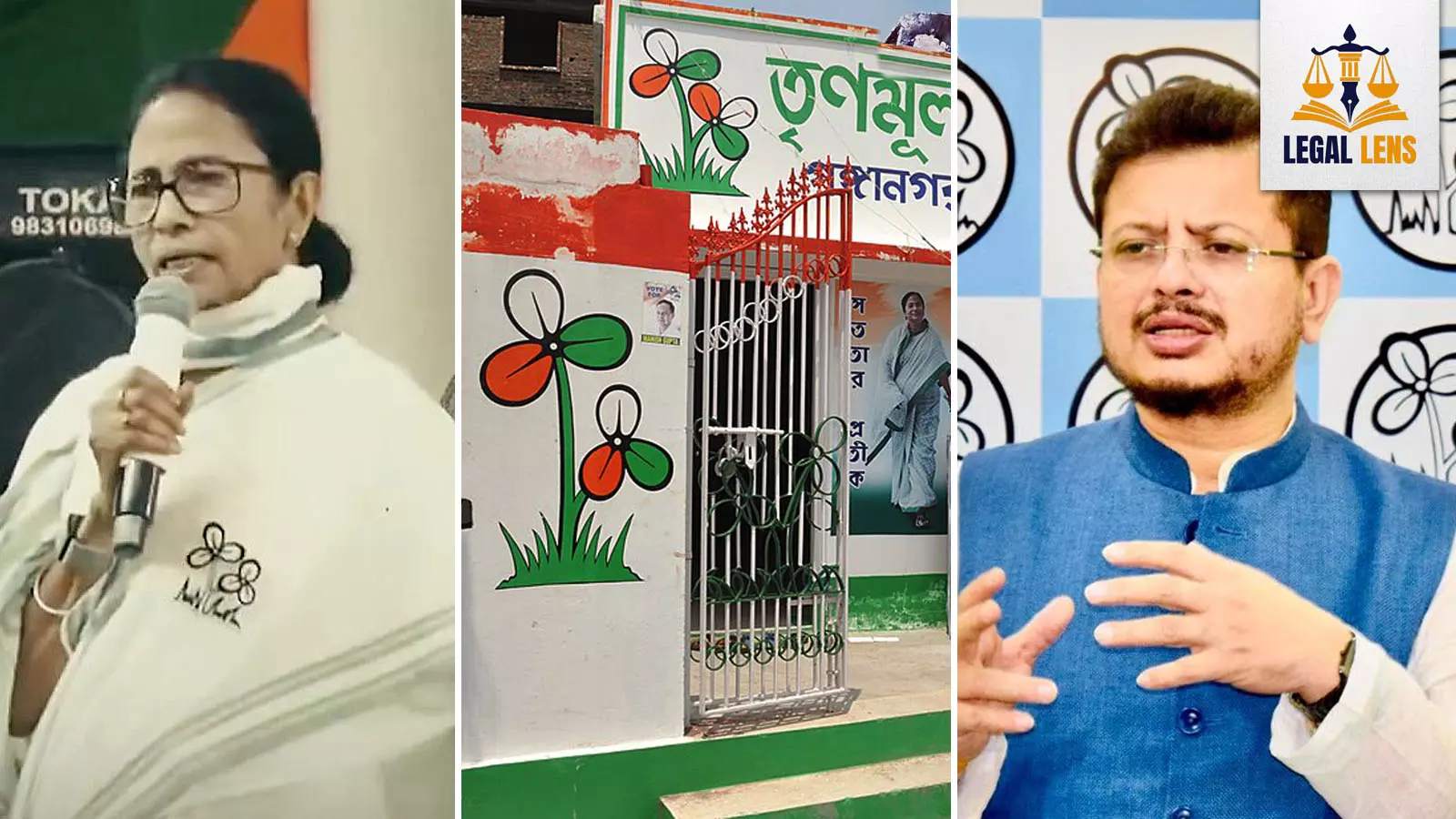
The fate of the Jora Ghas Phul (twin flowers with grass) will turn less on rival press conferences than on paperwork.
More than half a century ago, the Supreme Court held that a party symbol is not property to be shared out among rival claimants. The Trinamool Congress (TMC) is now splitting, and that ruling will decide where its symbol goes.
On June 22, the rebel Trinamool Congress faction led by Ritabrata Banerjee moved past its quarrel in the Assembly. At a meeting in Kolkata, it purported to remove Mamata Banerjee as chairperson. It constituted a new National Working Committee and named the former minister Arup Roy as chairperson. It also suspended Abhishek Banerjee. The rebels claimed about 60 MLAs and at least 70 Kolkata councillors attended the meeting. They displayed the party’s ‘Jora Ghas Phul’ (twin flowers with grass) symbol, shorn of Mamata’s photograph.
Also read: TMC collapse: Has BJP solved one problem and created two new ones?
The exercise is meant to turn a revolt by legislators into a claim over the party itself. Ritabrata says the faction will approach the Election Commission. No formal proceeding over the name and symbol is yet on record. One now looks likely.
When it comes, the question will not be who founded the Trinamool or who its best-known face is. It will be narrower. Which faction can prove, through constitutions, registers, minutes, affidavits and elected members, that it is the recognised party called the All India Trinamool Congress?
The Commission’s power
A party symbol is won in the party office, not on the floor of a House. The law divides the work. The Speaker decides whether defecting legislators keep their seats. The Election Commission decides the larger question. Under Paragraph 15 of the Symbols Order of 1968, it rules on which rival group is the party itself. After hearing the factions, it may recognise one group, or neither. Its decision carries the name and the reserved symbol, and binds all sides.
The decision settles the symbol alone. It does not, by itself, hand over party offices, bank accounts or other assets. Nor does it decide whether rebel legislators face disqualification. Those questions belong to the civil courts and to the Speaker.
The Commission weighs three broad indicators. They are adherence to the party constitution, support in the organisational bodies, and strength among MPs and MLAs. No formula fixes their weight. The Supreme Court has said the Election Commission may pick the test that fits the dispute. In practice, numbers have often prevailed, especially when membership claims cannot be verified.
The Congress split set the template
The founding case came from the 1969 Congress split after the presidential election. One faction, aligned with Indira Gandhi, was organisationally led by Jagjivan Ram. The rival camp followed S Nijalingappa. Both claimed the Congress and its “two bullocks with yoke” symbol.
The Commission first asked whether either side had abandoned the party’s aims. Both professed the same principles, so the test gave no answer. The Constitution proved little better, since each faction had expelled the other’s men. The Commission turned to numbers. The Jagjivan Ram camp held a clear majority of MPs, legislators and All India Congress Committee members. It was recognised as the Congress and given the symbol.
In the Sadiq Ali case, decided on November 11, 1971, the Supreme Court upheld the call. Justice HR Khanna held that majority and numerical strength were valuable tests in a democratic body. The court accepted that an election authority cannot poll millions of primary members in the time an election allows. It also held that a symbol is no leader’s personal property.
A founder can lose: The Samajwadi case
The 2017 Samajwadi Party dispute is the sharpest warning against leaning on founder status alone. Mulayam Singh Yadav and his son Akhilesh Yadav both claimed the party and its “bicycle.” Mulayam argued that he remained the elected national president.
Akhilesh answered with paper. His group filed affidavits from 205 of 228 MLAs, 28 of 46 National Executive members and 4,400 of 5,731 national delegates. Mulayam filed none but his own. The Commission found Akhilesh held an overwhelming majority across both wings. It gave him the party and the cycle. The founder’s title could not survive a proven majority through the party’s structure.
Also read: Mamata counters rebels with revised TMC committee list to EC
For the Trinamool, the lesson cuts two ways. It weakens any claim that the symbol must stay with Mamata because the party is inseparable from her. But Akhilesh did more than gather legislators. He produced support from nearly every formal layer of the organisation. The rebels must replicate that second half.
AIADMK: Both wings, and the freeze
The contest over the AIADMK’s “two leaves” after Jayalalithaa’s death adds two lessons. Facing a bye-election, the Commission first froze the symbol and gave the factions temporary names. A freeze stops either side from using the established mark while the dispute runs.
After the camps of O Panneerselvam and Edappadi Palaniswami united, they claimed the party against the Sasikala group. To read organisational support, the Commission counted affidavits from the General Council, the party’s highest body. It treated that council as a fair proxy for the rank and file, as the Sadiq Ali case allowed. The ruling group filed 1,741 affidavits against 145. With a matching majority among legislators, it took the symbol in November 2017. That is the strongest form of a Paragraph 15 claim: command of both wings.
Shiv Sena and NCP: The legislative shortcut
Maharashtra shows what happens when the organisation cannot be read. In the Shiv Sena dispute, the Commission found the 2018 constitution undemocratic and the rival office-bearer lists unverifiable. It set the organisation aside. It relied on the legislators, where Eknath Shinde held 40 of 55 MLAs and 13 of 18 MPs. It also counted the votes those members had won, finding them a large majority of the Shiv Sena’s poll. Shinde took the name and the “bow and arrow” in February 2023. Uddhav Thackeray’s camp kept an interim name and the “flaming torch.”
Also read: As TMC crumbles, what's next for Mamata and the state forces she fought over the years?
The Commission took the same path with the Nationalist Congress Party (NCP) in February 2024. The organisational claims could not be verified, so it counted lawmakers and gave Ajit Pawar the “clock.” Sharad Pawar’s group later received a new name. Together these orders suggest a recent habit. When the organisational record is opaque, the Commission counts legislators. But this is a practice, not a rule.
The Court’s caution against counting MLAs
In the Subhash Desai case, decided in May 2023, a five-judge bench warned against that habit. Chief Justice DY Chandrachud wrote that legislative majority is neither the sole nor the primary test. The Commission must choose the test that fits. Where legislators face disqualification, counting them can yield an odd result. A faction might win the symbol on the strength of members later disqualified.
The Court also kept the two forums apart. The Commission decides, looking forward, which faction is the party. The Speaker decides whether legislators defected at an earlier point. So the Bengal Speaker’s recognition of Ritabrata Banerjee as Leader of the Opposition does not bind the Commission. A later win for the rebels would not erase a defection already committed. The “split” defence vanished from the anti-defection law in 2003. Rebels cannot escape disqualification merely by declaring themselves the real party.
The rebels' numerical edge
The rebels’ strongest card is their support among MLAs. The Speaker recognised their leadership after they demonstrated the support of 58 of the party’s 80 legislators. The June 22 meeting claimed about 60. If those figures hold, the rebels have the kind of legislative majority that decided the Shiv Sena and NCP cases. They can also argue that legislators carry the most recent verdict of Trinamool voters. On legislative arithmetic, Mamata’s faction trails.
The hurried takeover
Their harder task is to show that the June 22 convention lawfully captured the organisation. The Constitution on the Commission’s record builds an electoral college from the party’s formal bodies. That college, not a gathering of willing legislators, elects the chairperson. The chairperson, in turn, holds wide control over internal elections.
Also read: Six Shiv Sena (UBT) MPs join Eknath Shinde camp in major blow to Uddhav Thackeray
So the rebels will have to answer hard questions. Who convened the meeting? Which body authorised it? How was notice given? Who was entitled to vote, and were they valid members of the relevant bodies? They rest their case on the lapse of the previous committee’s term under a three-year rule. But the expiry of a committee’s term does not, by itself, let any group of legislators raise a replacement. The claim of 70 councillors carries political weight. Its legal weight depends on whether those councillors belonged to the authorised electoral college.
Why expulsion and founder status may not suffice
Mamata’s camp, in turn, cannot close the matter by expelling rebels or dissolving committees after the revolt. The Commission has treated tit-for-tat expulsions with caution. Otherwise the faction that first seized the office and issued expulsion letters could manufacture a majority. The Commission is likely to examine the party as it stood before the split. Removals and hurried appointments by either side will be tested against that earlier record.
Also read: How a 20-year-old case’s verdict could upset Shiv Sena (UBT) MPs’ defection arithmetic
This makes Mamata’s recent dissolution of committees double-edged. It blocks rival footholds. Yet it unsettles the very structure she must later cite as proof of control. Her founder’s claim is politically formidable but legally incomplete. Mulayam founded the Samajwadi Party and still lost it. Mamata’s stronger case is documentary. She must show that the recognised bodies, valid delegates, registers and authorised office-bearers stayed with her. She must show the rebel convention had no constitutional base.
The NCPI merger complicates the rebels' case
The rebel MPs add a contradiction. Twenty Lok Sabha members have announced a merger with the Nationalist Citizens Party of India (NCPI), seeking the two-thirds protection of the anti-defection law. That stance is hard to square with a claim to be the real Trinamool. A group cannot say at once that it has left for another party and that it remains the party. The Assembly rebels have announced no such merger and may press the symbol claim alone. Even so, the Commission usually weighs legislative support across Parliament and the states. The rebels will need one coherent position.
An advantage, not yet a victory
The precedents hand the rebel faction an early lead, because its Assembly majority looks real. If it can add authenticated support from the Trinamool’s electoral college, state and district bodies, Mamata could face Mulayam’s fate. But a legislative majority need not be decisive. The Court has warned against treating it as the only test. The swiftly built committee will count only if lawful hands constituted it.
If neither side can show a reliable organisational record, the Commission’s recent practice may favour the rebels. If Mamata proves the recognised organisation stayed with her, and that the convention bypassed the authorised machinery, the Commission has reason to resist a bare headcount. A third path remains. If an election nears before the dispute is settled, the twin flowers could be frozen. The fate of the Jora Ghas Phul will turn less on rival press conferences than on paperwork. It rests on the records of a party that, for nearly three decades, seemed indistinguishable from its founder.