Surendra Koli: Freed from the gallows, failed by the State
Surendra Koli's case took the Supreme Court 14 years to admit its own conviction was wrong.

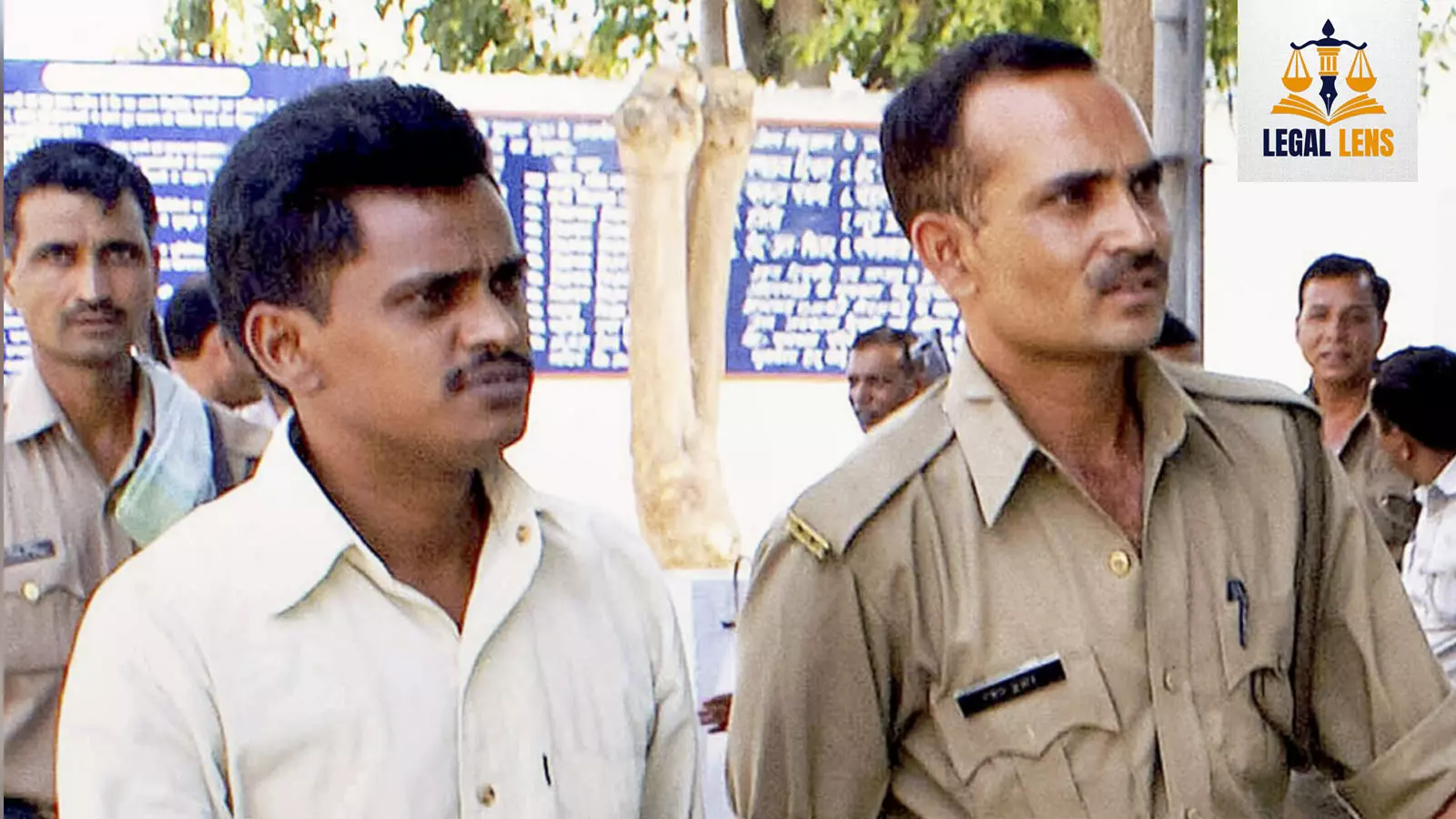
Nithari case accused Surendra Koli was found dead in his tea shop in Haridwar. Koli is seen being taken to a CBI court from Dasna Jail in Ghaziabad in this file image dated 12 May, 2010. PTI
Surendra Koli, the man once condemned to die for the Nithari killings, was found hanging at a tea stall in Haridwar on September 18. Police recovered no note. His death came 10 months after the Supreme Court cleared him of the last charge that had kept him in prison for 19 years.
The case began in December 2006, when police found the skeletal remains of children in a drain behind a Noida house. The house belonged to businessman Moninder Singh Pandher, and Koli worked there as domestic help. Investigators filed 13 prosecutions against him, and trial courts convicted him and sentenced him to death in several.
The Supreme Court upheld one of those convictions, for the rape and murder of 15-year-old Rimpa Halder, in February 2011. His review petition failed in 2014. By the ordinary course of criminal procedure, his execution should have followed within weeks.
Also read: ‘He was about to reveal information’: Nithari victim’s father alleges Koli was murdered
It did not, because of an intervention that has entered Supreme Court folklore. On September 8, 2014, senior advocate Indira Jaising learned that Meerut jail was preparing to hang Koli the next morning. She confirmed the report with jail officials, then rushed to the residence of Justice H.L. Dattu, then Chief Justice-designate. A special late-night hearing followed. The Court stayed the execution hours before it was due, so Koli's lawyers could argue a review petition in open court.
HC acquitted Koli in all 12 cases
The stay bought Koli 11 more years, though not through that route alone. In January 2015, the Allahabad High Court commuted his sentence in the Halder case to life imprisonment, citing delay in deciding his mercy petition. The remaining 12 Nithari cases unravelled more slowly, through ordinary appeal rather than any emergency hearing.
In October 2023, the Allahabad High Court acquitted Koli in all 12 cases. Justices Syed Aftab Husain Rizvi and Ashwani Kumar Mishra held his confession under Section 164 of the Criminal Procedure Code (CrPC) involuntary. He had spent about 60 days in uninterrupted police custody before making the statement, without meaningful access to legal aid. The investigating officer stayed within reach of the magistrate's room throughout, and the confession itself referred repeatedly to tutoring and coercion.
Koli's death completes a story that says more about the Supreme Court than about him. The Court that freed him in November 2025 was, in law, the same Court that affirmed his death sentence in 2011.
The state challenged the acquittal. The Supreme Court dismissed 14 such appeals on July 30, 2025, finding no perversity in the High Court's reasoning. That left only the Halder case, the sole conviction the Court itself had upheld in 2011, standing on evidence discredited everywhere else.
Koli asked the Court to resolve that contradiction through a curative petition, the rarest form of relief in Indian law. Courts reserve it for errors that survive even a review. A Bench led by Chief Justice B.R. Gavai, with Justices Surya Kant and Vikram Nath, heard him in open court. On November 11, 2025, it agreed. Two verdicts could not stand on one evidentiary foundation without producing an unjust result, the Court said. It recalled its 2011 judgment and the 2014 dismissal of his review petition, then ordered Koli's immediate release. Letting a conviction stand on evidence already rejected elsewhere, it held, would infringe Articles 14 and 21.
This left Koli's innocence undecided; the Court required only that the prosecution prove its case beyond reasonable doubt. The Nithari killings remain among the most horrifying in Indian criminal history, and the victims' families have never seen a conviction survive scrutiny. The Court conceded this openly. It called the offences heinous and the families' suffering immeasurable, yet insisted that suspicion, however grave, cannot substitute for proof. That remains the ordinary standard of criminal law, applied here to extraordinary facts.
Also read: Tata Sons at a crossroads: RBI listing, Chandrasekaran’s term
What the acquittal did not deliver was compensation. India has no statute entitling a wrongly convicted person to it as of right. The Law Commission proposed one in its 277th report of 2018, weighing incarceration, psychological toll, lost income and stigma. Parliament has not acted on it. The only recourse for someone in Koli's position is a writ petition invoking Article 21. Even that depends on judicial discretion and the petitioner's resources.
Koli appears to have pursued neither. After his release, he lived apart from his family. Some months before his death he moved to Haridwar's Bhupatwala area and worked at a tea stall owned by someone else. On September 17, he telephoned Narayan Singh Rawat, a district panchayat member and family friend who had long supported him. He alleged the stall's owner was harassing him over money. He was found dead the next day. Police have opened an inquiry and await a post-mortem report.
What this says about the Supreme Court
Koli's death completes a story that says more about the Supreme Court than about him.
The Court that freed him in November 2025 was, in law, the same Court that affirmed his death sentence in 2011. It took 14 years, a review, two rounds of appeal, and finally a curative petition, the narrowest door Indian law allows. Only then did the institution admit its earlier finding rested on evidence it would no longer credit. That amounts to a rare admission. A body with the final word on who lives and who hangs got that word wrong, and took 19 years to say so aloud.
The confession that unravelled was never unique to Koli. Interrogation-room confessions, recorded after prolonged and often unsupervised custody, have convicted thousands of undertrials with far less scrutiny than this case eventually received. Project 39A at the National Law University, Delhi, has tracked the toll. It has helped secure 22 acquittals and 44 commutations in death penalty cases since 2014 alone. That research team has since relocated to NALSAR University of Law, Hyderabad, and now operates as The Square Circle Clinic. The Supreme Court confirmed no death sentence at all in 2021 or 2023, the only two years since 2000 it failed to confirm one. Koli's case fits that record precisely. It is a data point that arrived, unusually, wearing a name and a face.
Curative jurisdiction exists precisely to correct such errors, but its rarity is the point. The Court reaches for it only when finality itself becomes untenable. By then, the person it was meant to protect has often spent a working lifetime behind bars. Correction, when it finally comes, restores liberty alone. The years, the reputation and the means to live stay lost. Koli walked out of Luksar jail in November 2025 with no job, no settled home, and no statutory claim on the state. That state had held him under sentence of death for a crime it could no longer prove he committed.
That gap, between judicial correction and any duty to make a wronged man whole, is what forces Koli's death back into view. The Court can recall a judgment. Recalling the years a wrongful conviction costs, or answering for them, remains beyond its reach and outside the state's practice.
The midnight hearing of September 2014 is remembered as a triumph of due process over an execution already in motion. The tea stall in Haridwar is a reminder that due process, once it concludes, offers no further guarantee at all.