SC’s conundrum: How to end cases protesting students faced
The Supreme Court's decision to permit the lawful ‘closure/withdrawal’ of cases against student protesters, without itself quashing the FIRs, exposes three very different ways in which a criminal case may end

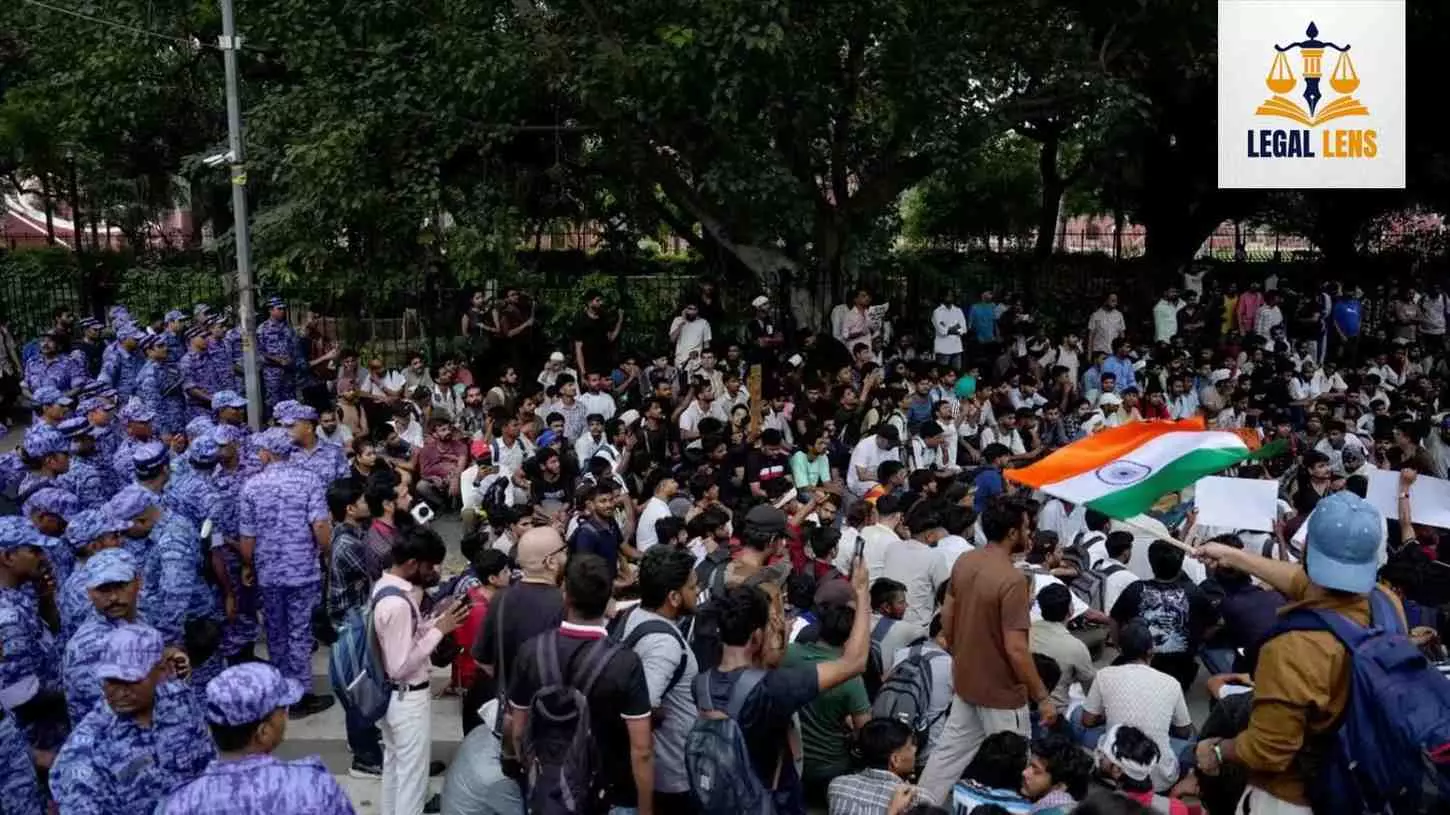
The govt's commitment will be measured by whether every FIR receives a legal endpoint, omnibus references to unknown persons are extinguished, students are informed, and facial or other digital data is not retained without lawful justification. File photo of CJP protest: PTI
A First Information Report (FIR) can be promised away in a political settlement much more easily than it can be made to disappear in law.
That difficulty surfaced before the Supreme Court on August 3, when the Union government said it remained committed to ending cases against protesting students, but faced a problem of legal “semantics”. Criminal procedure contains no button marked “withdraw FIR”. Police may submit a closure report, a prosecutor may seek withdrawal, and a constitutional court may quash the FIR. Each route has a different controller.
Also read: Fast-track courts without capacity, budget will only be fast on paper
Counsel urged the Court to consider quashing. Senior Advocate Vrinda Grover said closure and withdrawal would require proceedings across five States, exposing students to objections before different courts. A Bihar FIR, according to reports, charged 144 named protesters and about 5,000 unidentified persons, including at least 50 minors, with attempt to murder. Justice Joymalya Bagchi observed that the Court could “engineer” a quashing process. The final order instead allowed the States to “close/withdraw” FIRs in accordance with law, without deciding quashing.
That omission matters. “Closure”, “withdrawal”, and “quashing” are often treated as interchangeable ways of dropping a case. They are not.
Starting point: FIR belongs to criminal process
An FIR records information relating to a cognisable offence and sets the investigative machinery in motion. It is not a private pleading that the informant, police, or government can simply retrieve from the file.
Even if the complainant no longer wishes to proceed, the alleged offence may remain an offence against the State. Conversely, an executive decision to abandon a prosecution may require scrutiny by a Magistrate or trial court.
Also Read: CJP seeks withdrawal of FIRs against protesters after SC's clarification
A 15-year-old Noida girl booked over abusive remarks against Prime Minister Narendra Modi illustrates the point. Although the complaint was withdrawn and Delhi Police said it would not pursue the case, the Zero FIR still needs formal closure. Similarly, the Court's July 28 order restrained coercive action but allowed investigations to continue.
Closure: Police say evidence does not justify prosecution
Section 193 of the Bharatiya Nagarik Suraksha Sanhita, 2023 (BNSS), broadly corresponding to Section 173 of the CrPC, requires the investigating officer to report to the Magistrate after investigation. The police may recommend prosecution or say that no offence occurred, the accused could not be identified, or the evidence is insufficient.
The Magistrate may accept the closure report, reject it and take cognisance, or require further investigation. Under Bhagwant Singh v Commissioner of Police (1985), the informant must ordinarily be notified and allowed to object before closure is accepted. The police therefore do not have the final word.
Closure suits cases where evidence discloses no offence. In an omnibus FIR, however, it may clear identified persons while leaving thousands of others under investigation. Unless the report and Magistrate's order dispose of the entire FIR, its “unknown persons” component may remain a reservoir for names. Closure also does not erase the FIR's existence.
Withdrawal: Prosecutor asks Court to discontinue acase
Section 360 of the BNSS, corresponding to Section 321 of the CrPC, permits the Public Prosecutor to seek the court's consent to withdraw a prosecution before judgment. Withdrawal before charges results in discharge; after charges, in acquittal. The BNSS also requires the victim to be heard.
Also Read: After Centre, CJP confronts BJP-ruled states, warns Bihar, Bengal over protesters' arrests
The government may initiate the proposal, but the prosecutor cannot act as its post office. The prosecutor must independently conclude that withdrawal advances public justice, and the court must test its good faith and reasons. State of Kerala v K Ajith (2021) reaffirmed these principles while refusing withdrawal in the Kerala Assembly damage case.
In a mass-protest situation, applications may be required before different courts and objected to by victims, police personnel, or private informants. Withdrawal ends a prosecution before a court; it does not administratively delete an FIR.
Quashing: Court extinguishes criminal proceeding
Quashing is a judicial act. Section 528 of the BNSS preserves the High Court's inherent power to prevent abuse of process or secure the ends of justice. High Courts may also act under Article 226, and the Supreme Court under Articles 32, 136, or 142.
Under State of Haryana v Bhajan Lal, an FIR may be quashed where its allegations disclose no offence, the proceeding is legally barred, the claims are inherently improbable, or the prosecution is manifestly malicious. The power remains exceptional; courts ordinarily avoid weighing disputed evidence during investigation.
An FIR is not invalid merely because some accused are unidentified. Its purpose is to begin an investigation, not provide an exhaustive charge-sheet.
Quashing offers a single, authoritative termination of the FIR and consequential proceedings. A coordinated order could spare students from awaiting closure reports or withdrawal applications before numerous courts.
Blanket quashing also raises difficulties. The Court lacked a complete chart of the FIRs, offences, or accused. Some may concern peaceful assembly; others may allege assault, arson, or property damage. A universal order could benefit persons facing credible allegations of violence.
This may explain the Court's caution, although its order does not say so. It preserved the legal exit routes, but chose no universal one.
Can an FIR accuse 5,000 unknown people?
An FIR is not invalid merely because some accused are unidentified. Its purpose is to begin an investigation, not provide an exhaustive charge-sheet. The danger arises when “5,000 unknown persons” becomes a standing licence to add anyone who attended the protest.
Criminal liability must remain individualised. Mere presence does not prove membership of an unlawful assembly or participation in violence. Although a separate overt act need not always be proved, the prosecution must establish membership of the assembly and knowledge or sharing of its unlawful common object. Physical proximity is insufficient.
Also Read: Delhi Police drop FIR against teen who abused PM Modi in viral video
A catch-all FIR reverses that logic if police first treat a crowd as accused and then search for names to populate it. The question should be whether evidence connects a person to an offence, not merely whether technology places that person at the protest.
Facial recognition identifies a face, not an offence
Senior Advocate N Hariharan questioned how authorities had identified thousands of people said to have criminal antecedents. He alleged that facial recognition technology (FRT) was used to profile protesters. The Court did not decide whether FRT was used or lawful.
Administrative deployment does not settle the constitutional questions. Under KS Puttaswamy, an intrusion requires legal authority, a legitimate objective, necessity, and proportionality. Safeguards include accuracy, human verification, data retention, and protection against misuse.
Also Read: Law enforcement agencies must exercise restraint during protests: SC
Consent is not the sole test because police routinely collect evidence without it. Legal authority and safeguards are central. Most importantly, an FRT match may suggest identity; it cannot prove that a person committed violence or shared an unlawful common object. Identification and culpability remain separate.
Unfinished question of ‘criminal antecedents’
The July 28 order withheld protection from persons with “criminal antecedents”. On August 3, after Senior Advocate Dr Abhishek Manu Singhvi raised petty cases, the Bench clarified that it meant grave or heinous offences. Solicitor General Tushar Mehta said 2,700 FIRs involving such accused would not be withdrawn.
The government's commitment will be measured by whether every FIR receives a legal endpoint.
Does an antecedent mean an FIR, charge-sheet, pending trial, or conviction? Is an unproved allegation of a grave offence sufficient? An FIR is an accusation, not a finding of guilt, and each prosecution must stand on its facts.
Restraint today, guidelines tomorrow
On August 5, the Court heard a plea seeking action against protest organisers for provocative statements. It tagged the matter with the main case. Chief Justice Surya Kant observed that listening to young protesters, rather than confrontation, was the more effective response, even where some indulged in stone-pelting.
The Court seeks an account of why pellet guns and metal-fitted lathis were used, while proposing future guidelines. Guidelines may help later protests, but do not answer why this force was used on July 20.
Court left the destination open
Counsel sought quashing for finality and uniformity across thousands of cases.
The Supreme Court did not hold quashing unavailable; it simply did not exercise that power. “Close/withdraw in accordance with law” is an umbrella direction: police may file closure reports, prosecutors may seek withdrawal, and constitutional courts may quash proceedings where legal standards are met.
Also Read: Centre tells SC it's committed not to take action against students over NEET protests
But the direction is not self-executing. Until one of these processes ends in a formal order, the FIR remains alive.
The government's commitment will be measured by whether every FIR receives a legal endpoint, omnibus references to unknown persons are extinguished, students are informed, and facial or other digital data is not retained without lawful justification. The August 18 hearing, when State counter-affidavits are due, will offer the first measure.