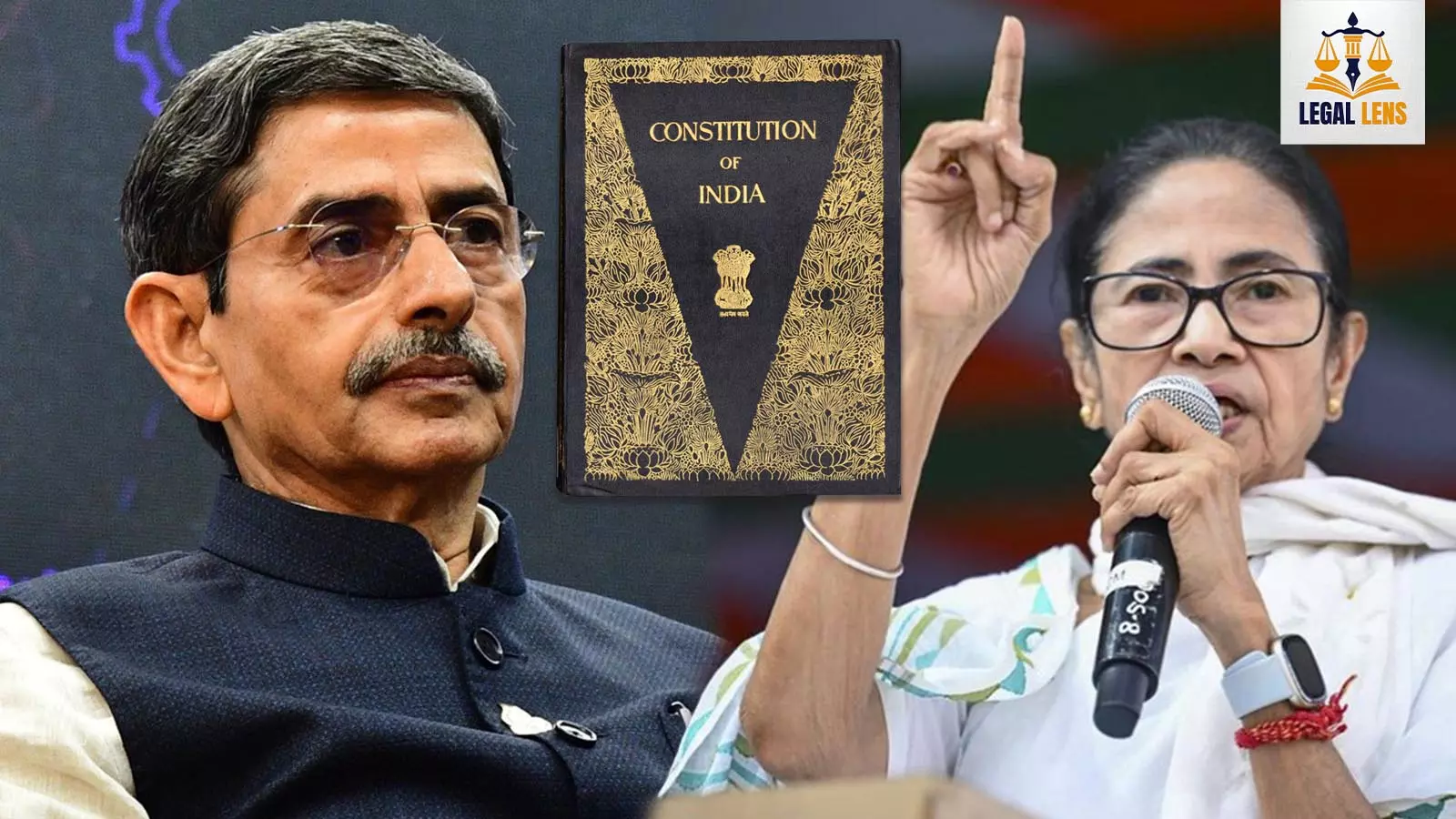
When West Bengal Chief Minister Mamata Banerjee complained on March 5, 2026 that the Union Home Minister Amit Shah had not consulted her before transferring Tamil Nadu governor RN Ravi to her state, she framed it as a violation of convention: “He never consulted with me as per the established convention in this regard. Such actions undermine the spirit of the Constitution of India and strike at the very foundation of our federal structure.”
Her grievance turns on a question that the Indian constitutional law has never squarely resolved: when is a constitutional convention an obligation, when is it violated, and what, if anything, can be done about it?
What is a Constitutional Convention?
The classic account of constitutional conventions comes from AV Dicey’s Introduction to the Study of the Law of the Constitution (1885). Dicey drew a sharp line between the “law of the Constitution” — enforceable in courts — and the “conventions of the Constitution” — understandings and practices that regulate constitutional actors but are not enforced by courts.
The modern refinement, associated with Ivor Jennings, asks three questions: Is there precedent for the practice? Did the actors believe they were bound by a rule? Is there a reason for the rule?
Jennings added a crucial gloss: “A single precedent with a good reason may be enough to establish the rule. A whole string of precedents without such a reason will be of no avail.”
Binding and broken
The convention that Banerjee invoked — that the Chief Minister of a state must be consulted before a governor is appointed or transferred to that state — satisfies the Jennings test and must be recognised as binding.
The reason for the rule is of the first order: a federally sensitive appointment made without state participation reduces state governments to passive recipients of centrally-chosen agents. Where the reason is as strong as this, even a single precedent suffices under the Jennings formulation. In the present case, there are multiple documented instances where consultation preceded governor appointments, particularly when it was politically convenient for the Centre.
That the convention has also been violated — frequently, and systematically against Opposition-ruled states — does not negate its existence. A convention can carry binding normative force while being breached; the characterisation of a departure as a “violation” only makes sense if the convention existed in the first place.
The convention’s credentials are further supported by four successive constitutional commissions spanning nearly four decades. The Sarkaria Commission (1988), Venkatachaliah Commission (2002), Punchhi Commission (2010), and the recent Kurian Joseph Committee (February 2026), appointed by the Tamil Nadu government, all recommended that the President consult the Chief Minister before appointing a governor.
The Kurian Joseph Committee noted that these suggestions had “never been implemented”. The commissions’ unanimity on this issue shows that the constitutional community, over a sustained period, has accepted that there is a reason for the rule and that the rule ought to exist.
There is one specific complication in Banerjee’s case. The convention’s precedents concern the appointment of a governor, not the transfer of one between states. The Constitution is entirely silent on transfers; Article 156 merely provides that a governor holds office during the pleasure of the President. In his speeches found in a book collection called Why the Constitution Matters (Penguin, 2025), former Chief Justice DY Chandrachud distinguished between “door-opening silences” that expand rights and “door-closing silences” that restrain power.
The silence on transfers has been exploited as a door-opening silence by the Centre — a space of unconstrained executive freedom.
The convention of consultation is precisely the mechanism by which that silence should be filled with federal values. That it was articulated in the appointment context does not diminish its force in the transfer context: the reason for the rule applies with equal strength.
From Convention to Law: The SC's trajectory
Written constitutions generate at least as many gaps as they resolve, and those gaps are filled by conventions that translate the text into workable practice. In the Second Judges Case (Supreme Court Advocates-on-Record Association v. Union of India, 1993), Justice Kuldip Singh elaborated this with particular care.
In paragraph 340, he observed that conventions “fill up the gaps in the Constitution itself, help solve problems of interpretation, and allow for the future development of the constitutional framework.” More significantly, in paragraph 351, he held that once a convention is established and followed as a binding precedent by constitutional functionaries, “there is no justification to deny such a convention the status of law.”
This is the most legally consequential articulation of the conventions doctrine in Indian jurisprudence: conventions, once sufficiently established, do not merely inform constitutional interpretation — they become law.
The Supreme Court’s treatment of conventions has moved from recognition to crystallisation. The Second Judges Case converted the convention of judicial primacy in appointments into a binding legal rule by holding that “consultation” in Article 124 must mean “concurrence”.
The NJAC Case (2015) entrenched this further, striking down the 99th Constitutional Amendment on the ground that the collegium convention had become so central to judicial independence — itself a basic structure element — that Parliament could not override it even by formal amendment. In Rameshwar Prasad v. Union of India (2006), the Court treated the convention governing government formation as an obligatory principle, holding the governor’s departure from it mala fide and subject to judicial review. And in SR Bommai v. Union of India (1994), the nine-judge bench confirmed that federalism is part of the basic structure and that executive power which undermines it is judicially reviewable.
The trajectory is one of increasing judicial willingness to treat conventions as substantive constitutional obligations.
Is there a judicial remedy?
Nothing in existing constitutional jurisprudence forecloses a judicial challenge to the Ravi transfer on the ground of non-consultation.
Banerjee could approach the Supreme Court under Article 32 on at least three grounds. First, under Justice Kuldip Singh’s paragraph 351 standard, the convention of Chief Minister consultation has acquired the status of law; a transfer in violation of it is constitutionally infirm. Second, the transfer without consultation violates the federal principle, which is part of the basic structure and not subject to executive override.
Third, in BP Singhal v. Union of India (2010), the Supreme Court held that even the removal of a governor — a power exercised at the pleasure of the President — cannot be arbitrary and must be supported by valid and compelling reasons. The same logic applies to a transfer: the pleasure doctrine is not a licence for constitutionally unreasoned action.
The court may or may not accept these arguments — the pleasure doctrine has never been subjected to a convention-based challenge in the transfer context. But the judicial door is open. Whether Banerjee mounts such a challenge, and whether the Supreme Court is willing to extend its convention jurisprudence from judicial appointments to gubernatorial transfers, are the real open questions.
The asymmetry that remains
A structural asymmetry persists in the enforcement of conventions. Conventions crystallise into law most readily when an institutional actor with enforcement power has an interest in enforcing them: the collegium convention survived precisely because the Supreme Court was the arbiter of its own constitutional status.
The governor appointment convention governs a different kind of power — the Centre’s patronage over state governments — and no institutional actor with equivalent enforcement capacity has an interest in policing it. Four commissions over forty years have recommended codification. None has been implemented.
The Ravi transfer is not merely a political inconvenience to Mamata Banerjee. It is a test of whether the Indian constitutional order is prepared to treat the convention of Chief Minister consultation as what, on any honest application of the Jennings test and Justice Kuldip Singh’s standard, it already is: a binding convention with the force of law, enforceable in a court of competent jurisdiction.
Whether it is enforced depends, in the end, on the political will to litigate and the judicial will to decide.