


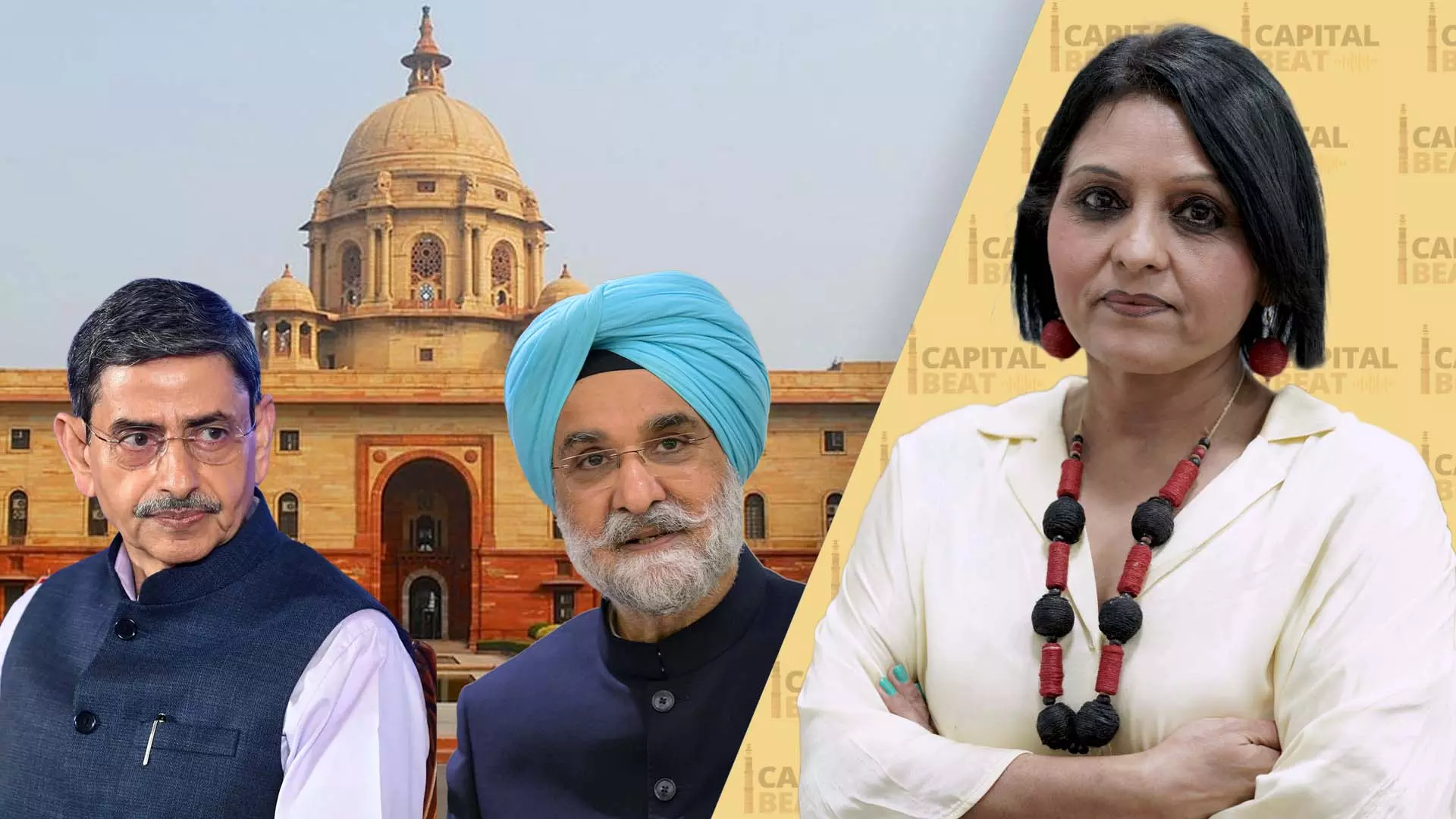
What's behind Centre's Governor rejigs? | Capital Beat
Panellists discuss if Centre’s move to shfit RN Ravi to West Bengal is part of a larger electoral strategy as states head into a high-stakes 2026 election cycle

A major reshuffle of governors ahead of crucial assembly elections in four states and one Union Territory has triggered political speculation, with some analysts suggesting the move could signal a broader electoral strategy.
Senior journalist Javed Ansari said the reshuffle appears aimed at placing “the right people in the right positions”, particularly in politically sensitive states.
The development comes after Dr CV Ananda Bose, the governor of West Bengal, resigned from his post just weeks before the state assembly elections, a move that has stirred controversy in political circles.
In a panel discussion, The Federal spoke to Shikha Mukherjee, political expert; advocate Alim Albuhari, general secretary of Tamil Nadu Youth Congress; and Javed Ansari, senior journalist, to understand the implications of the governor reshuffle and its possible impact on upcoming elections.
Political reaction
The reshuffle comes amid strong reactions from West Bengal Chief Minister Mamata Banerjee, who questioned the circumstances behind Bose’s resignation and the appointment of RN Ravi as the new governor of the state.
In a social media post, Banerjee said she was “shocked and deeply concerned” by the sudden development and alleged that the governor might have been under pressure from the Union government. She also criticised the Centre for not consulting the state government before making the appointment, saying such actions undermine India’s federal structure.
Mukherjee noted that Banerjee’s reaction highlights a longstanding debate over conventions related to gubernatorial appointments.
Also read: Is West Bengal heading for President’s Rule? Big buzz after Governor rejig
“There is a protocol regarding how governors are appointed or changed. Various recommendations, including those of the Sarkaria Commission, say that the state government should ideally be consulted,” Mukherjee said during the discussion.
She added that although the Constitution gives the President the power to appoint governors, political conventions have evolved to maintain cooperative federalism.
Election concerns
One of the key concerns raised during the discussion was whether the reshuffle signals potential delays in the West Bengal elections.
Mukherjee pointed to a complex issue involving the voters’ list verification process. According to her, a large number of cases related to voter inclusion are currently under judicial scrutiny. “The Chief Electoral Officer indicated that delays in releasing the final voter list are due to the Supreme Court’s involvement in the process,” she said.
Mukherjee explained that thousands of cases regarding voter eligibility are being examined, which could slow down the preparation of the final electoral roll.
“If the process takes longer than expected, elections may not be held on time,” she said. In such a scenario, she suggested, the state could face interim arrangements such as extending the tenure of the current chief minister for a limited period or imposing President’s Rule.
President’s rule debate
Ansari too raised the possibility that the reshuffle could be linked to contingency planning in case elections are delayed. “If the voter list process is not completed in time, the elections cannot be held before the assembly term ends,” he said.
In that case, he explained, the state could come under President’s Rule until fresh elections are conducted. Ansari argued that the appointment of a new governor might be part of preparations for such a scenario. “They may want someone who will vigorously implement their agenda if President’s Rule is imposed,” he said. He pointed to RN Ravi’s tenure in Tamil Nadu, where the governor frequently clashed with the state government, as an example of his confrontational style.
Also read: Bengal Guv Ananda Bose's abrupt exit after enrolling as Bengal voter baffles many
“If his tenure in Tamil Nadu is anything to go by, he did not hesitate to confront the state government,” Ansari said.
Tamil Nadu angle
The reshuffle has also drawn attention in Tamil Nadu, where Ravi’s tenure as governor was marked by frequent friction with the DMK government led by MK Stalin. Advocate Alim Albuhari argued that Ravi’s political role in the state had already reached its limit.
“Whenever he made statements or interventions, it often triggered political reactions,” Albuhari said. He pointed out that Ravi had previously drawn criticism for editing parts of the state government’s address in the Assembly and for making controversial remarks at public events.
According to Albuhari, such incidents repeatedly sparked political debates in Tamil Nadu. “Our chief minister often used those controversies to highlight issues of federalism and state rights,” he said. He added that the state government even joked about “missing” Ravi after news of his transfer surfaced, as his presence had inadvertently helped Opposition parties to criticise the Centre.
Strategic move?
Another interpretation discussed during the panel was that the reshuffle could be aimed at neutralising opposition narratives. Albuhari acknowledged that the Centre may have decided to move Ravi out of Tamil Nadu to reduce political friction in the state. “Maybe the Centre felt that continuing the same pattern of confrontation was giving the Opposition too much ammunition,” he said.
At the same time, he argued that Ravi’s approach could be used more effectively in a politically competitive state like West Bengal. “His style may be deployed where the BJP thinks it has a stronger electoral opportunity,” Albuhari said.
Unanswered questions
While much of the discussion focussed on West Bengal and Tamil Nadu, Ansari also raised questions about other changes in the reshuffle. One development he found puzzling was the replacement of Arif Mohammed Khan, who had been serving as governor of Bihar. Ansari noted that Khan had been politically active and had often engaged with state-level issues.
Also read: CV Ananda Bose quits as Bengal Governor; Mamata says RN Ravi named without discussion
“It is intriguing why he has not been given another posting,” Ansari said. He suggested that the Centre may have other plans for Khan, possibly involving a role in national politics. “There is speculation that he could be brought into the Union government, but nothing is confirmed,” he said.
Election timeline
Despite the speculation, Ansari cautioned against assuming that the reshuffle alone indicates a delay in election schedules. He said that, except for West Bengal, elections in other states are expected to proceed according to schedule. “Election dates cannot be arbitrarily postponed in most cases,” he said.
However, he reiterated that the voter list verification issue in West Bengal could create logistical challenges. “If that process is not completed in time, the election timeline may have to shift,” he said.
Political implications
The panel agreed that the reshuffle has already intensified political narratives ahead of the elections. Mukherjee said Banerjee has begun mobilising politically, even taking to the streets to highlight concerns about federalism. “She is preparing to take the issue to the public and frame it politically,” Mukherjee said.
At the same time, she argued that the situation could also work in Banerjee’s favour if the Centre is seen as interfering in state affairs. “Political narratives can cut both ways,” she said.
Watchful weeks
As the Election Commission prepares to announce the schedule for upcoming assembly elections, political observers are closely watching developments.
The reshuffle of governors, coming so close to the polls, has added another layer of intrigue to the political landscape. Whether the changes reflect administrative adjustments or a calculated political strategy remains a subject of intense debate. For now, analysts agree that the coming weeks will be crucial in determining how these developments shape the electoral contest.
The content above has been transcribed from video using a fine-tuned AI model. To ensure accuracy, quality, and editorial integrity, we employ a Human-In-The-Loop (HITL) process. While AI assists in creating the initial draft, our experienced editorial team carefully reviews, edits, and refines the content before publication. At The Federal, we combine the efficiency of AI with the expertise of human editors to deliver reliable and insightful journalism.
