One vote, one seat thinner: Vijay’s cushion after the Madras HC order
Legal Lens: Why the Madras HC has barred Vijay’s one-vote MLA from the May 13 trust vote, and what it changes

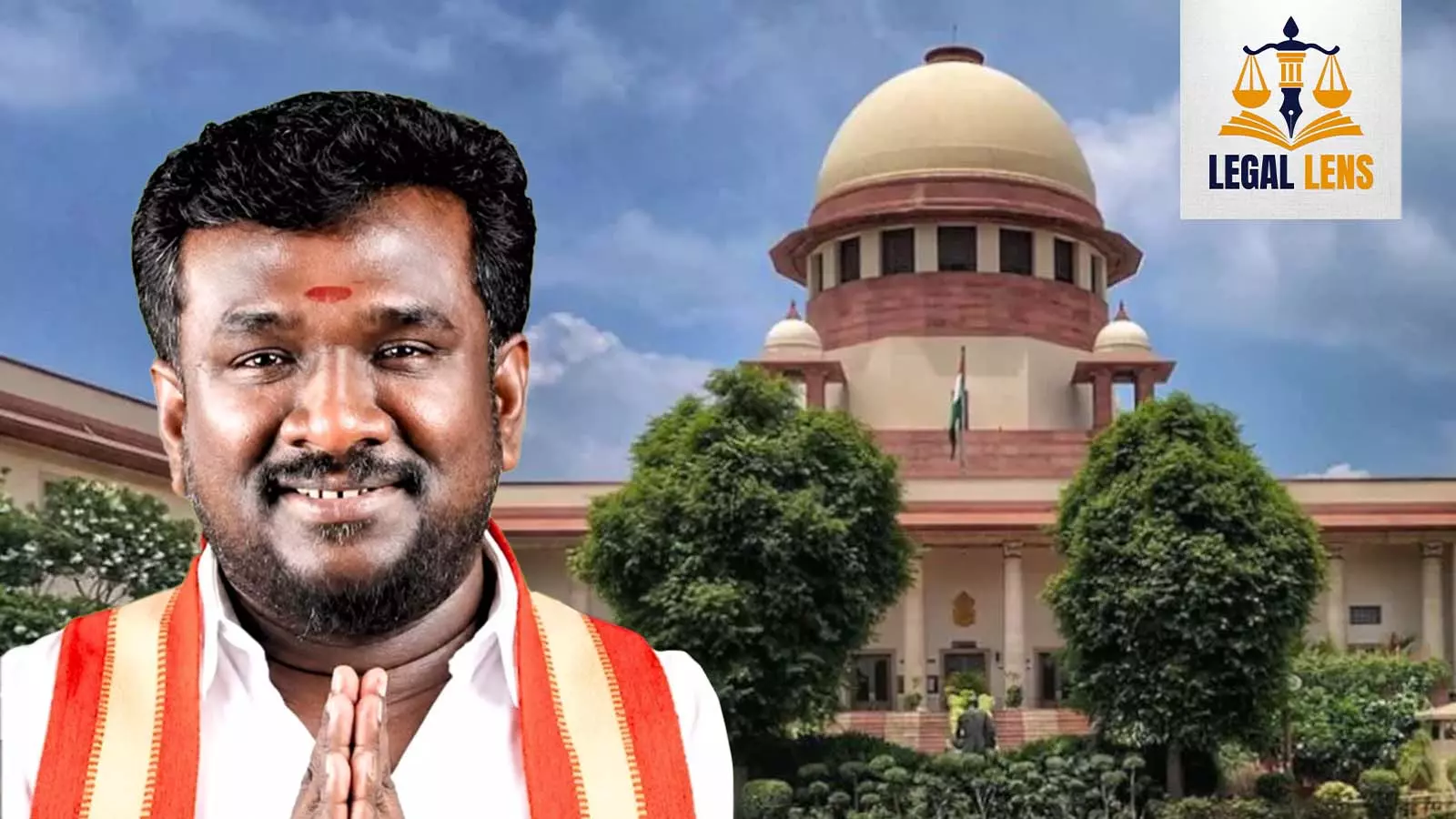
On May 12, a division Bench of the Madras High Court, comprising Justice L Victoria Gowri and Justice N Senthilkumar, restrained R Seenivasa Sethupathi from voting in any floor test, confidence motion or trust vote in the Tamil Nadu Legislative Assembly until further orders. Sethupathi is the Tamilaga Vettri Kazhagam (TVK) legislator who won the Tiruppattur seat in Sivagangai district by a margin of one vote.
The Bench's interim order directs the official respondents to preserve every record relating to the count, including the videography and the rejected postal ballot itself. And it bars the returned candidate from voting where his vote could determine the fate of a government.
The factual peg is small and odd. Tamil Nadu has two Assembly constituencies bearing the same name. Tiruppattur No. 185 lies in Sivagangai district in the south. Tiruppattur No. 50 lies in Tirupattur district in the north. A postal ballot meant for the southern Tiruppattur was delivered to the northern one. The returning officer there rejected it, finding that the cover did not belong to his constituency. He did not redirect it. The outgoing Cooperation Minister KR Periakaruppan of the DMK polled 83,364 votes. Sethupathi polled 83,365. The rejected ballot, on the petitioner's case, is the vote that turned the result.
Article 329(b), and the Ashok Kumar carve-out
Article 329(b) of the Constitution bars any election to the legislature from being called in question except by an election petition under the Representation of the People Act, 1951. Section 100 of the Representation of the People Act, 1951 lists the grounds; Section 80 makes the petition the exclusive remedy.
In Election Commission of India vs Ashok Kumar (2000), a three-judge Bench of the Supreme Court held that the bar is plenary but not absolute. Courts may not interrupt an election or adjudicate its validity outside the petition forum. They may intervene in a narrow band to remove a procedural obstacle or preserve evidence that would otherwise vanish.
Also read: MA Baby: CPM supporting TVK to honour people’s mandate | AI With Sanket
The Madras Bench has placed itself inside that band. It calls its order a preservation measure and a guard against the use of a disputed mandate to decide a government’s fate. It has gone one step further. It has held that the misdirection of a postal ballot, with no corrective restorative mechanism in statute, is a constitutional anomaly not contemplated by Section 100. The vacuum, in this view, justifies Article 226. The novelty is the second limb: not the preservation of records, which Ashok Kumar plainly permits, but the restraint of a sitting MLA's vote. That is the appealable part.
The arithmetic, and the order’s real political bite
The 17th Tamil Nadu Legislative Assembly has 234 seats; the majority mark is 118. The declared results produced the state’s first hung Assembly. The TVK won 108 seats, but Chief Minister C Joseph Vijay contested and won from two constituencies and must vacate one. Effective TVK strength is 107. The DMK won 59 and the AIADMK 47; the Congress 5; the IUML, VCK, CPI and CPI(M) two each; the PMK 4; and the BJP 1.
On May 6, the Congress quit the DMK-led Secular Progressive Alliance and backed the TVK. On May 8, the Left parties — the CPI and the CPI(M) — extended unconditional outside support. The VCK and the IUML followed on May 9. Vijay took oath on May 10 and was directed by the Governor to win a confidence vote by May 13.
Now, factor in the High Court order. TVK 107 minus Sethupathi is 106. Add Congress (5), IUML (2), VCK (2), CPI (2), CPI(M) (2) and the floor strength is 119. The majority mark is 118. The cushion is one seat.
Also read: Vijay govt's balancing act: Allies with one foot in, one foot out
That is where the order bites. With Sethupathi present, Vijay would have had 120 — a two-seat cushion. The Madras High Court has converted a two-party-loss tolerance into a one-party-loss tolerance. If any one of the four small parties — the IUML, the VCK, the CPI or the CPI(M) — walks out before the vote, the government falls to 117. The trust vote would fail by precisely the one-vote margin that produced the underlying litigation.
None of the four has signalled any such intention. Each formally extended unconditional support. The arithmetical fragility is therefore latent, not imminent. But it is real. And it sits inside the High Court's order, not outside it.
Where the order will be tested on appeal
The interim order is exposed on appeal on three counts. First, Ashok Kumar permits preservation of evidence. It does not, on its face, permit restraint of a returned candidate from exercising his constitutional functions. The Bench has elided the two by treating the restraint as preservation of the integrity of the eventual petition. The Supreme Court will have to decide whether that elision is permissible.
Second, the Bench’s reliance on a procedural vacuum to justify writ jurisdiction is creative. Whether absence from Section 100 is the same as exclusion from the election-petition remedy is a separate question. The petitioner could have framed the misdirection as an improper rejection of a vote under the Act.
Also read: Why Tamil Nadu’s new coalition government is standing on thin ice
Third, the restraint operates against a sitting legislator’s vote in a confidence motion. The Supreme Court has, in SR Bommai vs Union of India (1994) and after, treated the floor of the House as the proper forum for testing legislative majority. Pausing that forum for one MLA, even on a preservation rationale, is unusually invasive interim relief.
If, later, the AIADMK question arises
The cushion is one seat thick. The chamber is hung. Trust votes will recur. And the principal Opposition, the AIADMK with its 47 MLAs, has shown public signs of internal disagreement about whether to extend support to the new government. When that question arises legally, the Tenth Schedule architecture is now markedly tighter than it once was.
The 91st Constitutional Amendment of 2003 deleted paragraph 3 of the Schedule. The split defence is gone. A faction that walks out without merging is, on the plain reading, defecting. The only surviving defence is in paragraph 4. Sub-paragraph 2 reads that the merger of the original political party shall be deemed to have taken place if, and only if, not less than two-thirds of the legislature party concerned have agreed to such merger. That is a legal fiction. It is the source of two decades of doctrinal trouble.
The trouble is whether the two-thirds count is constitutive of the merger, or merely verificatory of one that has independently taken place in the original political party. The five-judge Constitution Bench in Subhash Desai vs Principal Secretary, Governor of Maharashtra (2023) tilted the answer decisively toward the verificatory reading. The political party and the legislature party, the Court held, are distinct entities under the Schedule. The whip and the leader are appointed by the political party, not the legislature party. To collapse the two would sever the umbilical cord between the legislator and the organisation that nominated, financed and elected them.
Also read: Vijay, the man who says very little: Is silence golden in politics too?
Applied to the AIADMK, two-thirds of 47 is 32. A legislature-party crossover at or above 32 would, on the constitutive view, trigger the deeming. On Subhash Desai, it would not. The registered AIADMK, whose General Secretary is Edappadi K Palaniswami and whose symbol is the Two Leaves, would have to merge as an organisation. The path of least legal resistance — a Tenth Schedule merger by legislators alone — is not as open as it once was.
What the order leaves behind
Even if read down on appeal, the order leaves two questions. The Conduct of Elections Rules, 1961 contain no provision for re-routing a postal ballot that arrives at the wrong returning officer. Rule 54A presumes the ballot is in the right place; there is no fallback if it is not. Separately, two same-named constituencies in one state, several hundred kilometres apart, is a delimitation infelicity. Distinct serial numbers do not help where postal staff handle covers by inscription.
Vijay will probably win. He will win by one. The order is interim, narrowly drawn, and on its own framing a preservation order. Its significance will outlast the trust vote. The doctrine will be tested on appeal.