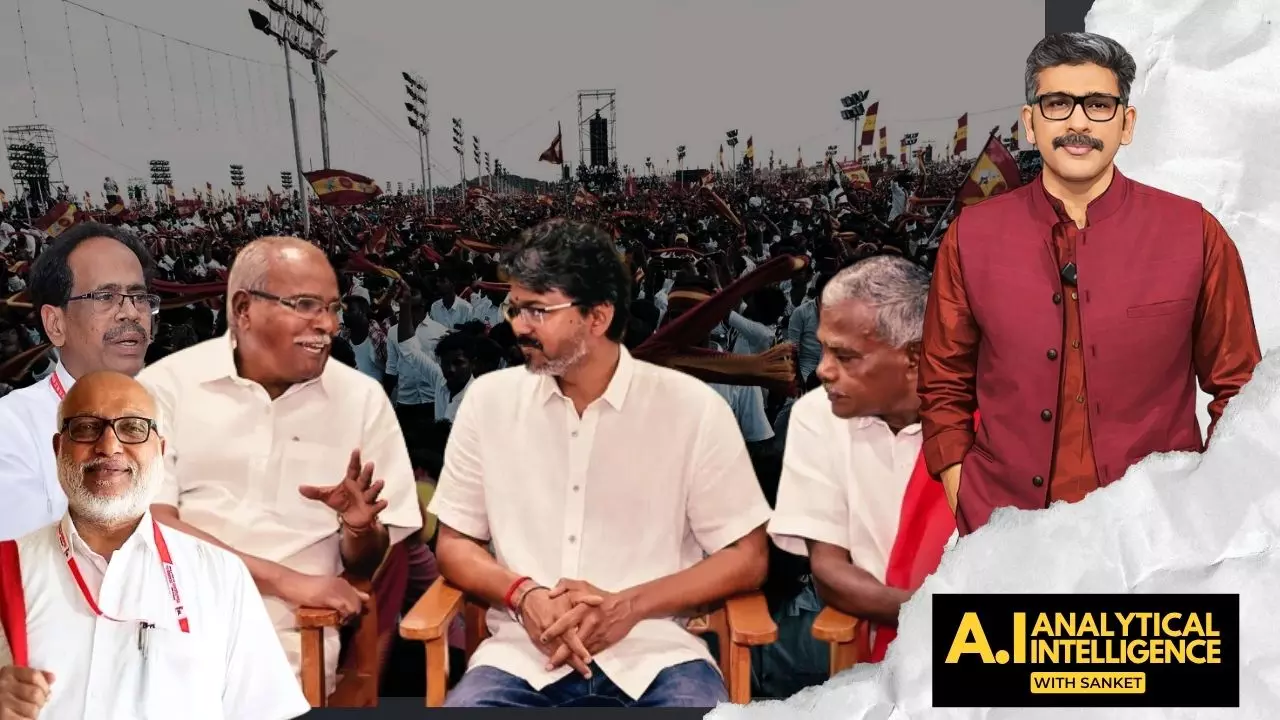
MA Baby: CPM supporting TVK to honour people’s mandate | AI With Sanket
CPM general secretary MA Baby says support to TVK was necessary after the Governor failed to invite the single-largest party to form a government

Actor-politician Vijay’s TVK received support from the CPI(M) because the Governor Rajendra Vishwanath Arlekar failed to follow “constitutional norms and democratic practices” by not inviting the single-largest party to form the government, CPI(M) general secretary MA Baby told The Federal on the latest episode of AI With Sanket.
On Saturday (May 9), TVK secured a 120-seat majority and is set to form the government with its party President Vijay as Chief Minister. TVK has received the support of the Congress, Left, IUML and VCK.
Also read: Vijay gets majority, albeit wafer-thin, as VCK and IUML back TVK to form govt
In this interview, Baby spoke on why his party decided to back TVK, the tensions within the Opposition bloc, and whether doors remain open for future cooperation with the DMK.
Why did the CPI(M) decide to support TVK?
This decision was taken due to a couple of points. First of all, the verdict of the people has to be respected. They did not give a majority to any party or alliance.
The people voted out the incumbent government led by the DMK, and we were supporting the DMK government from outside. They also did not give a majority to the Opposition alliance of the AIADMK-BJP-led NDA.
Instead, they overwhelmingly voted for Tamilaga Vettri Kazhagam (TVK), the new party led by Mr. Joseph Vijay. But that verdict was 11 short of a majority in the Tamil Nadu Assembly.
So the Governor should have followed convention, constitutional norms and democratic practices. He should have either invited the single-largest party or, if there was a post-poll alliance commanding a majority, he could have invited them even while ignoring the single-largest party.
There was no post-poll alliance with a majority. There was no one staking claim to form the government other than the single-largest party leader, Mr. Joseph Vijay. But the Governor did not follow democratic norms.
Also read: How Vijay glided effortlessly from Kodambakkam to Fort St George
You had said the DMK floated the idea of extending outside support to the AIADMK. Is that why the CPI(M) backed TVK?
What I stated was that the AIADMK wanted to form the government.
When the Governor strangely started saying that TVK did not have the numbers, the DMK stated that though they were the second-largest alliance, they did not want to stake claim to form the government.
Then rumours began circulating that the AIADMK would be called to form the government, even though it was aligned with the BJP. So the game became very clear — the BJP wanted to engineer something.
But I did not say that the DMK was engineering all this.
Does the CPI(M)’s move weaken Opposition unity and the INDIA alliance?
That is the result of the election. The electorate decided so.
As far as our relationship with the DMK is concerned, our party in Tamil Nadu has already briefed Mr. MK Stalin about the circumstances that led us to take this decision.
We still have a cordial relationship with the DMK. To honour the people’s mandate, we are extending support to Mr. Vijay, who is the leader of TVK.
Do you believe the DMK should also support TVK?
In the first instance, Mr. MK Stalin himself had stated that Vijay should be invited to form the government.
At that point, he said that for six months, people should be allowed to assess what policies and decisions TVK would take. That was his initial stand.
There is no indication so far that he has abandoned that position.
You seem to suggest the Governor’s actions forced the Left parties to step in. Was that the trigger?
Yes. The way Congress acted was different. Congress did not undertake discussions with the DMK or other alliance constituents before extending support.
The CPI(M), CPI and possibly the VCK took this position because the Governor was not conducting himself according to constitutional conventions by inviting the single-largest party to form the government.
That would naturally have led to horse-trading.
It was only after observing how the situation was evolving that the CPI(M), CPI and VCK decided we should call the Governor’s bluff.
Congress moved first. But we acted because we felt Raj Bhavan was pandering to another agenda and was not being fair.
What does this mean for Opposition unity nationally?
I am speaking from Madurai, where we recently held the 24th Party Congress.
The political line adopted there is to work with all those willing to cooperate at different levels to expose and defeat the BJP, which is controlled by the RSS. That is our tactical political line.
But this also depends on the responses and behaviour of other political parties.
There are certain areas where the way Congress conducts itself creates reservations for us.
During the Kerala elections, Congress leaders who came from Delhi were asking why the Kerala Chief Minister had not been arrested by the Union government.
At the same time, we saw what happened in Delhi. The Aam Aadmi Party (AAP) was part of the INDIA bloc, but Arvind Kejriwal was arrested and jailed by the BJP government. The first demand for action against Kejriwal actually came from Congress.
So sometimes the approach of Congress itself creates problems for Opposition unity.
All parties within the INDIA bloc must introspect and correct themselves. Only then can a broad political arrangement against the BJP be strengthened.
Under your leadership, will the CPI(M) maintain an anti-BJP line even if it means aligning with Congress?
India is a large country — almost a subcontinent. Every state has its own political situation.
In some states, we have contested elections in cooperation with secular non-BJP parties. In Tamil Nadu, we fought alongside the DMK, and Congress was also part of that alliance.
In Bihar, we had the Mahagathbandhan, which included the Rashtriya Janata Dal, Congress, CPI, CPI(M) and CPI(ML) Liberation.
Different states have different political patterns. We will try to strengthen anti-BJP cooperation wherever possible.
At the same time, the less positive contributions of Congress in certain states will also be factored in.
In Parliament, in both the Lok Sabha and Rajya Sabha, there will certainly be Opposition unity and coordination. But state-level situations will remain state-specific.
That is the objective political reality.
Have you left the door open for future cooperation with the DMK?
In politics, we have permanent goals. Our permanent goal is to isolate and defeat the BJP and prevent its entry into states like Tamil Nadu and Kerala wherever possible.
To implement the political tactical line adopted at our 24th Party Congress in Madurai, we will build political arrangements, alliances or understandings based on the concrete realities of each state.
We are not closing our doors against any secular democratic political party or any non-communal party.
If necessary, we will have understandings or alliances to achieve our declared goals.
Do you think the DMK should eventually join the TVK arrangement to strengthen the anti-BJP front?
The DMK has already stated that for six months it will not disturb a government possibly led by TVK.
Based on its own political experience, the DMK can even extend that period further.
It is for the DMK to take a suitable decision based on its own political line and political experience in Tamil Nadu.
(The content above has been transcribed from video using a fine-tuned AI model. To ensure accuracy, quality, and editorial integrity, we employ a Human-In-The-Loop (HITL) process. While AI assists in creating the initial draft, our experienced editorial team carefully reviews, edits, and refines the content before publication. At The Federal, we combine the efficiency of AI with the expertise of human editors to deliver reliable and insightful journalism.)