After NALSAR row, a bigger question for Bar Council: Who makes its decisions?
Five BCI office-bearers say chairman Manan Kumar Mishra issued original directive before seeking council's approval, putting the body's decision-making process under scrutiny

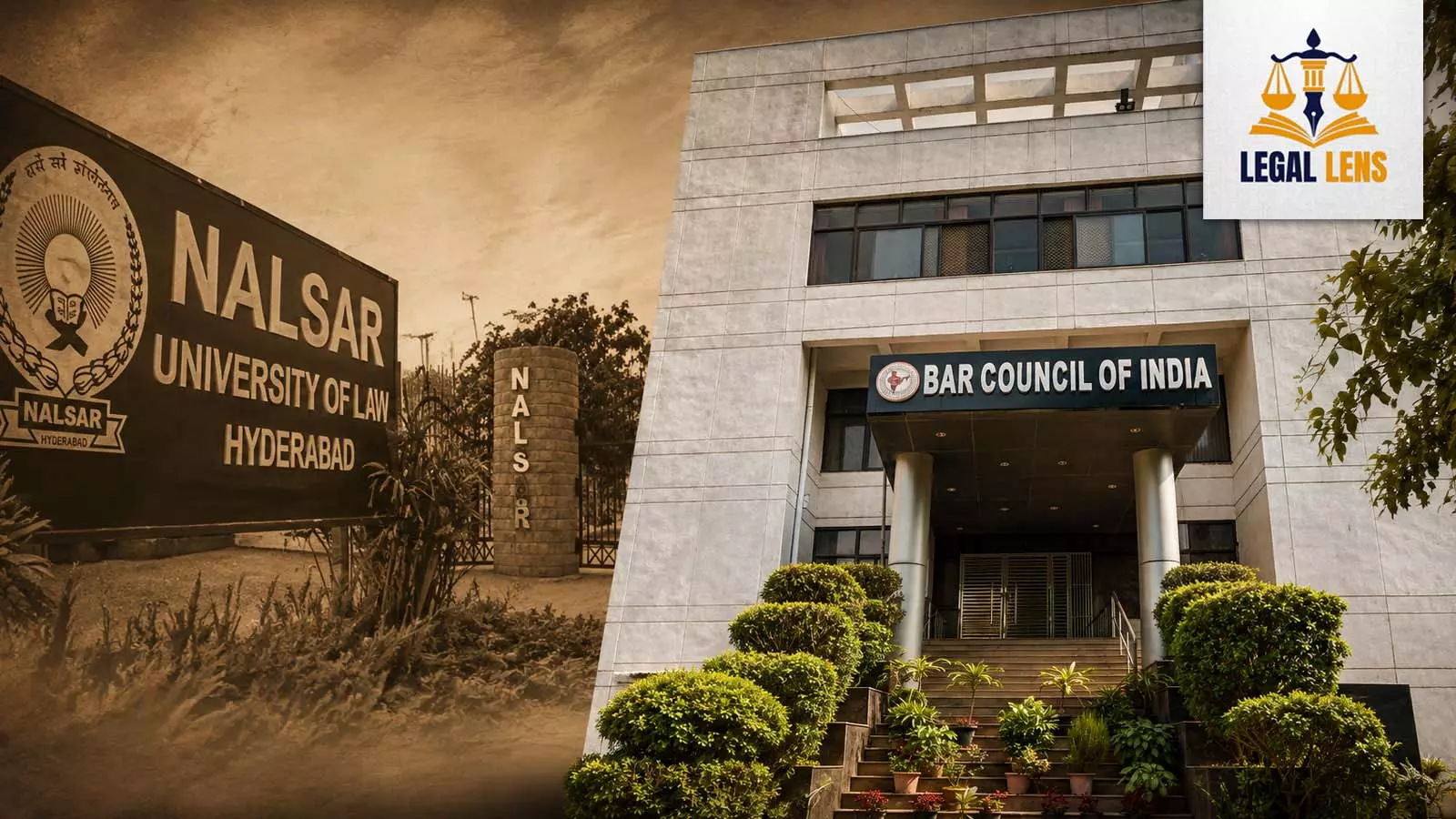
The NALSAR controversy has ended with a more consequential conversation about who gets to speak for the Bar Council of India.
Bar Council of India (BCI) chairperson Manan Kumar Mishra’s Independence Day apology to law students might have closed the immediate NALSAR controversy. Instead, by the time it arrived, the controversy had moved elsewhere.
The controversy was no longer only about why the Bar Council of India (BCI) intervened after students from NALSAR University of Law, Hyderabad, objected to the invitation extended to Chief Justice of India (CJI) Surya Kant for their convocation. A second question had come into focus: who within the BCI authorised that intervention, and through what process did the chairman’s decision become the council’s decision?
Two developments make that question timely. Five BCI office-bearers have told The Indian Express that Mishra issued the original August 13 directive before seeking approval from colleagues. Mishra’s directive sought to bar the 2026 graduating batch of NALSAR from enrolling with state Bar councils, apart from an inquiry against those who ‘instigated’ them to protest against the invitation to the CJI to participate in the convocation. Later, he withdrew both his directives, bowing to pressure from within the council and from outside.
Also read: BCI chief apologises over NALSAR enrolment order, backs students’ right to dissent
Separately, advocate M Varadhan has filed a Supreme Court petition seeking limits on repeated terms at the top of the BCI and wider changes in its governance. The BCI rules prescribe a two-year term for the chairman and vice-chairman. Mishra, who has headed the council continuously since November 2014, was re-elected in March 2025 for a seventh consecutive term. The rules, however, do not prescribe an overall ceiling on the number of terms a person may serve as chairman.
Together, they turn an episode about student dissent into a story about the internal accountability of the body that regulates India’s lawyers.
A decision first, consultation later?
What is new is the account from inside the BCI.
In a report published on August 15, The Indian Express said five BCI office-bearers told the newspaper that Mishra took the first decision without consulting colleagues, signed and published it on BCI letterhead, and only then sought approval in the council’s WhatsApp group.
Also read: BCI swiftly reverses NALSAR enrolment ban, continues inquiry into CJI invite row
According to the report, 10 of 19 office bearers approved the letter. At least three opposed it outright, while another wanted changes. Some members were reportedly unaware, while discussing it, that the directive was already public.
That matters because the BCI is a council, not simply the office of its chairman.
Its own rules say the chairman has general control and supervision over its affairs, but that authority is “subject to the resolutions of the council”. Decisions are ordinarily made by majority.
The rules also provide for urgency. Business can be circulated among members instead of waiting for a meeting, but the proposed action is not to be taken until a majority agrees. It must later be placed before the council or committee for confirmation.
The chairman also has power to pass interim orders in matters arising from the council’s supervisory jurisdiction. Whether the August 13 directive fitted that provision is something the BCI can explain when it responds in court. The important point is that the rules themselves distinguish between powers exercised by the chairman and decisions belonging to the council.
The BCI’s second communication is revealing in this context. As The Indian Express noted, it described the first document as the “letter issued by the chairman, Bar Council of India”, and said members later reached a unanimous view to modify the chairman’s order.
Also read: BCI chairperson says 35-40 per cent of advocates are using fake law degrees
The wording itself appears to distinguish the initial act from the council’s later deliberation.
Why Justice Bagchi’s question matters now
This gives fresh significance to a question asked in the Supreme Court a day earlier.
When Mihira Sood v Bar Council of India (2026) reached the court on August 14, the BCI said the disputed communication had been withdrawn. The court nevertheless issued notice and sought its response.
During the hearing, Justice Joymalya Bagchi asked whether the BCI had actually been convened before the decision was taken.
In light of The Indian Express report, that question now goes to the centre of the controversy: was the first directive an institutional decision, an urgent action later ratified, or an individual decision made in anticipation of approval?
Also read: NALSAR controversy: 'CJI sensed public mood is in favour of students'
The BCI will now have an opportunity to place its account before the Supreme Court.
An apology that changes tone
Mishra’s August 15 letter to law students is markedly different in tone from the communication that began the dispute.
He apologised if anything he had said or written in connection with the controversy had hurt law students. He described them as capable of independent judgement, recognised peaceful disagreement, questioning and protest as features of constitutional democracy, and said the choice whether to attend a convocation must ultimately remain with students.
The letter lowers the temperature. But it needs to be read precisely.
It does not name NALSAR. It does not say that the August 13 action lacked authority. Nor does it explain how that decision was made inside the BCI. The apology addresses hurt and seeks reconciliation. It does not answer the institutional questions surrounding the decision-making process.
Those questions have become harder to avoid because of Varadhan’s new petition.
From one Chairman to the system
Varadhan’s petition, according to presently available reports, challenges a broader structure which he says allows the same individuals to remain in leadership positions for prolonged periods.
The BCI’s own record of its chairmen shows Mishra in the post continuously from November 9, 2014, to the present, following an earlier stint between 2012 and 2014.
Also read: Litigant abuses CJI, 'orders' judges, flings case papers in Supreme Court
The petition also focuses on Section 4(3) of the Advocates Act. A BCI member elected by a State Bar Council can continue until a successor is elected. Varadhan argues that a provision intended to prevent a vacancy can, when elections are delayed, facilitate prolonged continuation.
According to LiveLaw’s report on the petition, he seeks a limit on repeated terms, wider regional rotation and periodic independent review of the BCI’s functioning.
These are the petitioner’s arguments and proposed remedies, not findings by the Supreme Court. Long tenure by itself establishes no wrongdoing. Repeated elections can equally be defended as continued confidence in a leader.
The question is whether a representative institution should depend only on repeated internal choice, or also build in mechanisms for renewal and rotation.
A problem older than NALSAR
Varadhan’s concern with the Bar Council governance predates this week.
In an earlier petition filed in 2023, he challenged delays in State Bar Council elections. In September 2025, the Supreme Court recorded that elections had not been held “for decades” in some states and directed the BCI to ensure their completion. The litigation has since involved court-supervised arrangements for State Bar Council polls.
That history matters because the fresh challenge cannot simply be reduced to anger over one NALSAR directive.
Also read: Explained: Legal practitioner status for corporate lawyers, other changes in Advocates Bill
What NALSAR has done is give a governance question a concrete example.
The BCI’s structure is collective. Its rules envisage meetings, voting and majority decisions. Even urgent business has a prescribed procedure.
If the account given by BCI office-bearers to The Indian Express is correct, August 13 showed how easily the line between a chairman’s initiative and the council’s decision can become blurred.
That is the question an apology cannot resolve.
Mishra’s letter may help repair relations with students. Mihira Sood can examine the specific BCI communications. Varadhan’s petition, if entertained, can test the rules governing continuity in office.
But there is a simpler question behind all three.
When the Bar Council of India speaks, how can advocates, students and the public know that they are hearing the considered decision of the institution rather than the view of the person who happens to lead it?
The NALSAR controversy began with an argument over who should speak at a convocation. It may end by forcing a more consequential conversation about who gets to speak for the Bar Council of India.