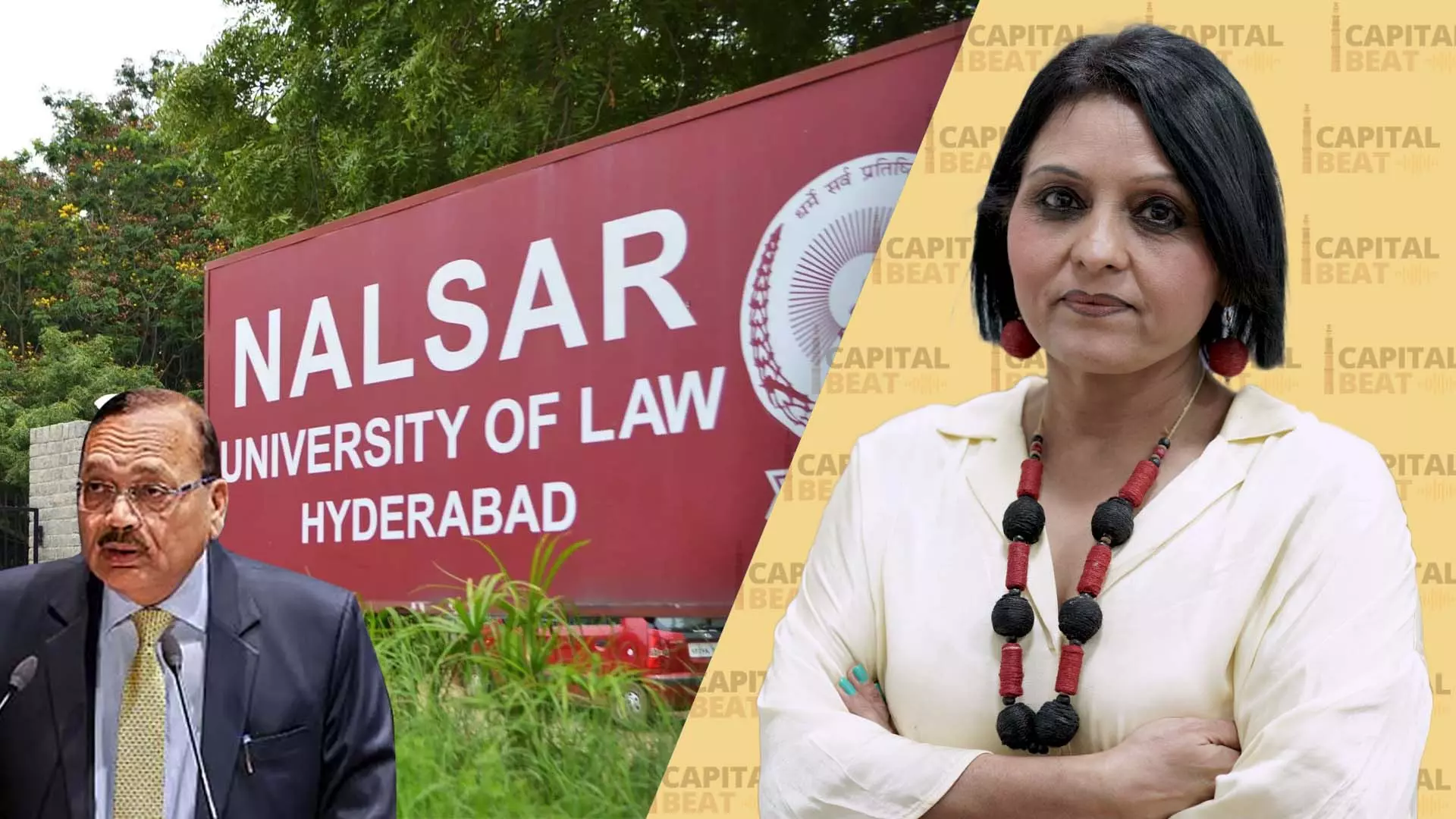
Political experts believe the controversy surrounding Chief Justice Surya Kant's earlier remarks about youth had contributed to the intensity of the public response.
NALSAR controversy: 'CJI sensed public mood is in favour of students'
Political observers say larger public response to recent controversies has put pressure on institutions to reconsider their approach to dissent

A day after Chief Justice of India (CJI) Surya Kant intervened in the NALSAR controversy, stating that students had the right to protest and that the Bar Council of India (BCI) had no role in interfering in such matters, senior journalist and political commentator Smita Gupta said that the CJI's remarks reflected a recognition of the broader public sentiment.
"I think that's very simple. He has sensed the public mood, and the public mood is in favour of the students," she said during The Federal’s Capital Beat show.
NALSAR row
The row centres on the BCI’s circular to protesting students at NALSAR University of Law after they objected to the invitation extended to Chief Justice Surya Kant for the university's convocation.
Also read: CJI Surya Kant slams BCI over NALSAR enrolment ban, calls move 'uncalled for'
The controversy flared up on social media, where activists and student supporters slammed BCI Chairman Manan Kumar Mishra's initial stance before the BCI subsequently withdrew its position.
Public sentiment
Commenting on the developments, Gupta said the Jantar Mantar movement had attracted support across social and political divides, unlike several earlier protests often viewed through narrower political or ideological lenses. She added that the controversy surrounding the Chief Justice's earlier remarks about youth had contributed to the intensity of the public response.
Also read: Rumpus at Umar Khalid book event shows fragile state of free speech in India
The senior journalist also viewed the CJI’s remarks as part of an effort to repair the damage caused by the earlier ‘cockroach’ controversy. She described activists such as Saurabh Das and Abhijit Dipke as prominent faces of a broader public movement and argued that the public mood they helped shape played a key role in forcing a rethink.
Debate on freedom of expression
The protests and controversies surrounding CJI Surya Kant’s remarks have unfolded alongside a wider debate over student dissent, judicial accountability and freedom of expression. Against this backdrop, the cancellation of political scientist Zoya Hasan’s Independence Day lecture at Delhi’s Sardar Patel Vidyalaya has further intensified concerns over how dissenting voices are being handled.
Political commentators describe the episode as part of a broader pattern in which “intermediary tactics” are used to restrict or discourage public criticism.
Also read: ‘Modi’s aura of invincibility dented by memes, not politics’ | Interview
Hasan had been invited to speak on pluralism, but the event was called off after a small group of protesters gathered outside the school, leading police to raise security concerns. Police described the move as precautionary, while critics questioned the decision.
‘Ideological conflicts’
Gupta said the government appeared shaken by the scale of recent protests but continued to rely on methods to control public discourse.
Supreme Court lawyer and Samajwadi Party spokesperson Sarvesh Tripathy argued that the NALSAR and Hasan episodes reflected broader ideological conflicts over pluralism, democracy and academic freedom.
He said institutions committed to constitutional principles would have to play a larger role in protecting democracy, pluralism, secularism and federalism, adding that institutional accountability would be crucial in the period ahead.