Vande Mataram row: Can a gesture or a remark amount to an offence?
Complaints against Sonia and Rahul Gandhi test the new offence, with police required to prove intentional disruption, and not perceived disrespect or an ambiguous clip

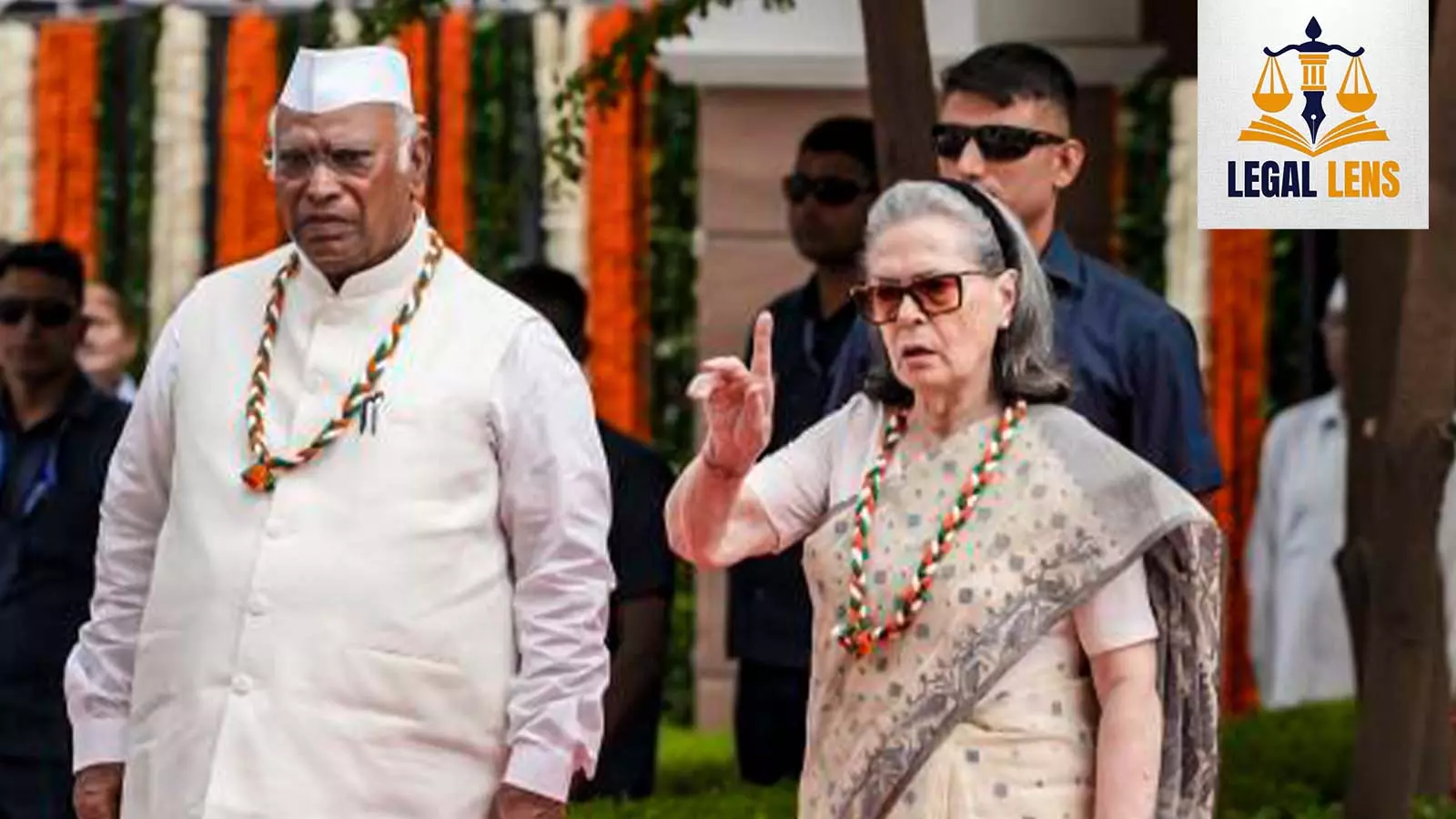
Advocates, in their complaint, alleged that senior Congress leader Sonia Gandhi gestured in a manner suggesting the song should stop. File photo
On August 11, 1986, the Supreme Court held that three schoolchildren who stood silently through the national anthem had committed no offence. Exactly 40 years later, the President assented to a law extending the same penal section to the national song. The dates may be a coincidence. What matters in practice is that despite the latest amendment, the 1986 verdict continues to apply.
Four days after the assent, the Congress held its Independence Day function at Indira Bhawan in New Delhi. What happened during the rendition is now before the Delhi Police, after Union Home Minister Amit Shah demanded an apology from Congress leader Sonia Gandhi for “insulting” the national song, Vande Mataram.
Also read: Vande Mataram Bill 2026: DMK opposes, calls it 'joke, fraud and foul play'
Two advocates filed a complaint on August 16 at Delhi's IP Estate police station. They alleged that Sonia gestured in a manner suggesting the song should stop. They allege that Rahul Gandhi was heard saying, “We are not singing Vande Mataram.” Both allegations rest on video footage in public circulation. The Congress says Sonia was asking for a chair for party president Mallikarjun Kharge. No first information report (FIR), the document that formally opens a criminal investigation, has been registered. The police are running a preliminary enquiry instead.
The political volume around this is high and largely beside the point. The legal questions are narrow.
Was the law in force on August 15?
The amending Act -- The Prevention of Insults to National Honour (Amendment) Bill, 2026 -- has two clauses. The first gives it a name. The second substitutes Section 3 of the parent statute of 1971. There is no third clause appointing a date of commencement. Where a central Act is silent on when it begins to operate, Section 5 of the General Clauses Act, 1897 supplies the answer. It operates from the day the President assents.
Assent came on August 11. The function was on August 15. The provision was alive on the day in question.
What does the section actually forbid?
The substituted Section 3 punishes a person who intentionally prevents the singing of the national anthem or the national song, or intentionally causes disturbance to an assembly engaged in such singing. It says nothing about a person who declines to sing, criticises the song, or fails to display sufficient enthusiasm.
Also read: Vande Mataram: What you can face for insulting the National Song if new law takes effect
That distinction is the holding in Bijoe Emmanuel v State of Kerala. The expelled schoolchildren had stood respectfully without singing. Ordering their readmission to the school, the Supreme Court held that such silence neither prevented the singing nor disturbed the assembly.
The sentence attributed to Rahul falls outside the section on its face: a statement that a group is not singing describes abstention, and abstention is not obstruction. But depending on context and addressee, the same words could be an instruction to others. The sentence alone does not settle which. Only the full audio can.
The gesture attributed to Sonia goes entirely to intention. If it sought a chair, Section 3 is irrelevant. If it was meant to stop the performance and did so, the provision could bite. Neither reading can be established from an isolated clip. And the Congress maintains the rendition was completed without interruption. If the unedited recording confirms this, prevention becomes hard to sustain, and disturbance would need proof of actual disruption. Disapproval is not a disturbance.
What the complaint's own authority says
The Delhi complaint reportedly relies on the Supreme Court's 2018 judgment in Shyam Narayan Chouksey v Union of India, on the anthem in cinema halls. That judgment made the anthem optional before films, and itself described Section 3 as an offence of intentional prevention or disturbance. It did not convert breaches of decorum into crimes, and cannot replace proof of the section's ingredients.
The Supreme Court drew the governing distinction again this year. On March 25, a bench of Chief Justice Surya Kant with Justices Joymalya Bagchi and Vipul M Pancholi declined to entertain a challenge to the Home Ministry's Vande Mataram protocol, because the instructions were advisory and then carried no penal consequences.
Also read: BJP, Congress clash over Sonia Gandhi’s alleged Vande Mataram objection
Justice Bagchi observed that the freedom was as much to sing as not to sing, which is why the protocol did not fall foul of Bijoe Emmanuel. Oral observations bind nobody, but that distinction is written into the amended text itself.
Why has no FIR been registered?
Section 173(3) of the Bharatiya Nagarik Suraksha Sanhita, which replaced the Criminal Procedure Code in July 2024, permits a station house officer, with the prior permission of an officer of deputy superintendent rank or above, to hold a preliminary enquiry, confined to whether a prima facie case exists and finished within 14 days, before registering an FIR. It covers offences punishable with three years or more and less than seven. Insulting the national song carries a maximum of exactly three years. It falls just inside the provision, at its lower limit.
Before this, Lalita Kumari v Government of Uttar Pradesh (2014) governed: registration is mandatory once information discloses a cognizable offence. Section 173(3) has carved out a new exception to that rule.
In Imran Pratapgadhi v State of Gujarat (March 2025), Supreme Court Justices Abhay S Oka and Ujjal Bhuyan read the two together: where an allegation rests on spoken or written words, a preliminary enquiry is always appropriate, and the superior officer should normally permit it, so that free expression is not overwhelmed at the threshold.
Also read: Silence stays legal, obstruction doesn't: What New Vande Mataram Bill actually means
The allegations here rest on a gesture and a sentence. On that reasoning, an enquiry before registration is not an indulgence. It is close to a duty. The safeguard was invoked in Imran Pratapgadhi's case to shield an opposition parliamentarian from a State police force.
Whether the Delhi Police obtained the required superior-officer permission is not on record. That is worth asking. Procedural safeguards fail quietly.
The multiplication problem
What should trouble a constitutional lawyer more than anything at Indira Bhawan is this: A complaint has been lodged in Delhi; another was filed in Mangaluru by a former BJP spokesperson; the city police commissioner has said no case has been registered there either. At the time of writing or after this publication, there might be complaints reported from other places.
T T Antony v State of Kerala (2001) settled it: there cannot be a second FIR on the same occurrence. In Arnab Ranjan Goswami v Union of India (2020), the Court applied it to a broadcast complained of in six states, and confined the investigation to one. Multiple prosecutions on a single cause of action, it held, abuse the statutory power of investigation.
Also read: Vande Mataram debate in Parliament: Historian questions Modi govt | Capital Beat
The asymmetry deserves attention. Section 173(3) protects a person at the threshold of one station house. It does nothing about the later complaints.
What the police must examine
The decisive evidence is the complete recording of the programme, not clips circulated by political parties. Investigators must determine what surrounded the alleged remark, whom Sonia was gesturing towards, and whether the rendition stopped, paused, or continued. Witnesses near the leaders will matter more than viewers of a clip. The official recording hosted by the Congress should be checked against the complainants' clips for omitted audio or footage.
Criminal law is a poor instrument for measuring sincerity. It can ask whether a person obstructed a song. It cannot ask whether a person loved it enough. The statute of 1971 was built around conduct, not sentiment, and Parliament preserved that design when it added the national song. The amended law will now be tested on whether its declared object merited its enactment, and whether the safeguards against its probable misuse against political opponents are strong enough.