Elvish Yadav is free, but his 'punishment' came from a case built on sand
Legal Lens | The case against the YouTuber shows that when procedural safeguards are ignored, the process itself becomes the punishment

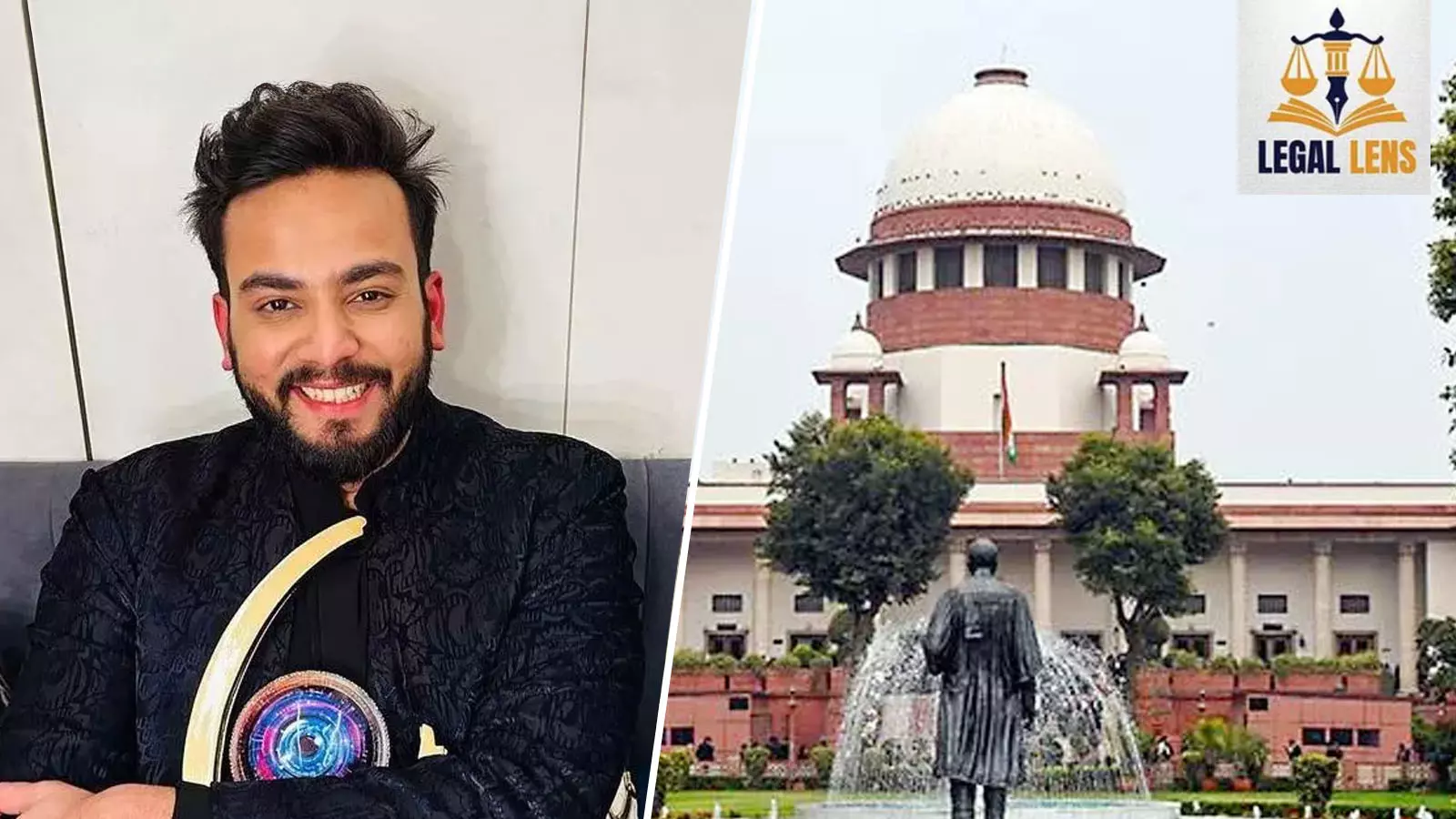
On March 19, the Supreme Court brought a close — at least for now — to one of the more unusual criminal prosecutions of recent years. Justices MM Sundresh and N Kotiswar Singh quashed the FIR, the chargesheet, and all court proceedings against YouTuber Elvish Yadav in a case that began with allegations of snake venom being used as a party drug at a rave in Noida.
The two-and-a-half-year legal saga, which saw Yadav arrested, vilified in the press, and then exonerated on procedural grounds, raises important questions not only about how criminal law is invoked against public figures, but also about who has the authority to set the law in motion in the first place.
How it began
In November 2023, Uttar Pradesh Police registered a First Information Report — the document that formally records a criminal complaint and sets an investigation in motion — against Yadav at the Sector 49 police station in Noida. The complaint came from Gaurav Gupta, an activist associated with People For Animals (PFA), an animal welfare organisation.
The allegation was that Yadav had misused snakes and their venom: first for YouTube content, and second by allegedly supplying venom to be consumed recreationally at rave parties attended by Indian and foreign nationals in the Delhi-NCR region.
Also read: Elvish Yadav grilled by Noida police in snake venom case
The case attracted enormous media attention, partly because Yadav had just won Bigg Boss OTT 2, and partly because the claim that snake venom could be used as a recreational drug was sensational enough to generate its own news cycle. The Federal covered the science at the time: whether snake venom could actually produce a high, and how dangerous such experimentation would be.
Yadav consistently denied the allegations, and his lawyers pointed out from the start that no snakes, no narcotics, and no banned substances were recovered from him personally. He was arrested in early 2024 and released on bail shortly thereafter.
His legal team made an argument that deserves attention now that the Supreme Court has vindicated it: that the police, "influenced by media attention", deliberately made the case more serious after Yadav's arrest by invoking the harshest provisions of the drug laws — provisions that carry severe penalties and that were grafted on to the case even though the evidentiary foundation for them was absent.
The charges, and why they collapsed
The chargesheet against Yadav invoked three separate bodies of law simultaneously: the Wildlife (Protection) Act, 1972; the Narcotic Drugs and Psychotropic Substances Act (NDPS), 1985; and the Indian Penal Code (IPC). The Supreme Court limited itself to two precise legal questions: whether the NDPS Act applied at all, and whether the Wildlife Act proceedings had been validly initiated. On both questions, it found against the prosecution.
On the NDPS Act, the critical fact was this: what authorities had described as "snake venom" — recovered not from Yadav himself but from a co-accused — did not fall within the ambit of Section 2(23) of the NDPS Act, which defines psychotropic substances by reference to a government-maintained schedule. That schedule does not include snake venom.
Also read: Who is a worker? SC Bench to revisit landmark 1978 ruling
The prosecution itself conceded the point before the Bench. Since the NDPS Act did not apply to the substance in question, and since no recovery of any kind had been made from Yadav personally — the chargesheet alleged only that he had placed orders through an associate — the drug charges had no legal foundation.
Route for private citizens
The Wildlife Act issue was more structurally significant, and it turns on Section 55. That section says that no court can take cognisance of a wildlife offence except on a complaint made by a designated government authority: the Director of Wildlife Preservation, the Chief Wildlife Warden of the state, or an officer authorised by either of them.
There is also a route for private citizens, but it requires giving 60 days' advance written notice to the appropriate authority before filing a complaint, so that the government has the opportunity to step in and act first.
This is a deliberate legislative filter: Parliament specifically chose to prevent private parties from independently triggering criminal proceedings under wildlife law, because the potential for misuse — to target individuals, to run personal vendettas, to convert publicity into prosecution — is obvious.
Built on sand
Gaurav Gupta was none of the above. He was not a designated wildlife officer. There is no indication in any court report that he gave the required 60 days' notice. The FIR was therefore lodged in breach of the precondition that the legislature had specifically imposed.
The Supreme Court also noted that it had doubts about Gupta's bona fides. When the FIR itself is invalid, everything that followed from it — the chargesheet, the trial court's decision to take cognisance, the summons — is built on sand and must fall away.
The IPC charges had a simpler problem. They were derived from a separate FIR registered in Gurugram against other individuals entirely, a case that had already been closed for lack of evidence. You cannot sustain criminal charges in one case that are entirely dependent on allegations from another case involving different people that has already been shut down.
What it doesn't mean
It is important to understand what the Supreme Court's order does not mean. The Bench was explicit: it did not examine whether Yadav was innocent or guilty of the underlying allegations. Justice Sundresh remarked that the court was "not going to give a clean chit to this person" and that if he had done something wrong, action must follow.
Also read: Indian courts have an AI problem, and the Supreme Court is not amused
The order grants the competent wildlife authority — a properly authorised government officer — the liberty to file a fresh complaint under Section 55 of the Wildlife Act if it has the evidence and the will to do so. The case has collapsed, but the door has been left open.
Yadav, who described himself as "very happy from within" after the ruling, struck a more complicated note in a video statement. "I have just one question," he said. "Who will compensate for the harassment that my family and I faced? Will anyone apologise for the false narratives and the turmoil created?"
It is the kind of question that does not have a legal answer. Indian law does not provide a general remedy for reputational damage caused by a prosecution that falls apart on procedural grounds, still less for the harm caused by two years of saturated media coverage of allegations that were never tested on their merits.
What this tells us about the law
The Elvish Yadav case is, at one level, a story about a YouTuber who escaped prosecution. At another level, it is a cautionary tale about what happens when criminal law is triggered by public outrage rather than legal rigour.
Police registered an FIR on the complaint of a private party who had no authority under the relevant law to file one. The chargesheet invoked a drug law that did not apply to the substance in question. Courts allowed proceedings to run for over two years.
Whether he misused snakes or not, the lesson here is procedural: the law imposes conditions on who can complain and under what statutes for good reason. When those conditions are ignored — as they were here, from the very first step — the criminal process itself becomes the punishment.