Trade unions in the dock? Reading the Constitutional stakes of the CJI’s remark
Judicial authority carries epistemic force; what might otherwise pass as an opinion acquires the tonal quality of institutional knowledge when voiced by a Bench

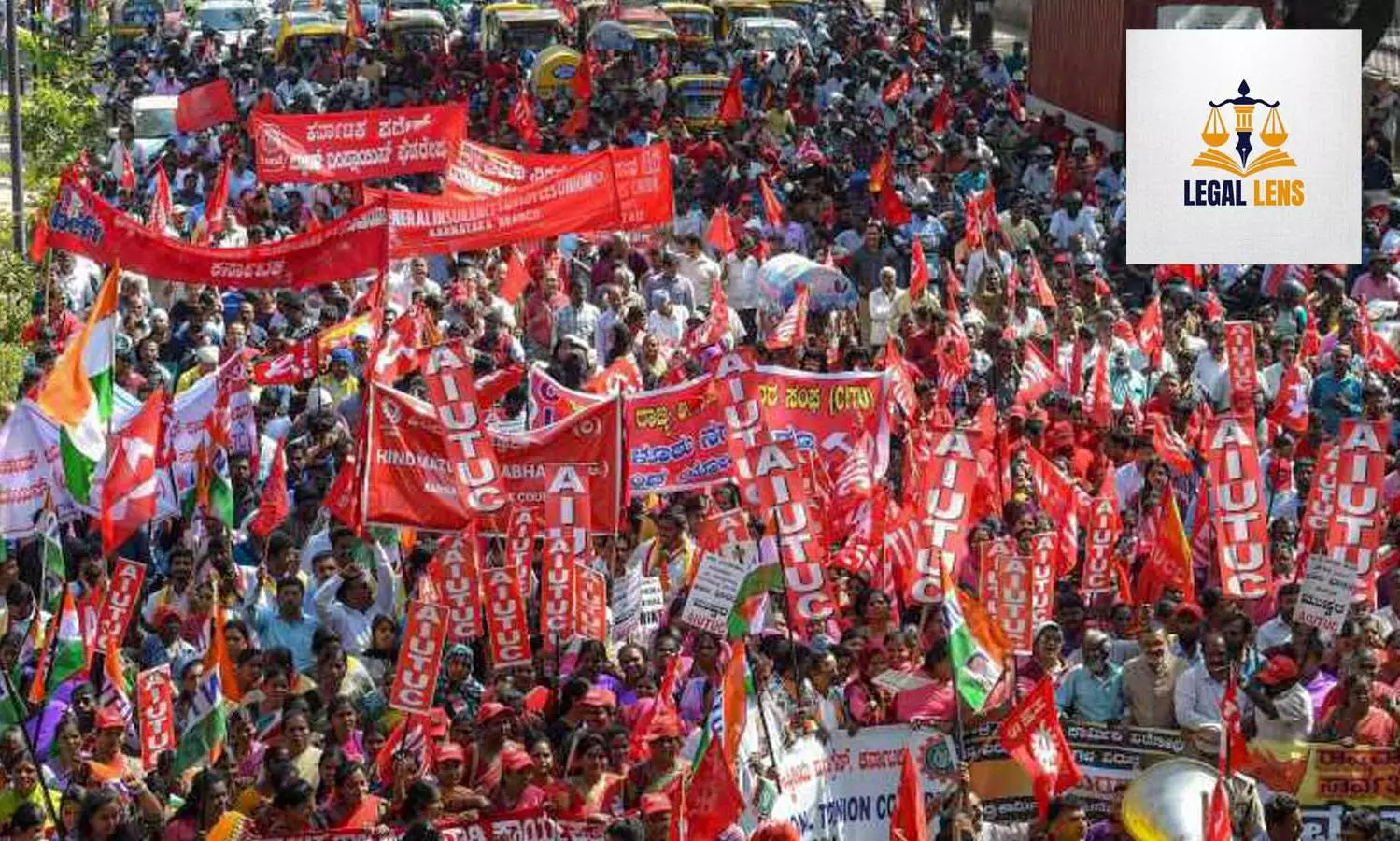
Oral observations from the Supreme Court often travel far beyond the courtroom, but some travel farther than others. When the Chief Justice of India(CJI), Surya Kant, recently remarked during a hearing that trade union leaders were “largely responsible for stopping industrial growth” and that many traditional industries had shut down because of “jhanda unions”, the statement quickly escaped the confines of a routine proceeding and entered the terrain of constitutional debate.
The CJI’s comment arose in the course of a petition concerning domestic workers’ welfare — a case the Court ultimately declined to entertain. Yet, the remark’s significance lies in what it signals about judicial engagement with labour questions.
When the head of the judiciary articulates a sweeping economic diagnosis, it inevitably raises institutional questions: how far should courts travel into macroeconomic commentary, and what happens when such commentary touches a constitutionally protected freedom?
A layered constitutional position of trade unions
To understand the unease the remark has generated, it is necessary to revisit the constitutional position of trade unions — a position more layered than public discourse often acknowledges.
The right to form associations is explicitly protected under Article 19(1)(c). From the early decades of constitutional adjudication, the Supreme Court recognised that workers must be free to organise. Yet the Court simultaneously resisted converting every instrument of collective bargaining into a fundamental right.
Also read: What Justice Bhuyan’s remarks on judicial transfers reveal about state of judicial independence
This calibrated approach first took authoritative shape in All India Bank Employees’ Association vs National Industrial Tribunal (1962), where the Court held that while workers possess the fundamental right to form unions, that right does not automatically extend to achieving every objective of the association — including an enforceable right to strike.
The judgment drew a conceptual boundary that has shaped Indian labour jurisprudence ever since: associational freedom is fundamental, but the modalities of industrial action remain subject to regulation.
Balance between two competing constitutional intuitions
Subsequent cases refined this position rather than abandoning it. In Kameshwar Prasad vs State of Bihar (1962), the Court protected peaceful demonstrations by government employees but permitted restrictions on strikes, thereby acknowledging protest as a democratic expression while treating work stoppages with greater caution. Later, in BR Singh vs Union of India (1989), the Court went further, describing strike — in an appropriate context — as a recognised weapon in the workers’ armoury, even if not elevated to the status of a fundamental right.
The jurisprudential pendulum, however, swung towards restraint in TK Rangarajan vs Government of Tamil Nadu (2003), where the Court categorically held that government employees possess no fundamental right to strike. The ruling reflected judicial anxiety about administrative paralysis and essential services — concerns that frequently surface when courts confront labour militancy.
Taken together, these cases reveal a Court historically engaged in balancing two competing constitutional intuitions: the democratic legitimacy of collective worker voice and the systemic need for economic continuity. It is precisely this delicate balance that makes broad judicial generalisations about unionism institutionally consequential.
Why judiciary must be more discreet
The Chief Justice’s remark appears to rest on a recognisable economic argument — that excessive unionisation can deter investment, trigger industrial closures, and reduce competitiveness. Versions of this thesis have circulated globally since the late twentieth century, particularly in debates around labour flexibility and market reform. Yet constitutional adjudication demands a discipline distinct from policy discourse: generalised economic claims ordinarily require evidentiary grounding.
Also read: Why Supreme Court is concerned with marriage battles choking its docket
The difficulty is not that judges should remain silent about economic consequences. Courts routinely engage in predictive reasoning, asking whether a particular remedy might produce unintended outcomes. The challenge arises when such reasoning assumes the form of historical assertion — for instance, that traditional industries across the country closed because of union activity — without the benefit of a factual record tested through adversarial process.
Judicial authority carries epistemic force. What might otherwise pass as an opinion acquires the tonal quality of institutional knowledge when voiced from the Bench.
Academic perspectives
Academic scholarship on labour offers a useful lens through which to read this moment. Writing on labour regulation in developing economies, Professor Kamala Sankaran has consistently argued that labour rights must be understood not merely as market variables but as entitlements rooted in dignity and citizenship. Where vast segments of the workforce remain informal, she suggests, collective organisation often serves as the primary vehicle through which workers access the constitutional promise of equality. (See her paper titled Labour Laws in South Asia: The need for an inclusive approach, International Institute for Labour Studies, Geneva, 2007, p.11 and her article, Emerging Perspectives in Labour Regulation in the Wake of COVID-19 published in the Indian Journal of Labour Economics in 2020)
Seen from that perspective, unions are not distortions within the economic order; they are mediating institutions that help reconcile markets with democratic legitimacy.
A related insight emerges from the work of Professor Babu Mathew, who has long examined the political economy of labour law in India. Mathew’s scholarship warns that regulatory reform frequently alters bargaining power in subtle ways, sometimes privileging capital mobility unless counterbalanced by effective worker representation. The health of industrial relations, in this view, depends less on the absence of unions than on the presence of credible negotiating frameworks. (See his article co-authored with Kavya Bharadkar, The Journey of Labour Regulation, Seminar, February 2021 and his article, Political Economy of Industrial - Relations Law in India, Artha - Journal of Social Sciences, published by the Christ University Institute of Social Sciences, Bengaluru, Vol. I, No. 1, 2022, pp.1-9)
Also read: Supreme Court stay on UGC Equity Rule | Justice Vs Injustice decoded| AI with Sanket
These academic perspectives do not deny that industrial conflict can damage productivity. Rather, they caution against monocausal explanations. Industrial decline is rarely attributable to a single factor; it typically reflects technological change, credit conditions, managerial strategy, global competition, and policy design. To assign primary responsibility to unions without sector-specific analysis risks oversimplifying a complex economic history.
It is here that the institutional question becomes unavoidable: should a Chief Justice articulate such a thesis in open court?
How to read the CJI’s observation?
There is no constitutional prohibition against judicial candour. Courts are not expected to operate in economic abstraction. Yet the legitimacy of judicial speech often depends on proportionality — the alignment between the breadth of a remark and the material before the Court. When a case concerns labour welfare rather than industrial closure, a sweeping indictment of unionism may appear to outrun the immediate controversy.
Equally important is the signalling function of the Supreme Court. Lower courts, administrators, and employers listen closely to the tone set at the apex. Even when not forming part of a binding order, such observations can subtly shape the interpretive climate in which labour disputes are resolved. For trade unions, the apprehension is less about criticism than about the possibility that constitutionally protected activity may acquire an aura of judicial scepticism.
Yet it would be reductive to read the remark solely as hostility towards organised labour. One might instead interpret it as reflecting a longstanding judicial concern about economic disruption — a concern visible in cases involving essential services, public-sector strikes, and administrative continuity. Courts have often viewed themselves as guardians not only of rights but also of institutional stability.
The need for discretion
The deeper issue, therefore, is not whether judges may speak about economic realities, but how carefully they must do so when constitutional freedoms are implicated. Associational rights occupy a foundational place within democratic structure. If courts appear to treat unions primarily as impediments rather than participants in industrial democracy, the symbolic balance shifts.
Also read: CJI Surya Kant: Mediation is cost-effective, win-win for litigants
History offers a quiet reminder here. The framers placed the freedom to form associations alongside speech and assembly because they understood that democracy extends beyond electoral participation into the everyday spaces where power is negotiated — workplaces among them.
What the present controversy ultimately reveals is less a doctrinal rupture than a recurring judicial dilemma. Courts must navigate the space between rights and consequences, between democratic participation and economic anxiety. That navigation becomes particularly delicate when the Chief Justice speaks, for his words resonate not merely as personal reflections but as markers of institutional mood.
The freedom to associate
The domestic workers’ petition that occasioned the remark has already been dismissed at the threshold, but the constitutional conversation it inadvertently sparked is unlikely to fade. Trade unions remain embedded in India’s labour architecture, and the jurisprudence protecting their formation endures.
The question now is not whether courts should engage with the economic dimensions of labour disputes — they inevitably will — but whether such engagement can remain anchored in the evidentiary discipline and constitutional memory that judicial authority demands.
For when the Court speaks about institutions that organise worker voice, it does more than comment on economic history. It shapes the normative horizon within which the freedom to associate continues to be understood.