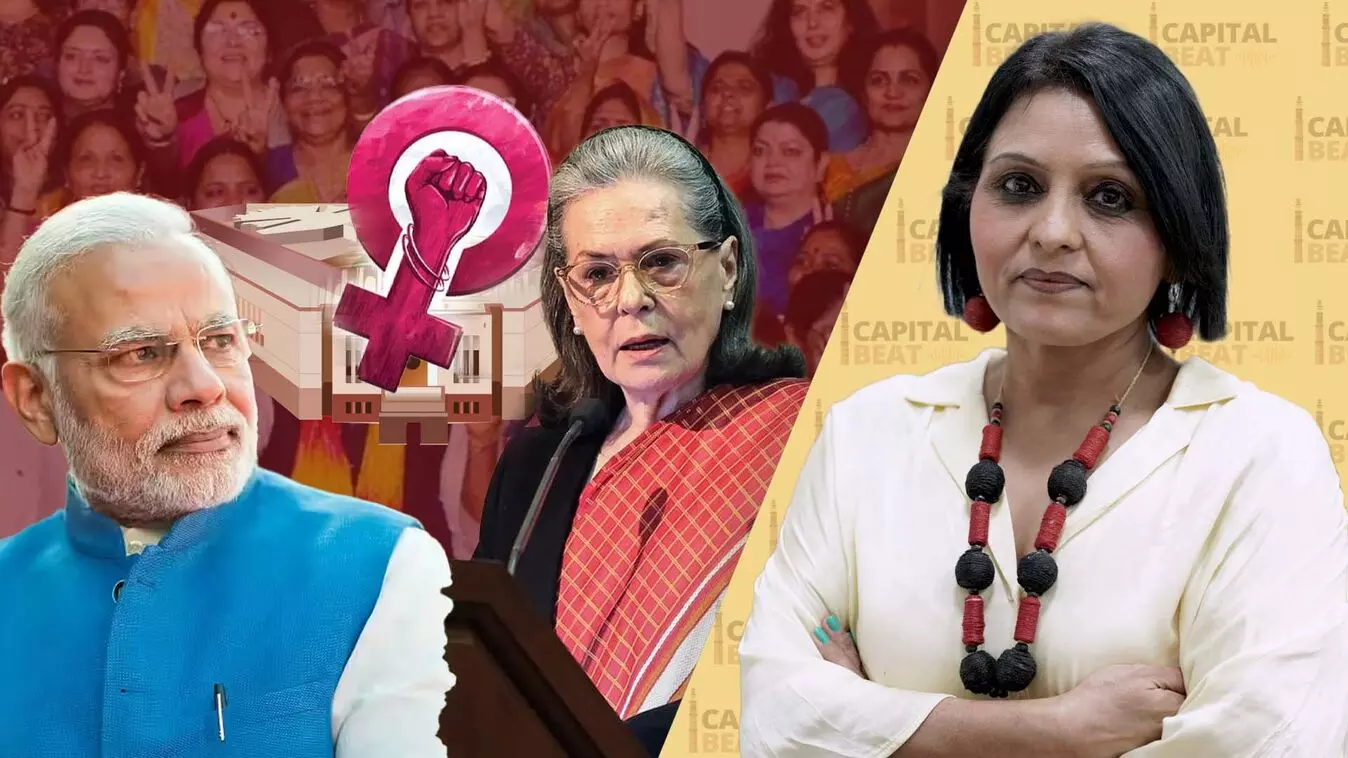
Women’s quota and delimitation: Experts flag lack of consultation | Capital Beat
With voting scheduled and stakes high, coming days will determine whether the legislation marks a transformative reform or deepens existing political divides

As Parliament convened for a special session to consider key legislations, including the Constitution (131st Amendment) Bill, the Delimitation Bill, and the Union Territories laws amendment, the debate has quickly escalated into a larger political confrontation.
In this episode of Capital Beat, The Federal spoke to political analyst R Kannan, BJP leader Rachana Reddy, author Vinod Kumar, and Supreme Court lawyer Harsha Azad to unpack the implications of linking women’s reservation with delimitation.
Modi’s pitch
Prime Minister Narendra Modi strongly defended women’s reservation in Parliament, urging parties not to politicise the issue.
He described the legislation as an opportunity to “add a new chapter to Vikas Bharat” and dismissed Opposition concerns as “technical bahanebazi (making excuses).” In a symbolic remark, he referred to DMK MPs wearing black outfits as a “kala tika” — a sign of auspicious beginnings in Indian tradition.
Modi also signalled confidence in the bill’s passage, even as questions remain over whether the government has the required two-thirds majority in both Houses.
Opposition concerns
The Opposition’s central argument revolved around the linking of women’s reservation with delimitation.
Congress MP Gaurav Gogoi questioned the Centre’s intent, asking why the increase in Lok Sabha seats—reportedly up to 850—was being tied to delimitation.
Also read: Is BJP electoral juggernaut deciding the shape of women’s quota, delimitation bills?
Similarly, KC Venugopal urged the government to withdraw the bill and initiate broader consultations, warning that the move could diminish representation of certain states.
Critics argue that delimitation cannot proceed without a fresh census, which remains uncertain. They also see the linkage as a strategic move that could alter political balances ahead of future elections.
Tamil Nadu view
R Kannan emphasised that the issue goes beyond technicalities and strikes at the heart of India’s federal structure.
“Women’s reservation is actually a red herring,” he said, questioning the Centre’s intent behind linking it to delimitation. “We don’t know why it’s being rushed through,” he said, pointing to the absence of clarity on the terms of reference and the timing of the move during election cycles.
He warned that southern states could see their share of parliamentary representation fall from 24.3 per cent to 20.7 per cent after delimitation. While Tamil Nadu’s seat count may rise from 39 to nearly 58, its proportional share would decline.
Also read: Women’s reservation a smokescreen for delimitation, warns activist Anjali Bhardwaj
Kannan also highlighted alternative models, including a hybrid formula proposed by Telangana’s leadership, combining population and economic contribution, as well as international examples like the United States and European Union.
Political divide
Despite concerns, Kannan noted that political unity on the issue is lacking.
“Even in Tamil Nadu, one of the Dravidian majors is supportive of the Centre’s move,” he said, suggesting that Opposition remains fragmented.
He attributed Tamil Nadu’s strong resistance to its political culture, where opposition to the BJP forms a central axis. This, he argued, makes the issue politically rewarding for the ruling DMK.
However, he cautioned against comparing the current moment to the anti-Hindi agitations of the 1960s, describing those as far more intense and historically significant.
BJP defence
Rachana Reddy defended the government’s position, arguing that the linkage between women’s reservation and delimitation was not new.
Also read: ‘Look at the intention’: BJP leaders defend delimitation-women’s quota link
“When the bill was initially passed two years ago, it clearly stated that implementation would follow delimitation,” she said, adding that the current move merely follows that framework.
She questioned why increasing Lok Sabha seats should be seen negatively and challenged the opposition’s shift in stance, calling it inconsistent.
Alternate perspective
Vinod Kumar offered a contrarian view, arguing that northern states could actually lose out under the proposed changes.
He pointed to disparities in representation, noting that states with similar populations currently have unequal seat allocations. For instance, Tamil Nadu has 39 seats compared to Gujarat’s 26 despite similar population levels.
“Southern states always play the victim card,” he said, adding that proportional representation based on population should be applied consistently.
Also read: BJP-leaning states to gain from delimitation, says Yogendra Yadav | AI With Sanket
He also framed the debate as part of broader political strategies, with both the government and Opposition leveraging the issue for electoral advantage.
Legal questions
Supreme Court lawyer Harsha Azad raised concerns about the legal and institutional framework underpinning delimitation.
She explained that while delimitation aims to ensure proportional representation, courts have historically been reluctant to intervene in such exercises, treating them as political questions.
“This is a new system they are trying to bring about,” she said, referring to the linkage with women’s reservation. “It has never been tested before.”
Azad also questioned the independence of delimitation bodies, arguing that they operate under government control, raising doubts about their neutrality.
Process concerns
A recurring theme across the discussion was the lack of consultation.
Kannan stressed the need for a more deliberative approach, suggesting that delimitation could be based on the 2027 census rather than outdated 2011 figures.
Also read: What is gerrymandering, and why is everyone suddenly talking about it?
“This needed extensive consultations,” he said, adding that the current approach reflects a breakdown in trust between the government and the Opposition.
Azad echoed this sentiment, calling for the bill to be withdrawn and reworked through a consultative process.
Uncertain outcome
As the debate unfolds, the bill’s fate remains uncertain. While the government appears confident, the requirement of a two-thirds majority makes the outcome difficult to predict.
Vinod Kumar described the situation as a “win-win” for the government. “If the bill is passed, they take credit. If it fails, they blame the Opposition,” he said.
With voting scheduled and political stakes high, the coming days will determine whether the legislation marks a transformative reform or deepens existing political divides.
(The content above has been transcribed from video using a fine-tuned AI model. To ensure accuracy, quality, and editorial integrity, we employ a Human-In-The-Loop (HITL) process. While AI assists in creating the initial draft, our experienced editorial team carefully reviews, edits, and refines the content before publication. At The Federal, we combine the efficiency of AI with the expertise of human editors to deliver reliable and insightful journalism.)