What Mahabalipuram meet said about South’s changing federal politics
While Vijay sought to expand voice beyond TN, Naidu pursued development, Satheesan attempted to alter Keralam's ties with Centre, DK Shivakumar opted for diplomacy

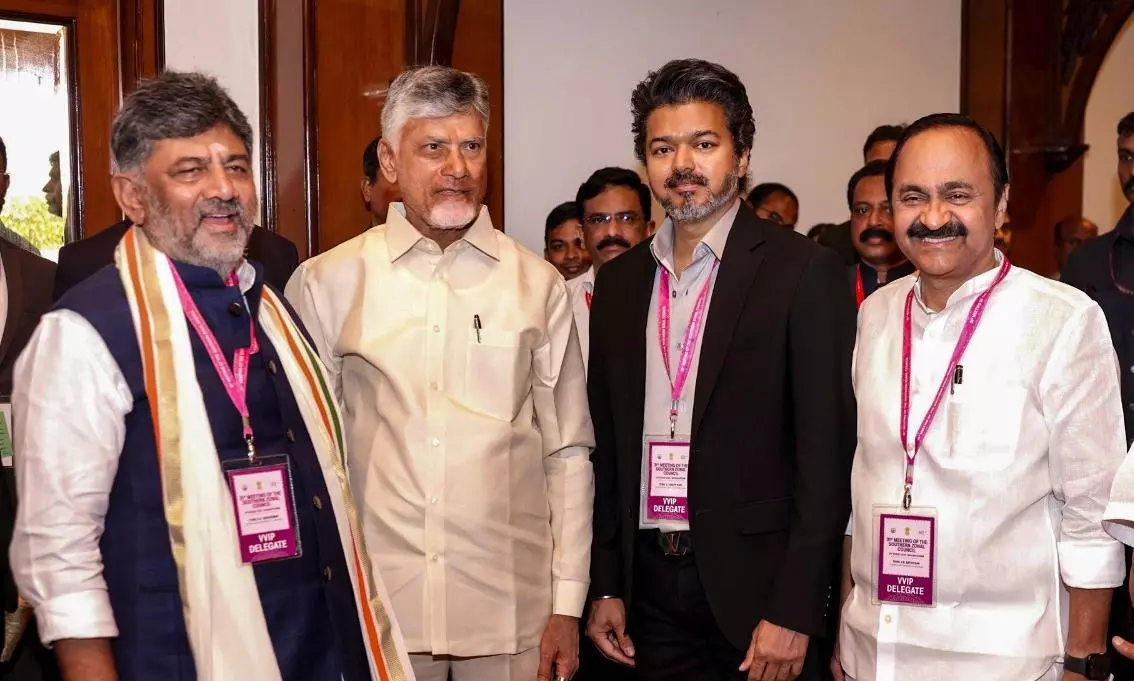
The 31st Southern Zonal Council meeting at Mahabalipuram, 57 km south of Chennai, brought together a South India that is politically different from the one that existed when the previous such meetings were held.
Four of the five states have the Congress in government — the party directly governs Telangana, Kerala and Karnataka, and is part of the TVK-led coalition in Tamil Nadu. Andhra Pradesh, the fifth state, is governed by N Chandrababu Naidu's TDP, an ally of the BJP-led NDA.
The mix made Thursday's (August 20) meeting, chaired by Union Home Minister Amit Shah, more than a routine exercise in resolving inter-state disputes. It provided a platform for governments with very different political relationships with the Centre to interact at a time when questions of political representation, fiscal federalism and the balance of power between Delhi and the states are becoming increasingly important.
TVK’s rise in Tamil Nadu
Tamil Nadu, and the political experiment led by actor-turned-politician C Joseph Vijay, gave the meeting a distinctive character. There was mounting speculation that Vijay has been softening his stance towards the BJP, which the party leadership has vehemently denied.
Also read: South CMs’ meet: Water issues dominate talks; no formal Vijay-DKS meeting
The TVK emerged as the single largest party in the 2026 Assembly election with 108 of the 234 seats, and subsequently formed a government with the support of the Congress, VCK, IUML and the Left parties. The Congress's decision to leave its long-standing alliance with the DMK and support Vijay has fundamentally altered Tamil Nadu's political equations. The DMK has been pushed into the principal Opposition role.
Vijay's rise was built around a political promise combining Tamil identity, social justice and state rights with opposition to the BJP's political expansion in Tamil Nadu. The TVK's post-election arrangements have now brought it into a working relationship with the Congress and Left parties, giving the new government a political configuration very different from the BJP-led governments in much of northern India.
Taking on the Centre
The Mahabalipuram (officially, Mamallapuram) meeting gave Vijay an opportunity to take that politics from the state arena to a larger federal platform. His predecessor MK Stalin’s tenure was defined by sharp federal confrontation such as public battles over NEET, Governor delays on Bills, education fund releases tied to the three-language formula, and repeated accusations of “fascist” central overreach. The DMK positioned itself as the primary ideological and political counter to the BJP in the South.
As a new entrant into politics, Vijay had declared the BJP his “ideological enemy” and “fascist”, while branding the DMK his “political enemy”. However, after becoming the Chief Minister, his tone shifted to administrative pragmatism. Analysts note that opposing the BJP ideologically does not, for Vijay, mean opposing every interaction with the Centre.
Also read: At South CMs’ meet, Shivakumar defends Mekedatu project, says ‘water should not divide us’
However, the TVK leadership denied that there had been any softening of its stance towards the BJP. “There is no room even for the talk that the TVK is moving closer to the BJP,” KG Arunraj, Tamil Nadu minister for health and family welfare, told The Federal. "Our leader has already clearly stated who our enemies are, and there is absolutely no confusion on that. It is our firm promise that we will not compromise on issues of the state’s rights, people’s welfare schemes, culture, or heritage in any way."
"However, after forming the government, we have also realised that there is no necessity to oppose the Central government on every matter," he added.
Cooperative federalism
At the conference, Vijay's intervention on delimitation was perhaps the most politically significant. He said there was a "genuine and shared concern" among the southern states that delimitation based predominantly on population could diminish their collective voice in Parliament. He initially supported a freeze on the existing 543 Lok Sabha seats for 25 years.
At Mahabalipuram, his formulation was somewhat more cautious. He sought an assurance that no southern state would lose its existing parliamentary representation.
Yet the larger political message remained intact. Vijay argued that the interests of the southern states could provide the basis for a wider federal conversation. "Strong states make a stronger India," was the thrust of his intervention, as he called for cooperative federalism and argued that shared economic interests and natural resources should unite the states rather than become sources of conflict.
He also raised Tamil Nadu's long-standing objections to NEET, the Cauvery river water dispute and concerns over the regulation of online medicines and narcotics. These are not merely administrative demands but issues that have traditionally formed part of Tamil Nadu's assertion of state autonomy.
"Governing requires different tools. Smooth Centre-state relations help deliver welfare and investment, which in turn consolidate TVK’s still-evolving organisation. Maintaining Congress and Left support preserves the secular firewall that was central to post-poll legitimacy," observed political commentator Dhayalan Shanmugam.
Keralam’s position more restrained
For the Congress, the Mahabalipuram meeting had another significance. With Congress governments now in Keralam, Karnataka and Telangana, the party has an unusually strong governmental presence across the South.
Karnataka Chief Minister DK Shivakumar was one of the strongest voices on delimitation, arguing that southern states should not be penalised for having successfully controlled population growth. Telangana, represented by Deputy Chief Minister Mallu Bhatti Vikramarka in the absence of Chief Minister A Revanth Reddy, also raised state-specific issues.
Also read: TN CM voices delimitation fears, wants Centre to assure it won’t hurt South
Keralam's position at Mahabalipuram was more restrained. The change in its political leadership from Pinarayi Vijayan's LDF to the Congress-led UDF has also changed the tone of the state's relationship with the Centre.
The Congress remains ideologically opposed to the BJP and is the principal national Opposition party at the Centre. But the VD Satheesan government has so far adopted a less visibly confrontational approach towards the Union government than the previous LDF administration.
Room for criticism
That shift has been a subject of political criticism in Keralam. The Opposition has cited Governor Rajendra Arlekar's interventions as examples, including the controversy over Vande Mataram at the swearing-in ceremony and the Governor's increasingly assertive role in university affairs.
His confrontations with student organisations, particularly the SFI, have also become a political issue. The criticism is that the new government has been less willing to turn such interventions into a direct confrontation with the Centre.
There has also been a noticeable difference in the language used in the Governor's address and the state Budget, where some of the sharper criticism of the Centre that had become characteristic of the previous LDF government has been absent.
The Mahabalipuram meeting offered another example of that change in political tone. Satheesan's own account of the meeting framed Keralam's position primarily around cooperation.
Proposal on Mullaperiyar
Apart from demanding the annulment of the recent amendments to the Mines and Minerals (Development and Regulation) Act to protect the state's control over coastal sand and mineral resources, the Chief Minister's presentation was largely matter-of-fact.
"Addressed the Southern Zonal Council meeting in Mahabalipuram chaired by Union Home Minister Shri Amit Shah. Pressed for cooperative federalism across healthcare funding, infrastructure, environmental protection, and regional security," Satheesan said in a statement.
That does not mean Keralam's demands were insignificant or that the disputes with the Centre have disappeared.
The southern leadership of the Congress could become an important federal counterweight to the BJP-led Centre, even as its governments in the states pursue their own priorities.
On the contentious issue of Mullaperiyar, Keralam made a proposal that attempted to separate Tamil Nadu's water requirement from its concerns over the existing structure. Satheesan said Keralam was willing to bear the entire cost of a new dam while allowing Tamil Nadu to decide its design, location and construction and receive its full water share. Tamil Nadu, however, rejected the proposal, reiterating that the existing dam was safe and that a new structure was unnecessary.
Naidu's developmental push
Andhra Pradesh offered a markedly different emphasis.
Naidu, who leads a government that is an ally of the BJP-led NDA, largely used the meeting to push the developmental requirements of the state and the wider economic potential of the South. He proposed a high-speed rail corridor linking Amaravati, Bengaluru and Chennai through Kuppam, along with a joint logistics network, dry ports and closer integration of the southern power grid with the national grid.
He pitched a larger economic vision as well, arguing that the South, which contributes around 31 per cent of India's GDP, could become a $10-trillion economy by 2047. Naidu also sought the resolution of long-pending issues arising from the bifurcation of Andhra Pradesh, including the division of assets and liabilities and pending commitments under the AP Reorganisation Act.
"Even though southern states achieve individual success, working together in unity will enable them to shape the very future of India. If the competition among states is channelled into collective strength, South India will be unstoppable," he said in a statement.
DKS wields his seniority
DK Shivakumar, rather than adopting his traditionally aggressive political style, appeared to have chosen a more mature and diplomatic approach while firmly putting forward Karnataka’s concerns. He appeared to have an advantage: he is currently one of the more senior and politically experienced Congress leaders among the South CMs. More importantly, he has developed personal and political relationships with several leaders across the southern states.
In his speech at Amit Shahʼs meeting, DKS said: "Andhra Pradesh Chief Minister Chandrababu Naidu told me that we need to resolve the Cauvery water issue between Karnataka and Tamil Nadu." This public acknowledgement highlighted the political understanding and personal rapport between the two leaders.
DKS has long carried the image of being the Congress party’s “troubleshooter”. He has been called upon by the party leadership to handle difficult political situations, negotiate with rival groups and manage crucial electoral battles. His apparent ambition now seems to be to extend that image from Karnataka to South Indian politics.
A southern voice
Vijay used the platform to establish himself as a southern voice on the larger question of political representation and federal power. Naidu concentrated on development, infrastructure and the unfinished business of Andhra Pradesh's bifurcation. Satheesan concentrated largely on specific negotiations involving Kerala's finances, infrastructure, environment and welfare.
Vijay is still defining what TVK means in Tamil Nadu after displacing the DMK from power and breaking the state's traditional political duopoly. His government has to establish itself as both a Tamil political force and a credible participant in national politics.
Naidu, meanwhile, has a more immediate developmental agenda. Andhra Pradesh's demands for infrastructure, industrial corridors, railway connectivity and financial commitments are closely tied to the state's post-bifurcation economic reconstruction.
Satheesan is leading a Congress government that has inherited a decade of LDF rule and is attempting to establish a different relationship with Delhi without abandoning Keralam's traditional demands for greater fiscal and political autonomy.
DKS appeared to understand that South India’s interests may be defended more effectively through a positive and collective political attitude rather than constant confrontation with the Centre. His tone was softer, but his political message was clear.
Shared concerns over delimitation
With Congress governments in Keralam, Karnataka and Telangana, the party has a substantial governmental presence across the South. At the same time, it remains the principal national Opposition to the BJP. The southern leadership of the Congress, therefore, could become an important federal counterweight to the BJP-led Centre, even as its governments in the states pursue their own priorities.
The Mahabalipuram meeting therefore offered a snapshot of a South India in political transition. There are shared concerns over delimitation, the distribution of resources and the balance between the Centre and the states. But there is no single southern political line.
The more important question is whether these governments can turn their overlapping interests into a common federal position, or whether the region's familiar inter-state rivalries and different political calculations will continue to keep its governments negotiating with Delhi separately.
(With inputs from Mahalingam Ponnusamy, Amaraiah Akula and Naveen Ammembala.)