



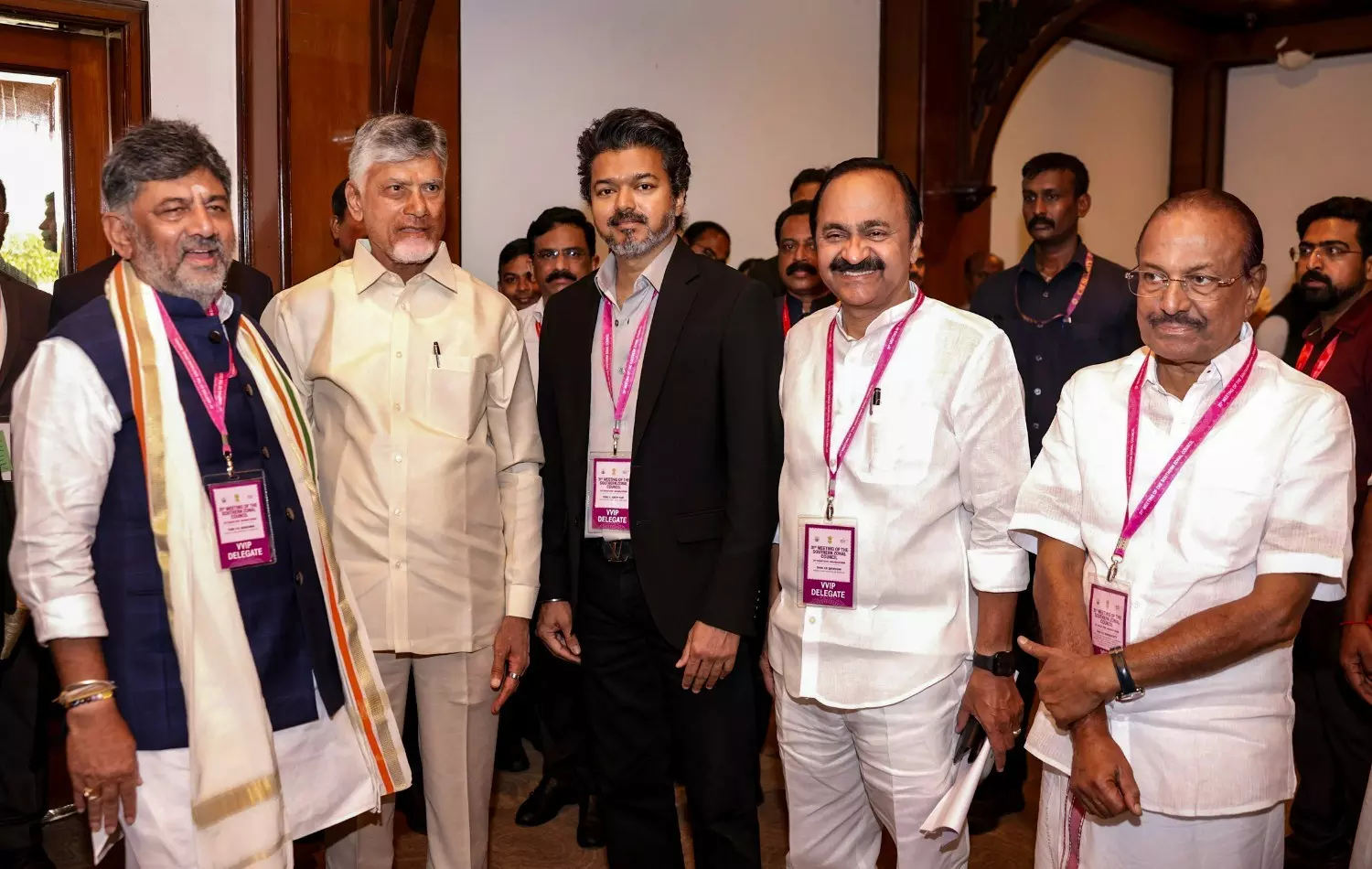
From left: Karnataka CM DK Shivakumar, Andhra Pradesh CM N Chandrababu Naidu, Tamil Nadu CM C Joseph Vijay, Keralam Chief Minister VD Satheesan and Keralam Minister for Industries and IT PK Kunhalikutty during the 31st Southern Regional Council meeting, in Mahabalipuram, Tamil Nadu, on Thursday (August 20). (@CMOTamilnadu/X via PTI Photo)
South CMs’ meet: Water issues dominate talks; no formal Vijay-DKS meeting
On the Cauvery River water, TN CM Vijay called for timely implementation of the Supreme Court order and the decisions of the Cauvery Water Management Authority (CWMA)

Water sharing, especially the Cauvery river and the Mullaperiyar dam, took centre stage at the 31st Southern Zonal Council meeting in Mahabalipuram, Tamil Nadu, on Thursday (August 20).
Leaders from Tamil Nadu, Karnataka, Andhra Pradesh and Puducherry raised the matter strongly during the main session and in private talks on the sidelines.
What TN CM Vijay said
Tamil Nadu Chief Minister C Joseph Vijay said in his speech that there can be no cooperation without sharing the rightful river water.
Also read: At South CMs’ meet, Shivakumar defends Mekedatu project, says ‘water should not divide us’
On the Cauvery river water, Vijay called for timely implementation of the Supreme Court order and the decisions of the Cauvery Water Management Authority (CWMA). On the Mullaperiyar dam, he insisted that the water level of the existing dam should be raised to 152 feet as per court rulings.
Vijay and Karnataka Chief Minister DK Shivakumar did not have a one-on-one interaction since the Cauvery river water issue is sub judice, according to Tamil Nadu Law Minister CRT Nirmalkumar.
Political observers believe Vijay meant that cooperation would be given only if water is released as per court judgments.
Karnataka CM: ‘Water must not divide us’
Shivakumar, who spoke later, said, “Water must unite us, not divide us. The time has come to move from water sharing to water cooperation.”
Also read: TN CM voices delimitation fears, wants Centre to assure it won’t hurt South
Observers see this as Karnataka indirectly asking Tamil Nadu to cooperate for the Mekedatu dam project or seeking help to use Cauvery water. This remains the central point of the water dispute between the two states.
He also said Karnataka respects its neighbours’ rights and expects the same in return, including its lawful share under tribunal awards and early completion of projects that take water to farmers.
Andhra CM proposes linking Godavari, Cauvery rivers
Andhra Pradesh Chief Minister N Chandrababu Naidu spoke about linking the Godavari and Cauvery rivers. He said the proposal to divert more than 500 TMC of water through this link could offer a lasting answer to Tamil Nadu’s water needs.
Naidu urged Andhra Pradesh, Telangana, Karnataka and Tamil Nadu to work together with better coordination on river waters. A long-term national plan is also needed for linking the Ganga and Cauvery, he said, and called for time-bound detailed project reports and clearances for such river-linking works.
Also read: South’s economic weight must match its political voice: Shivakumar at CMs’ meet
Puducherry Lieutenant Governor highlighted drinking-water problems in the Union Territory, which has no surface water of its own and depends on groundwater. He sought 7 TMC of Cauvery water for Karaikal every year and support to store excess monsoon water and recharge groundwater. He also asked for a dedicated pipeline from Sathanur dam and a joint working group with Tamil Nadu and the Centre.
Vijay meets Keralam CM
On the sidelines, Vijay held private talks with Keralam Chief Minister VD Satheesan. Kerala Industries and Information Technology Minister PK Kunhalikutty was also present.
Top sources said Satheesan told Vijay that Kerala is firm on building a new dam on the Mullaperiyar. “Tamil Nadu itself can handle the design and construction of the new dam. There is a chance to provide more water share to Tamil Nadu,” he reportedly said.
Keralam’s position is that it will give Tamil Nadu the water share that is due. The new dam can be built in the area before the existing civil structure. This would allow more water to be stored in the new dam and less in the old one, so safety issues with the old dam would not arise. Satheesan is also likely to raise the issue of stopping drug flow and interstate drug peddling across the border.
Tamil Nadu sources, however, made it clear that the state will not agree to demolish the existing dam, which is in good condition, while the 999-year lease agreement remains in force. In the main meeting, Vijay stuck to his stand that the water level of the present Mullaperiyar dam must be raised to 152 feet.
Can Zonal Council pass resolutions?
Senior journalist T Ramakrishnan said, “Kerala wants a new dam and claims it will give Tamil Nadu more water and better safety. But court judgments already exist. I do not think Tamil Nadu will agree to cooperate.”
On the dam’s safety, he added, “When AK Antony was Defence Minister, divers from the Navy were brought and studies conducted. The base, outer parts and foundation of the dam were examined. Based on various scientific studies that found the dam strong and in good condition, the Supreme Court ordered that the dam need not be demolished.”
Ramakrishnan further noted that the Zonal Council cannot pass resolutions on pending issues between states. “Chief Ministers have flagged the river water problems. In the meeting held in the presence of Home Minister Amit Shah, there has been an exchange of views among the Chief Ministers and broad ideas would have emerged. It is not certain whether this meeting will help get solutions. But a sub-committee can be formed on water-sharing issues in a way that does not affect court judgments.”
He also clarified the legal position. “Resolutions, recommendations or decisions of a Zonal Council have no binding legal force, executive power or coercive control. They are purely recommendatory and advisory. Governments at the Centre or in the states are not legally obliged to implement the advice. Implementation depends on the political will and cooperation of the governments concerned.”
