



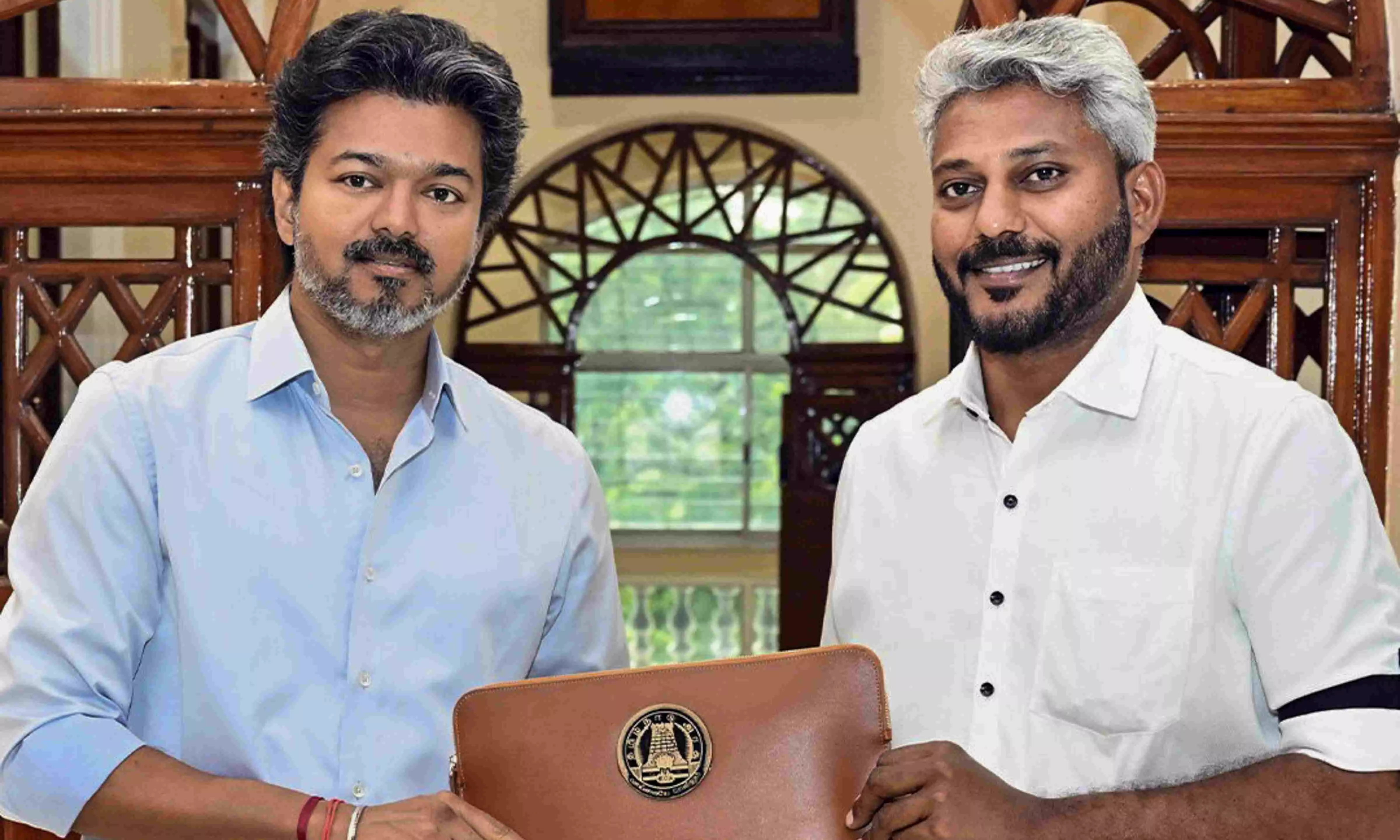
Finance Minister Mari Wilson clarified that the resolution only insists that Tamil Nadu receive its due financial devolution. Photo: PTI
Vijay govt moves resolution urging Centre for fairer devolution of taxes
Ask for more, say economic experts even as resolution receives support from arch rivals DMK and AIADMK

Amid much political rancor, Tamil Nadu parties are banding together to demand a larger share of funds from the Centre. The Joseph Vijay-led TVK government on Friday (August 8) moved and passed a special resolution in the Assembly, demanding “fair and equitable” financial devolution from the Union government. The resolution, introduced by state Finance Minister Mari Wilson, received support from both the DMK and the AIADMK before the Assembly adopted it unanimously by voice vote.
DMK leader and former Finance Minister Thangam Thennarasu welcomed the resolution, but proposed an important amendment. The fourth paragraph of the resolution must include an explicit provision ensuring 50 per cent devolution of the tax amount shared with the states from the taxes paid to the Union government, he said.
DMK seeks 50 per cent share
Thennarasu emphasised that the demand for 50 per cent devolution to the states, already urged by the Tamil Nadu government before the 16th Finance Commission, must be clearly reflected in the resolution. States’ revenue sources are continuously shrinking while their legal powers are being restricted, he said.
Also Read: Tamil Nadu budget highlights: USD 1.5 trillion economy target, Vetri laptop scheme, no-NEET push
At the same time, people’s expectations from state governments are rising. Expenditure responsibilities rest with the states, yet revenue sources are concentrated with the Union. Without correcting this imbalance, Tamil Nadu’s future growth cannot be assured, he warned.
Despite excellent fiscal discipline and tax collection efficiency, Tamil Nadu continues to be neglected in financial devolution, he claimed. For every rupee the State pays to the Union, it receives only 29 paise in return, while Uttar Pradesh receives Rs 2.73 and Bihar Rs 7.06. “We have no objection to funds being given to other states, but why is Tamil Nadu alone continuously neglected?” he asked.
Government clarifies stand
Mari Wilson clarified that the resolution seeks no special concession. It only insists that Tamil Nadu receive its due financial devolution in keeping with the constitutional principles of fiscal federalism and that the legitimate interests of progressive states receive proper recognition in future tax-sharing arrangements.
Also Read: TN Budget: TVK govt charts four-pillar plan to fix fiscal challenges
The government passed the special resolution by voice vote. The DMK’s demand to raise the devolution of funds to states from 41 per cent to 50 per cent was accepted and incorporated into the resolution.
Experts back demand
Economics Professor Jothi Sivagnanam told The Federal that the tax devolution has come down from 7-8 per cent to around 4 per cent precisely because states like Tamil Nadu are developing. When a state's population is high and revenue is low, the Centre allocates more funds.
Also Read: TN Budget: Critics slam 'Vetri' rebranding of existing welfare schemes
Tamil Nadu must press for a change, he said. More funds should not continue to be given to certain states without examining the outcomes. The vertical share from the Union, of which 41 per cent is to be allocated and divided among states, is itself being reduced. By increasing non-tax revenue and expanding cess and surcharge, the Centre is affecting the states, he said.
Sivagnanam further observed that after the Planning Commission was wound up, the NITI Aayog, created to manage controversies, has no real powers and functions only in name. The charge that non-BJP ruled states are not allocated their due funds is true, he asserted.
BJP cites allocations
Rejecting the accusation that the Centre is discriminating against Tamil Nadu and prioritising northern states in fund allocation, the BJP released numbers from 2014, when the Narendra Modi government came to power at the Centre.
Over the past decade, Tamil Nadu has received Rs 4.01 lakh crore as tax devolution and Rs 3 lakh crore as grants, it said. Compared with the Rs 1.52 lakh crore allocated during UPA rule, this is 4.60 times higher at Rs 7.02 lakh crore.
Also Read: Vijay govt prioritises Gen Z in debut Budget, nearly doubles youth welfare funds to Rs 1,051Cr
Including tax devolution and funds under central schemes, more than Rs 14 lakh crore has been provided. Tax devolution, which stood at Rs 94,871 crore during the Congress period (2004-14), was raised to Rs 4 lakh crore by the BJP government.
Grants under the Congress stood at Rs 57,925 crore. On August 1, the Centre released an additional instalment of Rs 1,09,019 crore as monthly financial devolution to states, of which Tamil Nadu received Rs 4,466 crore, the BJP stated.
Debate over figures
However, Jothi Sivagnanam cautioned that comparing raw numbers is misleading because the value of money keeps changing and the data sets are not comparable. The Centre’s contribution must be measured as a proportion of the State’s total GDP or total revenue. “If the Centre gave a subsidy of Rs 3 five years ago, today it is giving only Rs 1. Tax devolution has reduced by two-thirds,” he said.
Also Read: Soil conservation, Kuruvai support get priority in Vijay govt's maiden agri budget
He reiterated that 41 per cent of the total tax revenue should be shared with the states; of that, Tamil Nadu is allocated only about 4 per cent. The share has gradually declined from the earlier period when it was around 8 per cent (now 4.079 per cent).
Cess and surcharge collected by the Centre are not shared with the states. Declaring that funds will be released only if the BJP is elected is anarchy. Funds for Metro rail, school education and the PM SHRI scheme have been politicised and stopped, severely affecting the State’s finances, Sivagnanam said.
Political calculations
Senior journalist T Ramakrishnan said the TVK government appears to have decided to adopt a “soft” opposition stance against the Union government. Like the Chief Ministers of non-BJP ruled states such as Kerala and Karnataka, Vijay is also approaching the Centre in a similar manner. These Chief Ministers, without taking a hardline anti-BJP position, maintain good personal relations with Modi and are currently making efforts to secure funds.
Any closeness that the TVK, a new party, shows with the BJP could be politicised. Therefore, the TVK government may have brought this official resolution precisely to avoid appearing close to the BJP, he added. It is on this basis that Vijay has invited an all-party MPs’ meeting tomorrow (August 8) to discuss the issue of constituency delimitation, he said.
Even as the resolution on central tax devolution was passed in the Tamil Nadu Assembly today, Congress Rajya Sabha MP Praveen Chakravarthy, known to be ‘close’ to Vijay, met Union Finance Minister Nirmala Sitharaman in Delhi on Thursday (August 7). He discussed Tamil Nadu’s financial position, according to an official communication from the MP.
