



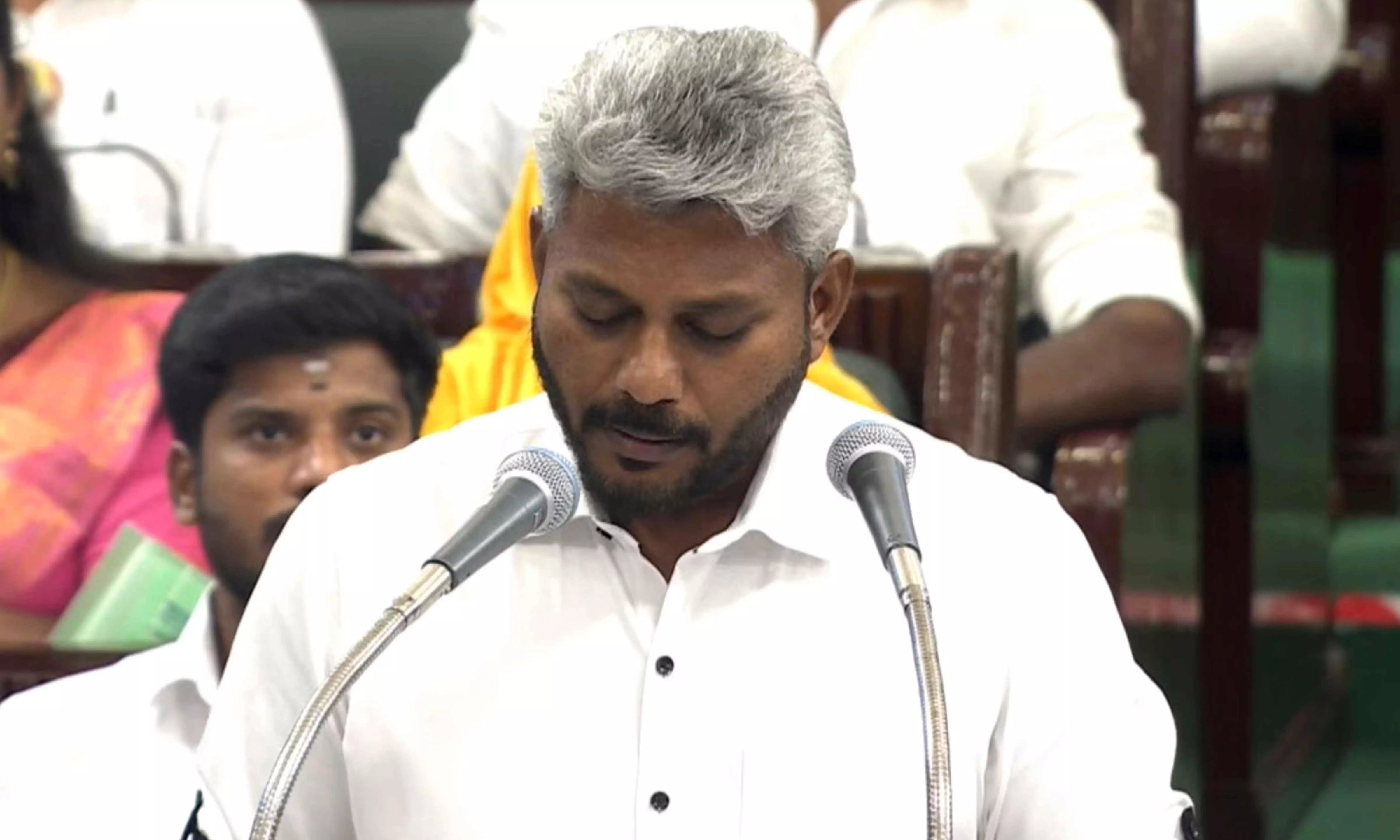
Tamil Nadu Finance Minister Marie Wilson acknowledged during his maiden Budget speech that fully restoring the state's financial administration would take at least two years. Photo: PTI
TN Budget: TVK govt charts four-pillar plan to fix fiscal challenges
Minister Wilson vows 'not a single paisa' of tax money will be misused, as government leans on tender reforms and tech-driven tax collection to recover lost revenue

In his maiden Budget for 2026-27 presented in the Tamil Nadu Legislative Assembly, Finance Minister N Marie Wilson outlined a clear multi-year strategy to stabilise and revive the state’s finances, which he said had been left in distress by the previous DMK government’s poor administration, revenue leakages and unchecked borrowings.
The Tamilaga Vettri Kazhagam (TVK) government, led by Chief Minister C Joseph Vijay, released a White Paper on Financial Management in June shortly after assuming office.
Inherited financial crisis
It showed that Tamil Nadu’s debt had roughly doubled over the past five years to about Rs 10 lakh crore. Outstanding liabilities are estimated at around Rs 10.99 lakh crore (Rs 10,98,768 crore in the Revised Budget Estimates), equating to about 27 per cent of GSDP.
Also read: Tamil Nadu budget highlights: USD 1.5 trillion economy target, Vetri laptop scheme, no-NEET push
Interest payments alone are projected at Rs 78,683 crore in 2026-27, consuming a significant share of revenue receipts and leaving limited room for fresh development spending. Revenue deficit stands at Rs 55,775 crore, and the fiscal deficit stands at Rs 1,21,819 crore.
Blame on previous governments
These figures echo campaign criticisms by the TVK leadership that successive DMK and AIADMK governments had strained the treasury through high borrowing without matching resource mobilisation, systemic leakages in revenue departments, and short-term political spending.
The speech stopped short of a new “revelation” of specific corruption cases, but repeatedly attributed the distress to poor administration and leakages under the previous regime, while stressing that clean, transparent governance is now the foundation of recovery.
Early actions against tender cartels and planning-permission corruption were cited as evidence of the new resolve: “We will not touch a single paisa of the people’s tax money.”
Roadmap
The TVK government’s roadmap to address the inherited fiscal challenges rests on four interconnected pillars. First, it prioritises plugging revenue leakages and mobilising additional resources: an extra privilege fee on liquor manufacturers is expected to bring in up to Rs 1,000 crore annually, while technology-driven initiatives such as Faceless Assessment under GST, Faceless Registration and end-to-end computerisation of mining are projected to generate around Rs 15,000 crore.
Also read: Vijay govt prioritises Gen Z in debut Budget, nearly doubles youth welfare funds to Rs 1,051Cr
Review Committees
Second, expenditure rationalisation and transparency measures include abolishing the requirement for mandatory unnecessary certificates in public tenders, opening eligibility to contractors registered with any government department, and relaxing criteria for low-value procurements to encourage new and small businesses steps that have already begun delivering cost savings. A high-level Expenditure Reforms Committee will review schemes for impact, enhance the productivity of service delivery and ensure resources reach intended beneficiaries without restricting genuine welfare expansion, while capital expenditure is prioritised for growth within the bounds of fiscal discipline, with medium-term projections showing a rising capital outlay.
Also read: Widening revenue deficit, growing debt: TVK white paper signals TN fiscal crisis
Third, the government seeks balanced continuity of welfare with fiscal sustainability by continuing and expanding most public welfare schemes, including the public distribution system that has operated for three decades, viewing them as investments in human capital rather than mere largesse
However, it stresses the need for a calibrated balance with physical infrastructure, noting that without sustained revenue efforts these schemes cannot be continued indefinitely.
An immediate measure is the cooperative crop-loan waiver offering full waiver up to Rs 75,000 and partial waiver of Rs 35,000 for others, covering 14.43 lakh farmers at a total cost of Rs 5,932 crore.
Fiscal plan
