







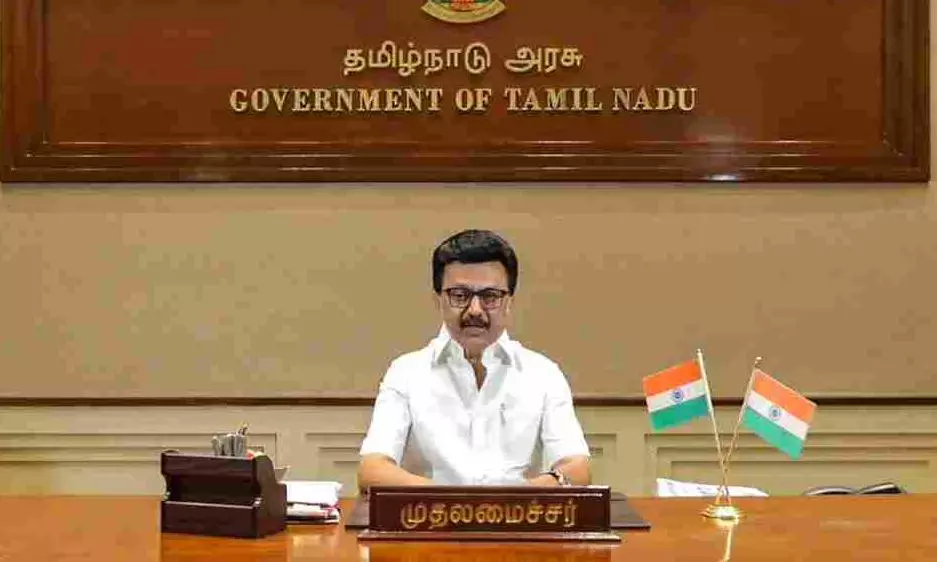
Stalin cites Indonesia's experiment to warn against One Nation, One Election
When Indonesia held simultaneous polls in 2019, nearly 900 workers died; its constitutional court ordered that the practice be abandoned from 2029, writes Stalin

Tamil Nadu Chief Minister MK Stalin has cautioned against India's proposed 'One Nation, One Election' (ONOE) policy, invoking Indonesia's experience of simultaneous polling as a "cautionary lesson" and arguing that the constitutional amendment underpinning the proposal risks violating the basic structure of the Constitution.
Writing in The Hindu, Stalin recalled that Indonesia's 2019 one-day simultaneous election — held to cut costs and simplify administration — resulted in nearly 900 poll worker deaths and over 5,000 serious illnesses. Even after reforms, the 2024 election saw more than 100 deaths and nearly 15,000 cases of illness.
Also read | TN panel report slams governor office 'misuse', recommends fixed 5-year tenure
In June 2025, Indonesia's Constitutional Court ordered that national and local elections be held separately from 2029, citing voter and administrator overload.
'Polls are not an overhead'
"Elections are not an overhead to be minimised but the recurring price of self-government, ensuring that power remains answerable to the people," Stalin wrote.
How simultaneous polls went wrong in Indonesia
♦ Each poll worker handled five simultaneous ballots in one day
♦ At least 569 election officers died; thousands fell ill
♦ Workers with chronic conditions forgot medications amid the workload
♦ Workers were paid as little as $35 for the entire period
♦ The Constitutional Court ordered separate elections from 2029
Counterview: Statistically, around 548 deaths were expected among 7 million workers anyway, in line with WHO mortality data
The Tamil Nadu Chief Minister argued that the Constitution (129th Amendment) Bill, 2024 — which proposes a new Article 82A to align all state assembly tenures with the Lok Sabha cycle — would allow state mandates to be truncated not because legislative confidence had collapsed, but purely to serve a national electoral calendar.
A state electing its legislature in 2033, he noted, could be left with a mandate of just one year if ONOE came into force in 2029.
'Quasi-presidential rule'
Stalin said the proposal subtly pushes India toward a "quasi-presidential model" that weakens legislative accountability, reversing the foundational logic of parliamentary democracy. Citing Dr BR Ambedkar's observations in the Constituent Assembly, he wrote that India had deliberately chosen executive responsibility over guaranteed tenure.
Watch/Read | EC's SIR in Bihar a precursor to One Nation, One Election? Talking Sense With Srini
"Democracy cannot simultaneously maximise stability and responsibility," he noted. "India chose responsibility."
On the question of fiscal savings — one of the central arguments made by ONOE proponents — Stalin dismissed the rationale as disproportionate to the constitutional changes being sought. Parliamentary Standing Committee estimates put combined Lok Sabha and state assembly election spending at around ₹4,500 crore in 2015-16, roughly 0.25% of the Union Budget and 0.03% of GDP. "Is it wise to amend the Constitution and weaken federalism to save fractions of 1% of GDP?" Stalin asked.
'Governance dead zone'
Stalin also flagged what he called a "governance dead zone" risk embedded in the Bill's "unexpired-term election" mechanism, under which a legislature dissolved prematurely would hold fresh elections only for the remainder of the original term.
Also read | Centre's debts, interest soar even as it deflects blame onto states
He argued this was legally unworkable at the Union level beyond six months, and could result in a caretaker government remaining in office without the ability to present a full Budget, limited instead to a Vote on Account.
He further raised concerns about the unchecked discretion granted to the Election Commission under the proposed Article 82A(5) to defer state elections without clear criteria, time limits, or parliamentary oversight. Citing the Supreme Court's 2015 NJAC judgment, he wrote that "constitutional validity depends on institutional design, not assurances of benign exercise."
'Benefits overstated'
Stalin noted that the Justice Kurian Joseph Committee on Union-State Relations, constituted by the Tamil Nadu government, had last month recommended that the Bill be withdrawn — a position the State government endorses.
"The promised benefits of the ONOE proposal are overstated, while its structural harms are profound," he concluded. "India must avoid repeating Indonesia's mistake."