







TN panel report slams governor office 'misuse', recommends fixed 5-year tenure
Citing a dangerous drift toward centralisation, the committee calls for reforms to restore the governor’s intended role as a bridge between the Union and states

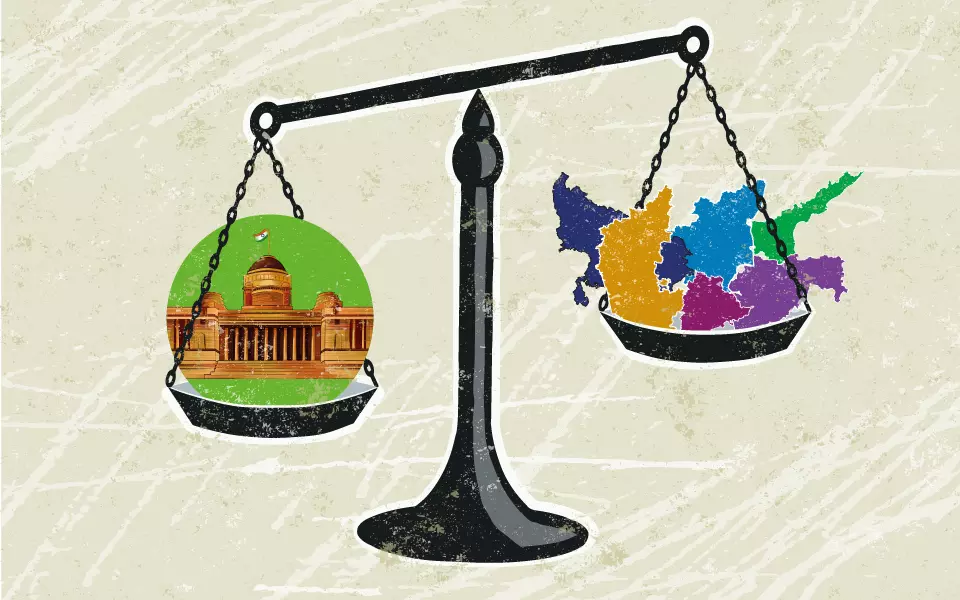
A high-level committee led by former Supreme Court judge Justice Kurian Joseph has submitted a comprehensive report to the Tamil Nadu government urging a fundamental reset in India's federal structure, arguing that excessive centralisation of power has outlived its historical necessity and is now undermining effective governance.
Also read: 'It is clear that all Governors are acting in concert' | Capital Beat
The 387-page report, whose first part was handed over to Chief Minister M K Stalin on Monday (February 16) and tabled in the Tamil Nadu Assembly on Wednesday (February 18), asserts that while the Indian Constitution appears federal in form, it was deliberately designed with a strong unitary bias.
Focus on governor role
The detailed first part has devoted substantial attention to the role of the state governor, describing his/her office as one of the most contentious flashpoints in India’s federal structure.
The panel argues that the governor has increasingly become an “agent of the Union government” rather than a neutral constitutional head, especially in states ruled by opposition parties.
Also read: Can states scrap governor’s address? PDT Achary explains
Drawing on historical precedents, constitutional debates, and recent political controversies, the report calls for sweeping reforms to insulate the governor’s office from alleged partisan misuse and restore its intended role as a bridge between the Union and the states.
Key recommendations on governor:
Some of the key recommendations of the report on the governor are the following:
Fixed 5-year tenure: The committee strongly recommends amending Article 156 of the Constitution to set the governors’ tenure fixed at five years. The current “pleasure of the President” doctrine, which allows removal without stated reasons, should be abolished except in cases of proven misbehaviour or incapacity (similar to the process for impeaching judges).
A fixed term would prevent the governors from being transferred or removed as political punishment or reward.
Appointment process: Governors should be eminent persons from outside the state, with no active political affiliation for at least five years before appointment. The Union government must consult the concerned chief minister (with meaningful, recorded consultation) before finalising the name. The report cites the Sarkaria and Punchhi commissions, which made similar suggestions, but notes that these were never fully implemented.
Also read: Assam's normalisation of hate can steadily erode the very idea of India
Limited and defined discretionary powers: Under Article 163, governors must act on the aid and advice of the Council of Ministers in almost all matters. Discretionary powers (for example, reserving bills for the President’s consideration, recommending the President’s rule) should be narrowly interpreted, exercised only in exceptional circumstances, and accompanied by written, public reasons.
The report criticises recent instances of governors withholding assent to state bills for prolonged periods.
Time-bound assent to bills: Governors should be required to grant assent, withhold assent with reasons, or reserve a bill within a fixed period (suggested: one month). If the state Assembly re-passes a returned bill, the governor must grant assent. Indefinite delays or routine reservation of bills for the President undermine the legislative sovereignty of states.
No post-retirement political roles: To ensure impartiality, the governors should be barred from taking up any political office or active party role after their tenure.
Removal of governors from the chancellor role: In states where governors serve as ex officio chancellors of universities, this dual role should be ended to prevent interference in higher education, an exclusively state subject.
Also read: Federal fault lines widen in 2025 as states push back on NEP, MGNREGA, more
The report frames these changes as essential to prevent the governor’s office from being weaponised to destabilise elected state governments, citing multiple recent examples across the opposition-ruled states.
Other key arguments
Some other key arguments of the report include:
Historical context vs present reality: The Constitution drew heavily from the Government of India Act, 1935, and centralised power amid post-Partition fears. However, today's political maturity, linguistic reorganisation, coalition governments at the Centre, and the rise of strong regional parties have created conditions for genuine cooperative federalism without threatening national unity.
True federalism requires devolution: Quoting Constituent Assembly member K Santhanam, the report stresses that real federalism lies in clearly defining what the Centre should not do, allowing local authorities, closer to the people and better aware of ground realities, to exercise power effectively.
Dangers of over-centralisation: Excessive concentration weakens the Centre itself by burdening it with tasks it cannot efficiently perform (from space research to rural sanitation). Once acquired in the name of necessity, power is rarely relinquished.
Delhi's micromanagement: Union ministries increasingly duplicate state functions, engage in micro-management, and override state priorities through subordinate legislation, contrary to democratic federal principles.
Also read: Viksit Bharat or centralised control? The risks of India’s new higher education law
Supreme Court affirmation ignored: Despite the landmark S R Bommai (1994) judgment declaring federalism a basic feature of the Constitution and states as sovereign within their spheres, continuing legislative and administrative overreach undermines state autonomy.
States as laboratories of democracy: Successful national schemes, including Tamil Nadu's mid-day meal and healthcare models, Kerala's literacy achievements, and Maharashtra's employment guarantee originated at the state level. Over-centralisation stifles such innovation and experimentation.
Myth of state incapacity: Claims that states lack administrative or technical capacity are self-fulfilling; constant central intervention creates dependency and erodes capability. Responsibility and the freedom to learn from mistakes are essential for building competence.
Performance failure: Compared to more decentralised federations or global benchmarks, India's centralised model has delivered disappointing outcomes in universal reach, quality, equity, and global competitiveness, while breeding bureaucratic complexity, fiscal strain, and reduced accountability.
Illusion of strength: The notion that weakening states strengthen the Centre is a “dangerous myth”. The Union and states are not competitors but partners, upholding a shared constitutional framework.
Also read: Democracy came before development in India: Arvind Subramanian | Voices That Count
Tamil Nadu's legacy: The state has long championed greater autonomy from Annadurai's 1967 critique and M Karunanidhi's slogan “Autonomy for states, federalism at the Centre” to the 1969 Rajamannar Committee without ever compromising national integrity.
Major recommendations:
The report also came up with some significant recommendations, including:
- Fixed, non-renewable five-year term for governors, appointed from a panel of three names approved by the state Assembly.
- Binding two-thirds majority requirements for certain constitutional amendments, with state ratification for changes affecting specific states.
- Correcting Census distortions in language classification and abandoning "One Nation, One Language" policies.
- Reforming the GST Council voting and quorum to prevent unilateral central decisions.
- Union government to bear at least 80 per cent of costs for Centrally Sponsored Schemes, offer flexible untied grants, and avoid intrusion into core state domains such as health and education.
Also read: How Centre has bullied states over GST compensation over the years
The committee emphasises that the goal is not to weaken the Centre but to refocus it on truly national responsibilities while restoring meaningful autonomy to states, a reform that would strengthen India's unity through genuine accountability and cooperative partnership.
Challenges remain
Political analysts describe the recommendations as constitutionally sound and politically urgent, but implementation remains challenging:
Constitutional hurdles: Most reforms require amendments to Articles 155, 156, 163, and related provisions, needing a two-thirds majority in Parliament and ratification by half the states, which is difficult without cross-party consensus.
Judicial route offers partial relief: The Supreme Court has recently intervened in several cases (for example, directing timely action on bills), setting precedents that curb gubernatorial overreach without requiring amendments. States may increasingly rely on courts for immediate redress.
Political climate: With several non-BJP states facing governor-related friction, there is growing multi-state support for reform. However, the Union government has defended the current framework, viewing governors as guardians of constitutional propriety.
