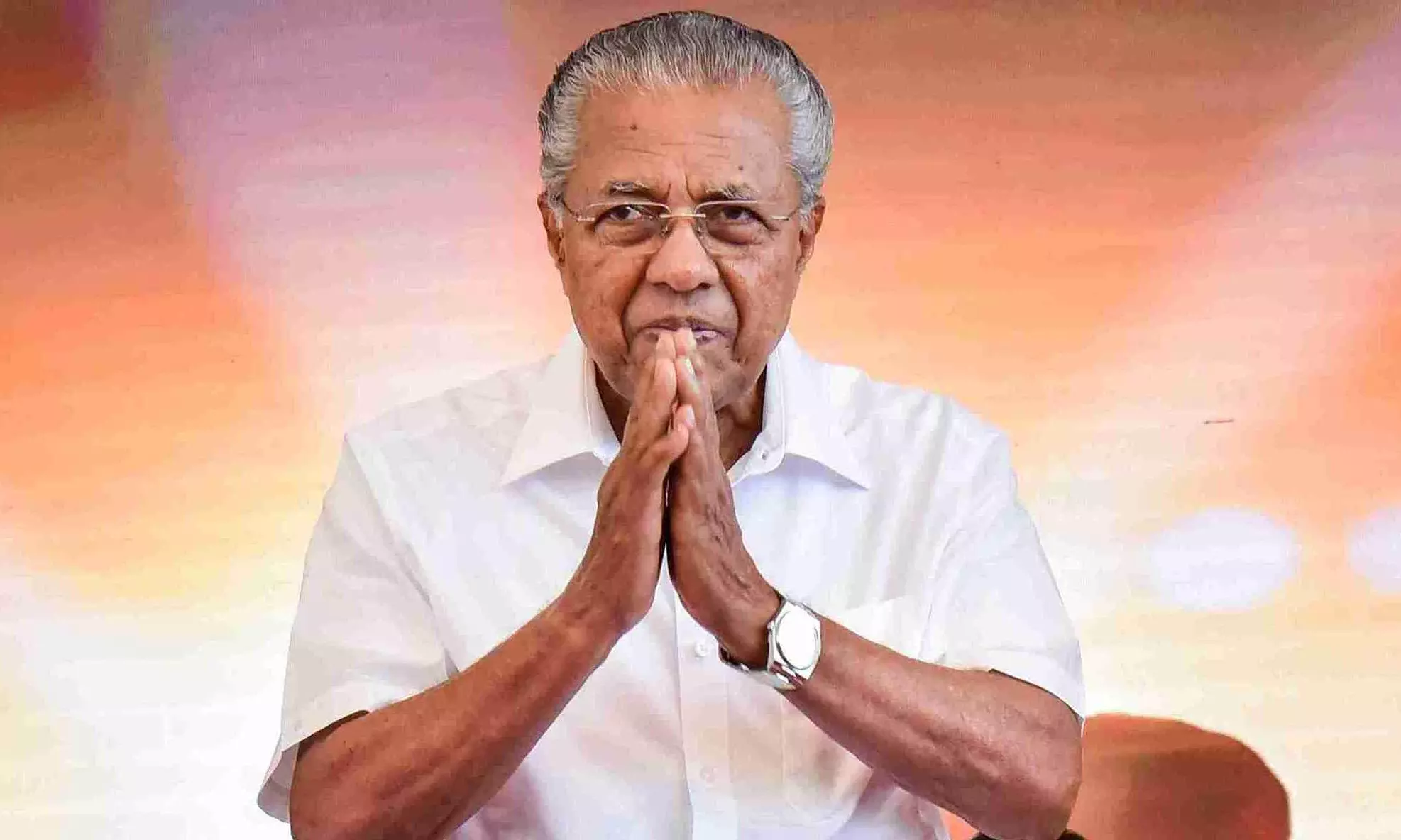
Kerala gears up for political showdown as LDF turns financial grievances into poll plank
CM Pinarayi Vijayan to lead ‘satyagraha’ on January 12 against Centre’s ‘financial blockade’ as LDF frames narrative for the 2026 assembly election battle

As Kerala heads into a year of intense political mobilisation in the run up to the assembly election, the Left Democratic Front government has chosen the streets as much as the legislature to frame its battle with the Union government.
The satyagraha led by the chief minister, announced for tomorrow (January 12) at the Palayam Martyrs’ Memorial in Thiruvananthapuram, is not merely a protest against fiscal policies, but the opening move in what is clearly shaping up to be a larger election narrative.
Centre's 'financial blockade'
Chief Minister Pinarayi Vijayan has positioned the agitation as a defence of Kerala’s development model against what he calls a “financial blockade” imposed by the Centre. In a statement, he said the protest is against “the Centre’s financial blockade that is pushing back the progress we have achieved over the past ten years,” adding that the people of Kerala would stand with their elected representatives in resistance. The language is unmistakably political, crafted to portray the state as a victim of discriminatory federal practices and the LDF as the only force capable of defending Kerala’s interests.
Also Read: Malayalam Language Bill inclusive, protects minorities, says Pinarayi Vijayan
From an independent point of view, the agitation reflects a convergence of governance, grievance and electoral strategy. Fiscal federalism has long been a sensitive issue in India, and Kerala’s complaint that it is being unfairly treated is not new. What is new is the scale and intensity with which the LDF is now projecting this dispute in the public domain, at a time when the ruling coalition is preparing to defend its record and renew its mandate.
Numbers as political weapon
The Chief Minister’s list of figures is central to this narrative. According to the state government, Rs 5,900 crore has been cut from the Rs 12,000 crore loan approval due for the final quarter of the financial year. The permissible borrowing limit has been reduced by Rs 17,000 crore, citing off-budget borrowings.
Permission to raise loans in lieu of Rs 6,000 crore spent on land acquisition for national highways has been withheld. An amount of Rs 965 crore under IGST recovery has allegedly been retained by the Centre. Loan approval worth Rs 3,300 crore has been denied in the name of guarantee deposits. In addition, arrears under centrally sponsored schemes are put at nearly Rs 5,784 crore.
Also Read: Why Kerala CM's car-pooling with Vellappally could be a costly ride for the Left
For the LDF, these numbers are not merely accounting details; they are political ammunition. The chief minister argues that the Centre is “trying to choke both the government and the state by obstructing this development momentum,” a phrase that has already begun to echo across party platforms and campaign speeches. By framing the issue as a deliberate attempt to weaken Kerala, the LDF hopes to consolidate public opinion across social and political divides.
Conflict shifts to streets
At the same time, the government is careful to project confidence in its own management. Vijayan points out that Kerala’s own revenue has risen from Rs 54,000 crore in 2015–16 to over Rs 1.03 lakh crore, that per capita income has nearly doubled, and that the state’s debt-to-GSDP ratio is below the national average. “Despite this severe financial squeeze, Kerala continues to move forward strongly on the path of development,” he says, crediting “prudent and efficient financial management.”
This dual strategy of highlighting both victimhood and resilience is politically significant. It allows the LDF to argue that any slowdown or constraint in welfare and development is not due to misgovernance as alleged by the opposition, but because of external pressure. At the same time, it reassures supporters that the government remains competent and in control.
The agitation also signals a shift in tone. While previous confrontations with the Centre were often confined to official correspondence and legislative debates, the current move takes the conflict directly to the public arena.
Electoral strategy
Critics, however, argue that the timing reflects a clear electoral strategy. With elections approaching, the LDF is grappling with anti-incumbency, governance-related questions, and controversies ranging from the Sabarimala gold theft case to allegations of minority alienation. Turning the spotlight on the Union government helps redirect public anger and provides a unifying theme that can rally party cadres and sympathisers alike.
The Opposition, particularly the Congress-led UDF and the BJP, is expected to counter this narrative. The UDF has traditionally accused the LDF of financial mismanagement and excessive borrowing, while the BJP argues that Kerala’s problems stem from its own policy choices rather than central discrimination. For them, the agitation is less about genuine federal concerns and more about political theatre.
Also Read: CM Vijayan predicts bigger LDF win in upcoming Kerala polls
Yet, from an independent perspective, it would be simplistic to dismiss the LDF’s claims entirely. Kerala’s economic structure, with high social sector spending, a large welfare commitment and limited industrial tax base, does make it more sensitive to borrowing limits and central transfers. Any sudden curtailment in fiscal space has a direct impact on pensions, subsidies and development projects. The political question is not whether the problem exists, but how it is being framed and used.
Ideological contest
Pinarayi Vijayan makes it clear that the LDF intends to turn this into a broader ideological contest. He accuses the Union government of trying to undermine people-centric schemes and welfare measures, including women’s safety initiatives, scholarships and pension distribution. “Kerala will firmly resist the Centre’s attempts to obstruct these initiatives,” he says, projecting the agitation as a defence of social justice and inclusive governance.
For voters, the coming months will test the persuasiveness of this argument. The LDF will try to convince the public that supporting the Left is equivalent to defending Kerala’s rights within the Indian Union. The BJP, on the other hand, will seek to portray the agitation as an excuse to hide state-level failures. The UDF will attempt to position itself as a more balanced alternative that can negotiate better with the Centre.
Also Read: Pinarayi accuses Congress of helping BJP grow in Kerala via 'Mattathur Model'
What is certain is that the January 12 protest is only the beginning. It marks the start of a carefully planned political campaign in which financial data, federal principles and welfare politics will be woven into a single narrative. The LDF is not merely protesting; it is setting the stage for an election battle in which the Union government will be its primary adversary.