







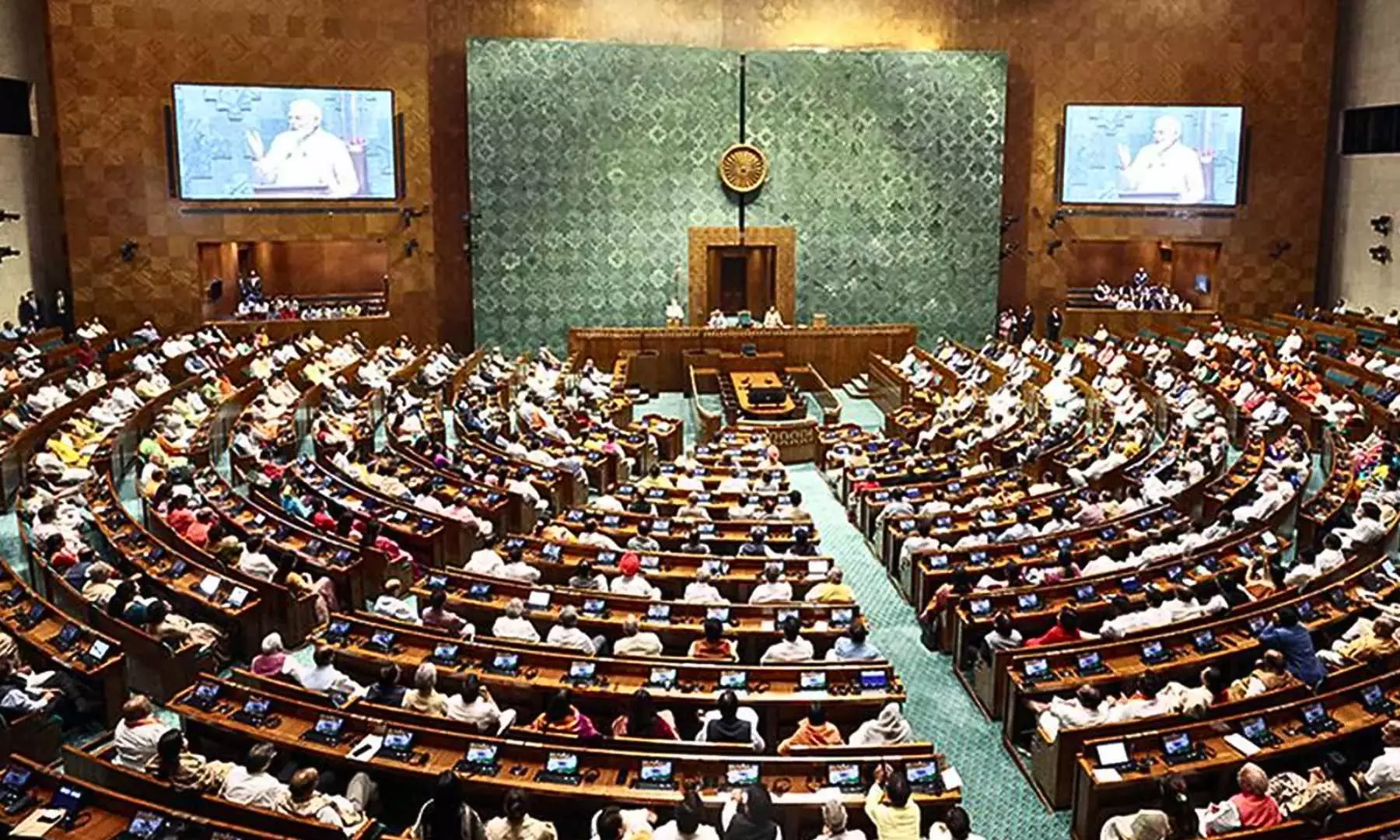
Delimitation Bill: How India’s Parliament compares with legislatures worldwide
With the proposed 50% increase in Lok Sabha seats, India could have one of the world's largest legislatures. But how do other countries size their parliaments and ensure fair representation?

The average Lok Sabha MP represents around 26.3 lakh people, nearly 3.3 times the number represented by a member of the US House of Representatives, according to sources. The comparison puts India’s constituency sizes in perspective as the Centre prepares to push ahead with a fresh delimitation exercise.
India has 543 directly elected Lok Sabha seats, while the US House of Representatives has 435 voting members and six non-voting members. The average Indian MP represents around 26.3 lakh people, against 8.02 lakh for a US representative, according to the sources, who cited data analysis.
How India compares globally
The figures assume significance as the government argues that delimitation will help rationalise constituency sizes, allowing MPs to represent fewer people and address their concerns more effectively.
Also read | Delimitation | The 34-vote gap: Who BJP is counting on, and who could still say no
Under the government’s proposed delimitation plan, the Lok Sabha’s strength would rise from 543 to between 816 and 824 seats. This would put it ahead of Britain’s 650-member House of Commons and Germany’s 630-member Bundestag, as well as the 720-member European Parliament, whose members are elected across the European Union's 27 member states.
If the delimitation bill is passed, India’s Parliament, comprising both the Lok Sabha and Rajya Sabha, would have a combined strength of 1,061 to 1,069 members. That would still be smaller than Britain's Parliament, which has 1,418 members across its two Houses. China and Britain have larger legislative chambers, but neither is directly elected by the people.
China’s National People's Congress, the country's top legislative body, has 2,977 deputies and meets in a full session once a year. Its members are elected by provincial-level people's congresses and the armed forces, within a political system dominated by the Communist Party.
How Britain redraws constituencies
Britain’s House of Lords, the upper chamber of Parliament, has 768 eligible members and is responsible for scrutinising and revising legislation. With the exception of 22 bishops, its members are appointed rather than elected. Hereditary peers, who inherited their seats through aristocratic titles, lost their right to sit in the House under a law passed in March this year.
The British House of Commons has 650 seats, with constituencies periodically redrawn to keep their electorates broadly equal in size. Four independent boundary commissions, one each for England, Scotland, Wales and Northern Ireland, are responsible for the exercise. In the last review, completed in 2023, the average constituency had 73,393 registered voters, with each seat required to remain within 5 per cent of that figure.
US rules for allocating seats
The US House of Representatives has had 435 voting members for most of the past century, a strength fixed by a 1929 law. Representatives from Washington DC and US territories also sit in the House, but they do not have voting rights.
The allocation of these 435 seats is reviewed every 10 years after the US census. Known as reapportionment, the process redistributes seats among the 50 states based on changes in their populations. Every state is guaranteed at least one seat, while the remaining seats are allocated according to population. This means states with faster-growing populations can gain seats at the expense of those growing more slowly.
Germany’s bid to cap parliament
Germany’s Bundestag grew over the years because of the way its electoral system works. Voters cast two ballots: one for a candidate in their constituency and another for a political party. The party vote determines each party’s overall share of seats. Until recently, when a party won more constituency seats than its share of the party vote entitled it to, it was allowed to retain those extra seats. Other parties were then given additional seats to maintain the overall proportional balance.
The system pushed the Bundestag to a record 736 members after the 2021 election. In March 2023, lawmakers scrapped the provision for these additional seats and capped the strength of the chamber at 630. Germany’s top court upheld the core of the reform in 2024.
Italy’s push to cut lawmakers
Italy took the opposite route, choosing to reduce rather than expand its legislature. In 2019, Parliament approved a cut in the strength of the lower house from 630 to 400 seats and the Senate from 315 to 200.
The move had long been pushed by the anti-establishment Five Star Movement, which argued that a smaller Parliament would save public money and improve efficiency. The proposal received the backing of around 69 per cent of voters in a September 2020 referendum and came into effect with the 2022 general election.
Also read | Delimitation: Why Bengal is more worried about political boundaries, than numbers
Italy’s decision to reduce the size of its Parliament was projected to save around €100 million annually. However, critics cautioned that having fewer lawmakers could come at the cost of adequate public representation.
Centre’s plan to expand legislatures
These international examples offer contrasting approaches to parliamentary representation as the Centre prepares to introduce a fresh Constitution amendment Bill in the Lok Sabha on Monday. The proposed legislation seeks to implement one-third reservation for women by increasing the Lok Sabha seat allocation of every state and Union Territory, as well as the strength of their legislative assemblies, by 50 per cent. It also proposes to freeze the revised seat allocations and constituency boundaries until 2051.
A special sitting of Parliament has been convened. The Lok Sabha has been reconvened on November 30 and the Rajya Sabha on December 2. The sittings will conclude on December 3.