My Lord Review: Strong politics, but middling execution
A sharp political clash between bureaucratic erasure and Vallalaar’s humanism, but dated melodrama blunts its emotional impact

Director Raju Murugan has built a filmography around characters who appear eccentric but are, in truth, frighteningly ordinary in the Indian context. In 'Joker', a villager declares himself the President of India and dies trying to fulfil a basic promise: to build a toilet for his wife. In 'Gypsy', a free-spirited nomad falls in love across rigid communal lines, only to be crushed by majoritarian politics. In 'Japan', a flamboyant thief diagnosed with HIV embarks on a final, defiant journey.
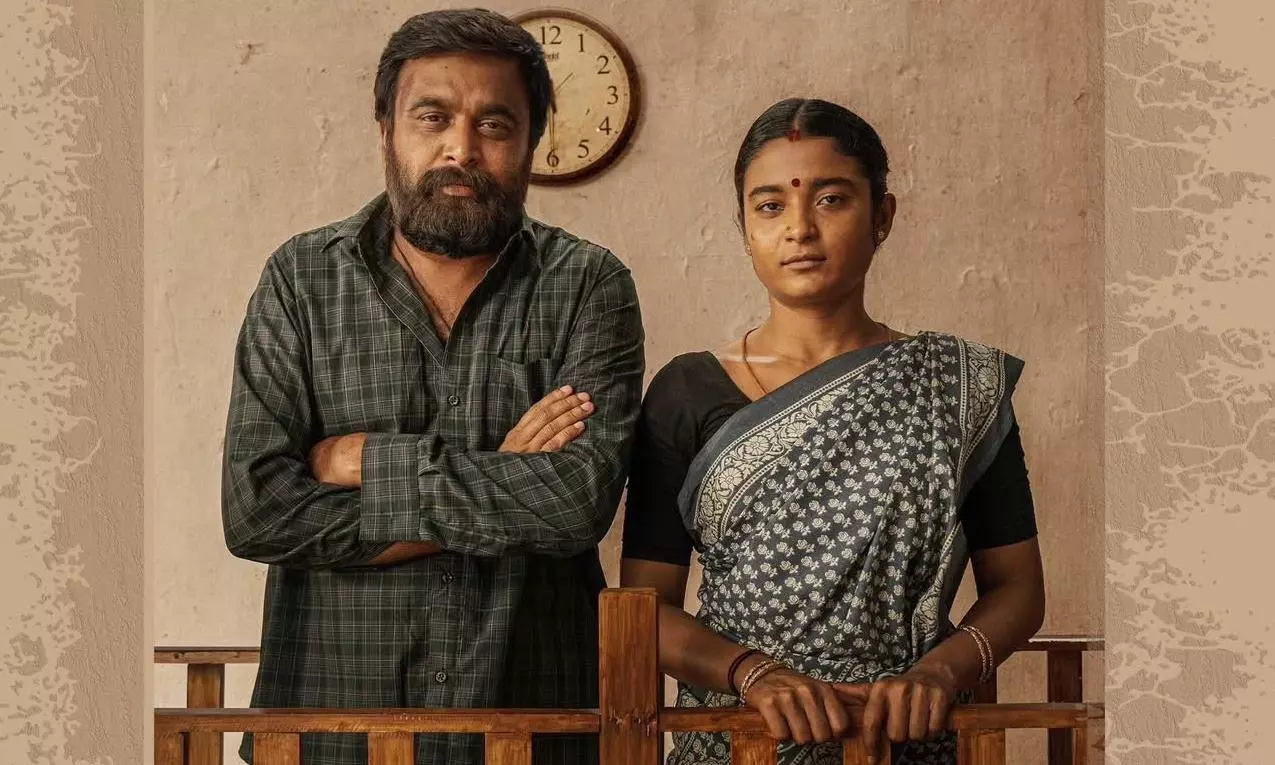
Now, in 'My Lord', Murugan returns with yet another political satire, this time about a couple declared dead in official records but painfully alive in reality, forced to confront a system that erases them to benefit the powerful and the wealthy.
Also Read: Tu Yaa Main review | Bejoy Nambiar’s lively Gen-Z influencer romance slips on its ambition
On the surface, Murugan’s stories may seem to hinge on quirky premises. But eccentricity is never ornamental; it is diagnostic. His cinema suggests that what appears absurd is routine for millions navigating India’s bureaucratic labyrinth. In one scene, when Muthuchirpi (Sai Kumar) and Sushila (Chaithra) attempt to obtain a ration card, a petty broker offers to “arrange” it for ₹1,000. Even after bargaining the amount down to a few hundred rupees, Muthuchirpi refuses. The broker, exasperated, snaps: “Kaasu illathavan ellam yaen da government office pakkam vareenga?” (Why do people with no money even step inside a government office?). It is a throwaway line, but it captures the film’s tonal balance: both funny and devastating.
Muthuchirpi is an orphan, who was raised by Sushila’s father, who ran an ashram rooted in the principles of the 19th-century Tamil saint Vallalaar, known for his emphasis on compassion and equality. The film does not explore Vallalaar’s philosophy in depth, but his moral universe shapes the narrative’s endgame. The antagonist, a powerful Union minister confined to a wheelchair due to failing health, seeks Muthuchirpi’s kidney for survival. Though her ideology is never explicitly named, Murugan layers visual cues: a framed photograph of a figure resembling Mohan Bhagwat, her insistence on knowing the donor’s community, and a saffron-clad godwoman who functions as her aide. The implications are clear without being spoken.
At its core, 'My Lord' stages a clash between two worldviews. On one side stands concentrated political power, sustained by identity and hierarchy; on the other, a man rendered legally nonexistent, possessing nothing but his body. As the narrative unfolds, the film gestures toward a moral inversion, the frailty of human existence levels both the powerful and the powerless. The expected catharsis, the villain’s death, never arrives. Murugan withholds it, aiming instead for a broader ideological statement about compassion and transcendence. The ambition is undeniable. The emotional payoff, however, is uneven.
Also Read: Why did Tamannaah bag Mysore Sandal deal when Rashmika Mandanna, Pooja Hegde hail from Karnataka?
Technically, 'My Lord' is not deficient. Yet many scenes feel curiously dated in treatment and tone. The film often slips into the familiar melodramatic tone of the conventional Tamil “social problem” drama. A late montage meant to evoke Vallalaar’s humanist values exemplifies this — sincere in intention but staged in a manner that feels stylistically outdated rather.
Also, Raju Murugan is generous when it comes to shaping the moral universe of his protagonists. The editor of a small local paper titled Makkal Kuthu (“People’s Punch”), played with quiet conviction by Guru Somasundaram, the measured High Court judge portrayed by Jayaprakash, and even Gopin Nainar’s brief appearance as a leftist lawyer — all are given texture, dignity and ideological clarity. They feel like thinking participants in the narrative rather than mere functions of the plot.
That generosity, however, does not extend to the antagonists. With the exception of a darkly amusing moneylender, who, in a cruelly comic touch, renames his indebted clients after cricketers, most of the villains are sketched in broad strokes. They are cunning, maleficent, and predictably cruel, but rarely complex. Their lack of interiority flattens the conflict, dulling the film’s otherwise ambitious political edge.