Gandhi Talks review: Vijay Sethupathi’s film is silent in form, talkie in soul
Premiered at the International Film Festival of India in 2023, the silent movie ends up saying very little

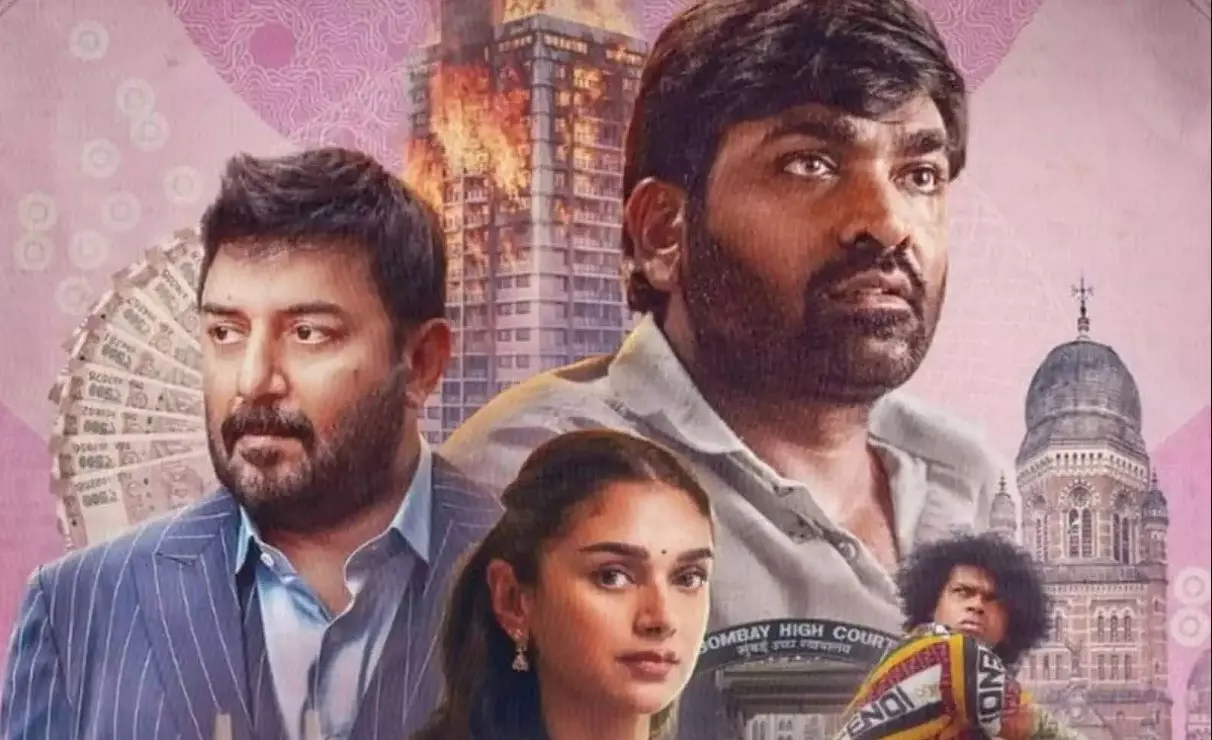
In many ways, Gandhi Talks feels like a spiritual remake of Kamal Haasan’s Pushpaka Vimana (1987), also released in Tamil as Pesum Padam — a silent film about a struggling, unemployed man who takes a shortcut to wealth and high life before returning to honesty and struggle.
The protagonist of Gandhi Talks, Mahadev (Vijay Sethupathi), is even more miserable. Unlike Kamal Haasan’s unnamed hero, Mahadev never even gets a fleeting taste of the good life. Similarly, Gandhi Talks itself is not as rewarding as Pushpaka Vimana, because it denies not just its hero but also itself any sense of playfulness, while half-heartedly attempting to be a dark comedy.
Over the top squalor
The film opens with an extreme close-up of an old man gargling and spitting from the first floor of an extremely cramped Mumbai chawl. The water lands in a fish seller’s basket, and the fish are later sold to the old man’s daughter-in-law.
Mahadev, another chawl resident, lives with his bedridden mother. Carrying her in his arms, he queues up at the common toilet shared by the entire chawl, framed against an intimidating skyscraper looming in the background. Mahadev is given a special pass because of his mother’s condition, and the scene abruptly cuts to a woman making murukku (chakli in Hindi) — a supposedly symbolic transition.
Also Read: Dhurandhar becomes first Hindi film to earn Rs 1,000 crore in India
Another similarity between Pushpaka Vimana and Gandhi Talks is their use of ‘gross-out’ humour. For reasons unknown, it is humour in the old, and just gross here. It could be because in Pushpaka Vimana, toilet humour was integral to the narrative; in Gandhi Talks, it comes across as an incongruous attempt at dark comedy.
Towards the end, Mahadev plunges his hands into a toilet commode in a desperate search for something valuable, and the film expects the audience to feel sympathy for him. This tonal inconsistency— where the film mocks the corruption of the world with dark humour in one moment and demands empathy in the next — makes the experience confusing rather than affecting. We aren't sure whether the some sequences are satire or emotional or neither.
For instance, the portrayal of Mahadev’s poverty and his mother’s illness is overtly tear-jerking, but the impact is closer to watching the infamous ‘khujli-wali roti’ scene from 3 Idiots. Director Kishor Pandurang Belekar is relentless, and often repetitive, in underlining this misery that you become more exhausted than moved.
Exposition over visual storytelling
The film is equally indulgent in establishing Boseman's (Arvind Swami) backstory as an ambitious industrialist who is cheated and backstabbed by his workers and financiers, losing almost everything to a calculated ploy. For a silent film, Gandhi Talks spends an inordinate amount of time dumping information through on-screen text, letters — among the laziest exposition tools — and laughably blunt text messages that read along the lines of: “You guys are selfish and opportunists.”
Gandhi Talks is silent in form but deeply verbose in spirit. A silent film is not about avoiding dialogue; it is about creating moments that don’t need words in the first place.
A crucial scene in which the heroine realises her lover is about to commit a crime is staged in an embarrassingly simplistic manner, reminiscent of amateur YouTube short films. Endless flashbacks and empty lunch boxes are unnecessary when visual storytelling should do the work.
As a silent film, less would have meant more. Instead, Gandhi Talks, true to its title, keeps talking, and ends up saying very little.
Music as emotional crutch
AR Rahman’s background score further weakens the film. Rather than complementing the mood, the music dictates emotions, functioning as an instruction manual on how the audience should feel. Swap the cues around, and scenes might accidentally turn comic, because the visuals themselves lack emotional weight. The constantly shifting score feels like a barrage of auditory emojis.
Also Read: Kishor Pandurang Belekar on directing silent film Gandhi Talks, working with AR Rahman
The performances, especially by Vijay Sethupathi and Arvind Swami, contribute more to the film than the film does to them.
There are isolated moments where Gandhi Talks works — notably the courtroom scene where Boseman’s opponents attempt to buy off a lawyer, culminating in a sharp twist, and Mahadev’s interview for a government job. These sequences honour the silent-film form by letting actions, not exposition, do the talking.
Morality reserved for poor
The film’s most troubling aspect, however, is its ‘social message’. It concludes with a familiar moral lesson about honesty and an underwhelming redemption arc. Mahadev is shown sweeping roads as a sanitation worker, while Boseman’s fate is left ambiguous.
The implication is hard to miss: morality appears to be a burden reserved for the poor. By Gandhi Talks’ logic, the rich always find an escape route, because they don’t deal in Gandhi (Indian rupees), a depreciating asset.