Baby Do Die Do review: Huma Qureshi film had no excuse to be made
Directed by Nachiket Samant and produced by Qureshi and her brother Saqib Saleem, the film stars Qureshi as an assassin. The film flouts basic technique and is a mindless clutter. It takes confidence bordering on delusion to juggle as many elements as Samant does here.

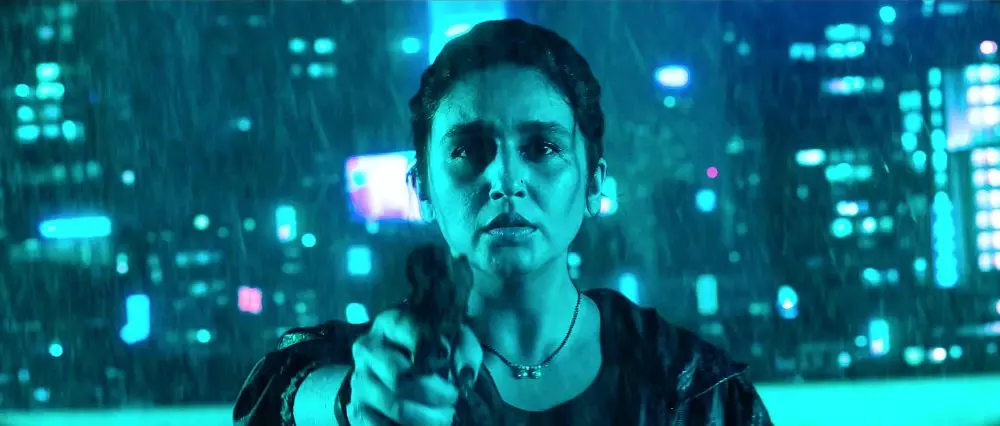
Huma Qureshi in Baby Do Die Do.
We often underestimate the power that comes with having a backup plan. This is probably what people with standbys feel when they get cheated on. Or what folks with a lucrative job offer in their pocket think to themselves when they’re presented with peanuts during appraisal season. Having a backup plan affords you the agency you normally wouldn’t have in everyday life. But as immensely privileged a responsibility as reviewing movies may be, it often leaves you without a plan B. And where there is no plan B, there is no power. For two, sometimes three hours, you’re at the mercy of whatever is projected in front of you. No running, no hiding, no sneaking into the theatre next door to sacrifice precious brain cells to Cocktail 2 again. These are the thoughts that run through your mind when you watch something like Baby Do Die Do, the new movie starring the otherwise capable Huma Qureshi.
A baffling mystery
She plays an assassin in the film, which she has produced with her brother, Saqib Saleem, who makes a rather eye-catching cameo that we’ll get to in a moment. In case you were wondering, the movie is called Baby Do Die Do because Qureshi’s character is named Baby Karmarkar. Now say that name again in English. There you go.
Baby, we are told in a black-and-white flashback, is hearing- and speech-impaired. As a child, she was wandering about in an abandoned hotel with her twin sister when they were attacked by a murderer who happened to be murdering someone else there at the same time. Baby survived, but her sister died. The dead sister narrates the movie from beyond the grave.
Also read: Enola Holmes 3 review: Millie Bobby Brown starrer retains earnestness of franchise's first two films
Why Baby chooses to deal with her trauma by becoming an assassin is a mystery. What’s even more baffling is that she is an assassin without any code whatsoever. It isn’t that she kills only bad guys. Because why make the protagonist of your movie an honourable person when you can make them an irredeemable monster? Baby kills willy-nilly. And even though she seems to have gotten away with it all her life, you get the sense that this is down to the ineptitude of the authorities more than any special skill that she might have. For instance, Baby shoots a man in a crowded local train compartment in an early scene and slips away by simply getting off at the next platform. She’s even caught on CCTV.
Baby’s handler is a middle-aged property dealer whom she addresses as ‘Papa’. He’s played by Chunky Panday with the sort of haplessness that makes it seem like he didn’t read the entire script. If there was one. While Panday is the gentlest nudge away from yelling “I’m-a-joking” (his one-liner in the Housefull franchise) at any given moment, Qureshi appears to be in a version of John Wick (the Hollywood film starring Keanu Reeves as a hitman).
Pointless love story, cavalier philosophy
Director Nachiket Samant also shoehorns in a pointless love story that begins with blatant stalking and ends, as Bollywood stalking often does, in marriage. Baby agrees to tie the knot with her stalker neighbour not because she loves him — they’ve never even interacted properly — but because the movie makes a face and begs her to.
This is the cavalier philosophy with which the plot progresses. For instance, you’d think that it would be an impossible feat for one movie to offend three separate minorities. But Baby Do Die Do gets it done. A character with vitiligo is described as “black-and-white”, and it’s supposed to be a joke. Later, a heterosexual man infiltrates a gay club where everyone is a grotesque predator. This is the scene where Saleem makes a cameo as a stripper. Of course, jokes are also made at the expense of Baby, often by her own mother, who is meant to serve as comic relief in a movie that doesn’t realise how accidentally funny it already is.
Basic techniques, perfected by talented filmmakers over decades, are flouted carelessly in Baby Do Die Do. It’s an incoherent mess, unfit to be shown to the public. It takes confidence bordering on delusion to juggle as many elements as Samant does here. There was no reason, for example, for this movie to be as cluttered as it is; perhaps focusing on Baby and her journey more intently would’ve made it obvious to Samant that most of the film’s subplots are unnecessary. The best movies aren’t the ones that suddenly turn into silent-era romances or sociopolitical dissertations; they’re the ones that tap into basic human emotions — jealousy, love, greed, vengeance, empathy.
Did this movie need to exist? Did this story need to be told? Was it made purely for financial reasons? Was everyone on some kind of deadline? You’d hope that at least one person involved was in it for the right reasons, because the alternative is too upsetting to confront. Stuff like Baby Do Die Do has the power to rob you of your spirit; they transport you to the dark ages of Bollywood, when gangsters were funding movies as an excuse to hobnob with stars. But at least the filmmakers of that era had the decency to admit that they were working with no scripts and dealing with actors who wouldn’t show up to work. They didn’t have a backup plan, and therefore, they had no power. What excuse do the people who made Baby Do Die Do have?