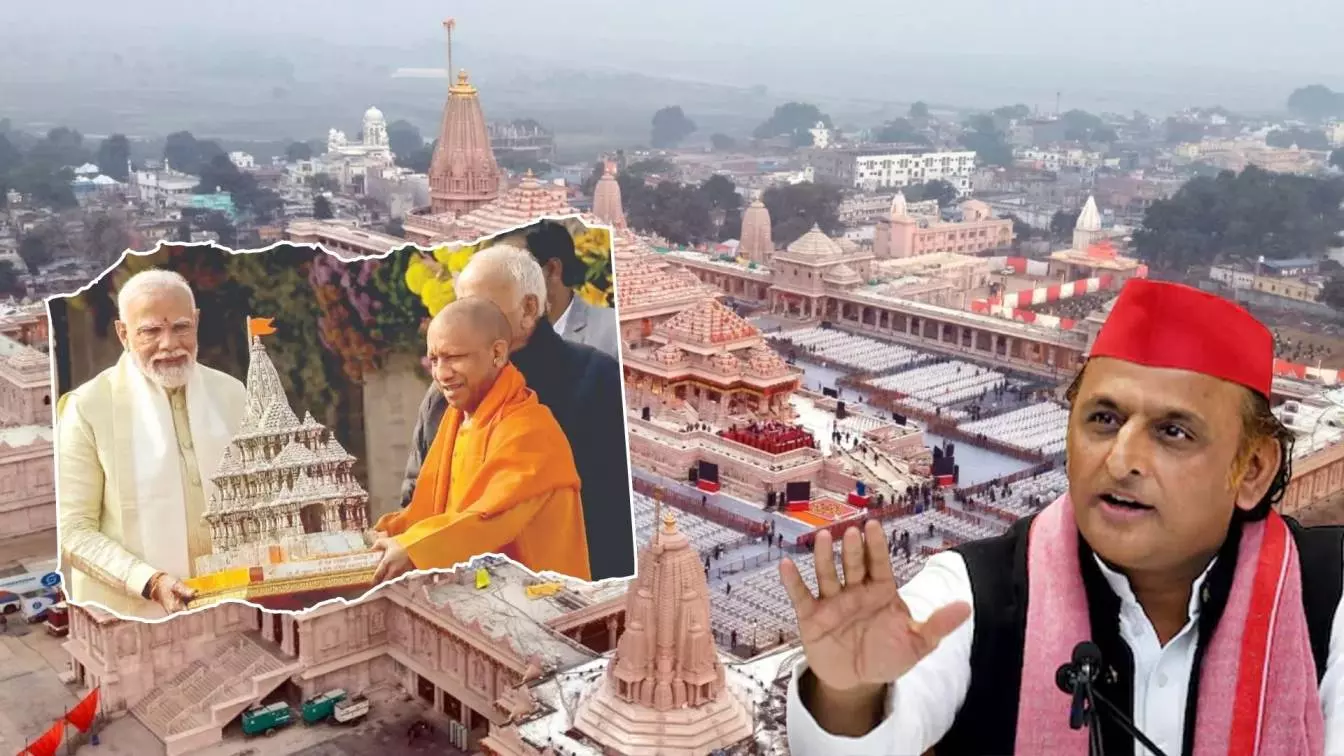
Vote magnet to political liability: BJP’s Ram Mandir dilemma in UP
Hit by 2024 Ayodhya rout and Chanda Chori scandal, Yogi-led UP BJP quietly drops temple as poll topic ahead of 2027, even as SP turns spotlight on its silence

For more than three decades, the Ram Mandir campaign has been both the ideological bedrock and the electoral fuel for the BJP's electoral juggernaut. Yet, ahead of the 2027 Uttar Pradesh Assembly elections, the saffron party appears increasingly cautious about leaning on one of the foundational totems that has delivered it enormous political dividends.
After a stunning rebuke in Ayodhya (Faizabad seat) in the 2024 Lok Sabha elections, the party was expected to reassert the much-touted civilizational victory it claims to have delivered. Instead, an embarrassing expose of donation theft (‘Chanda Chori’) has fractured the sacred narrative and moral authority it spent decades weaponising.
Not surprisingly, the Ram Mandir has quietly disappeared from Yogi Adityanath's stump speeches and those of other BJP leaders. In an ironic inversion of political dynamics in the Hindi heartland, it is now the opposition, principally the Samajwadi Party, weaponising the issue by turning the spotlight on the BJP’s uncharacteristic aversion to the very vortex around which the party’s four decades of mobilisation has revolved.
Also Read: Ayodhya Ram Mandir | God, temple, prayer, and all things personal
Speaking to The Federal, political commentators and scholars argue the BJP now faces a peculiar predicament. Invoking what was once the lodestar of its political manifesto risks resurrecting the very 'scandal' the party would much rather prefer to avoid. The resulting reticence, they argue, is as much a tactical retreat as an acknowledgement of the issue’s mounting political liability.
“Predictably, all this has made them jittery about making mention of the Ram Mandir in these assembly elections. On the contrary, the party has been trying to brush the entire issue under the carpet to evade any public scrutiny that will challenge their Hindu nationalism narrative,” said Lucknow-based political commentator Piyush Rai.
From 2 to 303
In its early years, BJP, a fledgling outfit created from the remnants of the Jana Sangh, managed to win just two seats in Lok Sabha.
Things, however, changed when the BJP, then led by Lal Krishna Advani, aligned itself with the temple cause during the Palampur resolution in 1989. The decision provided the saffron party a compelling cause celebre that it had been desperately searching. Its parliamentary tally rose to 85 seats that year.
Thereafter, LK Advani’s 1990 Rath Yatra from Somnath to Ayodhya helped embed Hindutva in the party’s electoral imagination and elevated the promise of a grand Ram Mandir into a defining test of ideological fidelity.
Also Read: Nripendra Mishra's shifting defences on Ram temple row: Genuine or managed?
Since then, it has become one of the most consequential exercises in politico-religious mobilisation in independent India. Religious identity was weaponised and transformed into political identity.
The Ram Janmabhoomi movement got a fresh push under Prime Minister Narendra Modi in 2014.
“While the Ram Mandir construction promise provided the party with an emotive issue to bind Hindu sentiments together, the development rhetoric gave it a progressive outlook. It was a potent formula that helped BJP’s juggernaut sweep the 2014 election,” said political science professor at Babasaheb Bhimrao Ambedkar University Shashi Kant Pandey.
In 2019, the temple-construction promise was relayed once again, this time fused with chest-thumping nationalism and patriotism. Consequently, the party increased its seats from 282 in 2014 to 303 in 2019.
Corporatisation of Hindutva
In January 2024, the BJP consecrated the Ram temple in Ayodhya amid an elaborate spectacle of religious triumphalism. Its clarion call was Abki Baar, 400 Paar. According to media reports, PM Modi uttered the term "Ram Mandir" 244 times across 155 analysed Lok Sabha election rallies between March and May 2024
The verdict, however, proved humiliating. The party fell well short of its target and slipped to second place in Uttar Pradesh. More gallingly, it lost Faizabad, the constituency that houses Ayodhya, the very epicentre of its Hindutva project.
Its once-potent cause célèbre, political commentators argued, appeared to have become spent fuel.
Also Read: Why there's some optimism around SC's handling of Ram Temple donation row
“Besides, since the promise was delivered, it also lost the political urgency that had helped the saffron party galvanise Hindu voters under one umbrella,” said veteran political observer Anand Vardhan.
Experts argue that Ayodhya was seething with resentment well before the consecration due to what experts describe as the corporatisation of Hindu sentiment, where religious reclamation became entangled with the dispossession of local communities.
The town was upended by relentless construction. Streets were excavated, shops were demolished and residents lost land to infrastructure projects, including the airport.
“The influx of outsiders overwhelmed the town’s fragile public infrastructure. Daily life was disrupted, while stretches once revered for their tranquillity became chaotic and inaccessible to Ayodhya’s own inhabitants,” said Shashi Kant Pandey, a political science professor at Babasaheb Bhimrao Ambedkar University.
The indignity deepened further after industrialists acquired large swathes of land to build farmhouses and resorts, while locals were displaced by road-widening projects designed to accommodate VVIP convoys and celebrities.
“This was seen as the corporatisation of Hindutva, where the profits of a few trumped the sentiments and rights of lakhs of people. The same resentment was visible in Varanasi as well and that’s why Modi’s victory margin shrank from nearly 5 lakh votes in 2019 to around one lakh in 2024,” Pandey added.
Damning scandal, hurt sentiments
The corporatisation of Hindutva, as political observers describe it, has acquired an altogether more sinister dimension with the Ram temple donation theft scandal.
Allegations of systematic pilferage from the Ram temple’s donation boxes have exposed glaring deficiencies in management of the temple. The state government's Special Investigation Team (SIT) has revealed damning evidence of repeated thefts and serious supervisory lapses.
The controversy has also ensnared the temple trust, a 12-member body constituted by the Modi government in 2020. Since most of it prominent figures were seen as close aides of Modi, the PM finds his image deeply tarnished. His silence, experts say, has only done more damage to the saffron party's image as the government has yet to come out clean on the issue, especially when PM Modi has repeatedly asserted ‘Na Khaunga, Na Khaane Duna'(Neither I will indulge in corruption, nor let anyone else do that) on multiple occasions, experts say.
Also Read: Ram temple construction heralds establishment of 'Ram Rajya' for next 1,000 years: BJP resolution
“It is very clear that the very administration of the temple was being carried out from Nagpur and the close aides of the Prime Minister were entrusted with overall accountability. So, his silence and the manner in which they are trying to evade their accountability and answerability is being read as their complacency,” Vardhan added.
For the BJP, the more intractable predicament is the erosion of its claim to moral stewardship over Hindu faith among its core voter base. Brahmins, in particular, a consequential constituency in Uttar Pradesh’s political arithmetic, have voiced sharp indignation.
“It has defamed our faith. Because of their (BJP) misgovernance, the name of Shri Ram is now being associated with a theft scandal. This is just not acceptable to us and we hold the BJP, especially its central leadership, accountable for hurting our sentiments. This shall not be forgotten,” said national president of Akhil Bhartiya Brahmin Mahsabha Pandit Rajendra Nath Tripathi.
“It will serve them best if they keep the name of Ram out of their speeches for electoral purposes,” he added.
Subtle shift fraught with risks
BJP’s Hindutva nationalism remains central to its political architecture. Thus, it seems to be testing waters on alternative fault lines, from the Krishna Janmabhoomi dispute in Mathura to the Gyanvapi controversy in Varanasi and the Shahi Idgah mosque dispute in Sambhal.
This manoeuvre, however, experts warn, risks reviving uncomfortable questions about the temple administration.
“Ayodhya toh Jhaki hai, Kashi Mathura baaki hai, has been their iconic catchphrase. Obviously, they are trying to reclaim the Hindutva nationalism narrative. But that isn’t as easy now. More than anything, evoking Krishna Janmabhoomi and Gyanvapi will again shift the focus to the Ram Mandir donation theft scandal. Also, it will not be easy to replicate the tumultuous campaign for Ram Janmabhoomi,” Rai added.
Also Read: Ram Temple Trust rift deepens as Champat Rai's note exposes VHP-PMO divide
The BJP may still deploy religious polarisation, but its claim to unassailable moral authority has suffered a conspicuous setback. For Pandey, its likeliest electoral counteroffensive will fuse governance claims with communal insinuation, invoking ‘mafia’ figures from a certain community — such as Atiq Ahmed— to portray the BJP’s removal as a threat to law and order and Sanatan Dharma.
The opposition, meanwhile, would be ill-advised to mistake the scandal for an invitation to contest the BJP solely on its Hindutva terrain.
“Opposition's best bet is to capitalise on the SIR issue and tap into the high incumbency. Cornering BJP on its Hindutva plank can only be a supplementary strategy and not the mainstay for political campaign in the run up to assembly elections,” Rai added.
Watch the video here.