Centre blinks on UGC Equity rules, but upper castes may still ‘teach BJP a lesson’
With a four-week window from SC to revisit policy, BJP faces an unwinnable choice: scrap it and risk OBCs and Dalits, or retain it and lose its upper-caste core

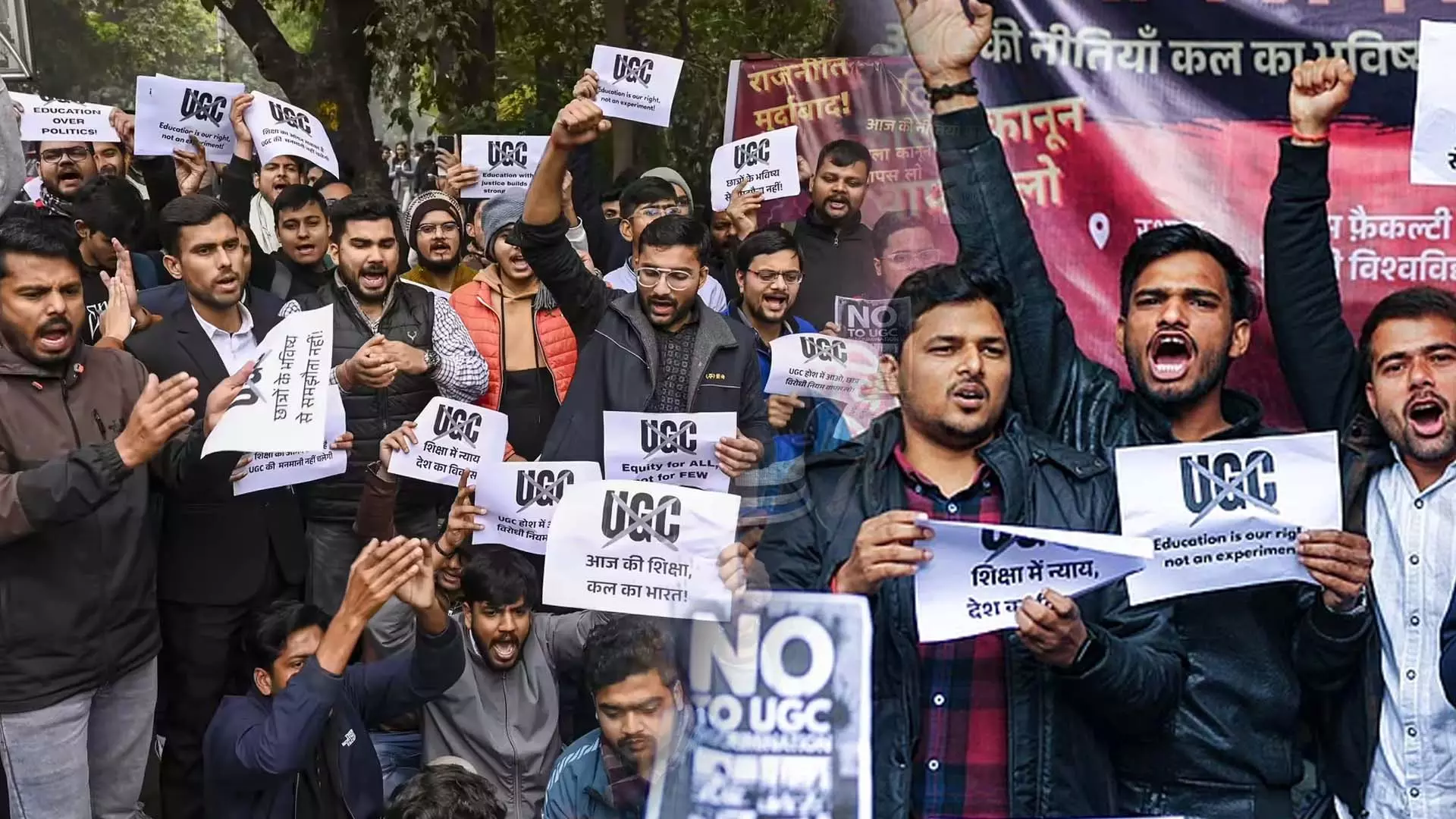
Ahead of the 2027 Assembly elections, the BJP government in Uttar Pradesh is caught in a bind over the UGC (Promotion of Equity in Higher Education Institutions) Regulations, 2026. While SC, ST and OBC communities have largely backed the rules, upper castes are demanding that they be scrapped.
The Centre has now sought time from the Supreme Court to constitute a committee and revisit the policy, a rare climbdown that experts attribute to growing resentment among the party’s core upper-caste voter base.
The BJP cadre and the Rashtriya Swayamsevak Sangh (RSS) have also reportedly warned that the rift could hurt the party’s electoral prospects.
Damage control mission
Political analysts note that the ruling dispensation is exceedingly wary of the political ramifications of allowing this resentment to fester. They see the decision as an exercise in electoral damage control. “Increasingly, the party is experiencing massive pushback from every section of society, most notably among the upper caste. Revisiting the UGC Equity guidelines is nothing but a time-buying strategy to keep upper caste voters in good humour,” veteran political analyst Anand Vardhan told The Federal.
Also read: Akhilesh Yadav’s Hindu pivot and search for a coalition beyond Muslims, Yadavs
The Centre, however, remains non-committal on its rollback, as that path is fraught with risks of upending its expansive Hindu voters’ coalition, which has been instrumental in scripting its electoral success in the Hindi heartland.
“Either way, the BJP is set to upset the social coalition that it has meticulously managed to cobble together over the past decade," noted political analyst Shashikant Pandey. "Merely buying time will not serve them. In fact, for the first time in the past decade, the party looks indecisive and jittery,” he told The Federal.
Rising anger spilling publicly
Last week, Solicitor General of India Tushar Mehta told an SC bench headed by Chief Justice of India (CJI) Surya Kant that the Centre is looking at constituting a committee to revisit the UGC Equity guidelines, which it had introduced earlier this year to address rising cases of caste-based discrimination in higher education institutions.
In his submission to the court, Mehta argued that the “government was examining the issue to ensure that the concerns of students from all sections were addressed and no one felt dissatisfied or apprehensive.” The court subsequently awarded the government four weeks to revisit the policy.
Also read | Uneven reality of Yogi’s UP growth story: Proposals aplenty, delivery patchy
The move amid rising backlash against the BJP in recent months. More recently, a Brahmin Sammelan organised in Prayagraj became the flashpoint of the simmering anger. Deputy Chief Minister Keshav Prasad Maurya was addressing the gathering at the event, when a Brahmin youth rose from the crowd and demanded that Maurya clarify his government’s stance on the UGC Equity Regulations. While Maurya offered evasive answers, the youth persisted with his demands.
The matter came to a head when the youth was allegedly slapped by BJP councillor Vinay Mishra for his vociferous defiance. As videos of the altercation circulated on social media, the ruling BJP drew massive public criticism. Several Brahmin interest groups threatened to “teach the party a lesson” in the upcoming elections.
“These MPs and MLAs of the BJP have secured power based on the votes of upper castes. And now, not only are they resisting scrapping the draconian law but also slapping our youths for demanding an answer. They’ll have to pay for this in elections,” said national president of the Akhil Bhartiya Brahmin Mahasabha, Pandit Rajendra Nath Tripathi.
The anger over UGC spilled over into the ballot boxes during the recently concluded MLC elections in the state. Reportedly, many voters wrote “withdraw UGC” alongside the names of BJP candidates on their ballot papers.
Too little, too late
The BJP feels nervous that the issue may erode its substantial voter base at a time when the Samajwadi Party makes inroads among the very sections of the Hindu electorate that it has sought to consolidate, including upper castes, sections of the OBCs and non-Jatav Dalits.
Even as the government hopes that buying time and soliciting feedback from upper castes on the UGC Equity guidelines may help appease its core voter base, political analysts and student unions say otherwise.
Watch: What's behind strained Congress-SP ties in poll-bound Uttar Pradesh?
The criticism of the UGC Equity Guidelines hinges primarily on Regulation 3(1)(c), which defines caste-based discrimination against members of the SC, ST and OBC communities. Groups representing “upper caste” interests allege that it could be used to “harass” general category students and create “caste divisions”.
The right-wing upper caste associations of students in the state have denounced the move to revisit the policy as an indecisive and piecemeal effort to placate their anger. They demanded that the policy be scrapped altogether.
“This is an eyewash, and we aren’t going to fall for that. The government has to roll back this black law. Anything less than that will not be acceptable. If the government fails to scrap the policy altogether, we will start mobilising voters to boycott the BJP in the coming elections,” said national president of Rashtrawadi Chhatra Sangathan, Pushkar Sharma.
Stuck in a dilemma
For the BJP, scrapping the policy is easier said than done. OBCs and Dalits have been instrumental in expanding the party’s social coalition beyond its traditional upper-caste support base. OBCs account for roughly 43% of Uttar Pradesh’s population, while Dalits make up about 21%.
In 2017, the BJP secured around 60% of non-Yadav OBC votes and 31% of non-Jatav Dalit votes, helping broaden its social coalition. In the 2022 Assembly elections, the BJP retained substantial support among both constituencies.
Experts argue that the UGC Equity Guidelines were also aimed at holding this coalition together, as the INDIA bloc’s “Save Democracy” campaign, spearheaded by Rahul Gandhi, had eroded the BJP’s support among OBCs and Dalits in Uttar Pradesh in the 2024 Lok Sabha elections.
“Announcing a complete rollback of the UGC equity guidelines will dismantle BJP’s social justice narrative that it wants to project to keep the backward classes and sections of Dalits under its fold. On the other hand, if it goes ahead anyway and implements it, it is bound to face the ire of its core voting blocs — Brahmins, Thakurs, Baniyas and Kayasthas,” Pandey added.
'Piecemeal changes'
Vardhan, however, feels that while the party would try to drag its feet on the issue for as long as it can, if the tension still persists, it may be forced to take a calculated risk of going ahead with the policy, albeit with some “piecemeal changes”.
“Just as SP is confident that Muslims won’t go anywhere, the BJP feels that the majority of the upper caste votes will still rest with them regardless of the resentment. It is the Dalits and OBCs that they cannot afford to lose at this juncture. But both scenarios do not bode well for the party,” Vardhan added.
Either way, the ruling BJP finds itself in a classic Shakespearean dilemma of “to be or not to be” ahead of a crucial Assembly election.