Can Chirag Paswan’s LJP break into UP’s fiercely contested Dalit politics?
The LJP chief hopes to tap the BSP’s eroding voter base in UP, but fierce competition, weak organisation and BJP’s alliance calculations could limit his prospects

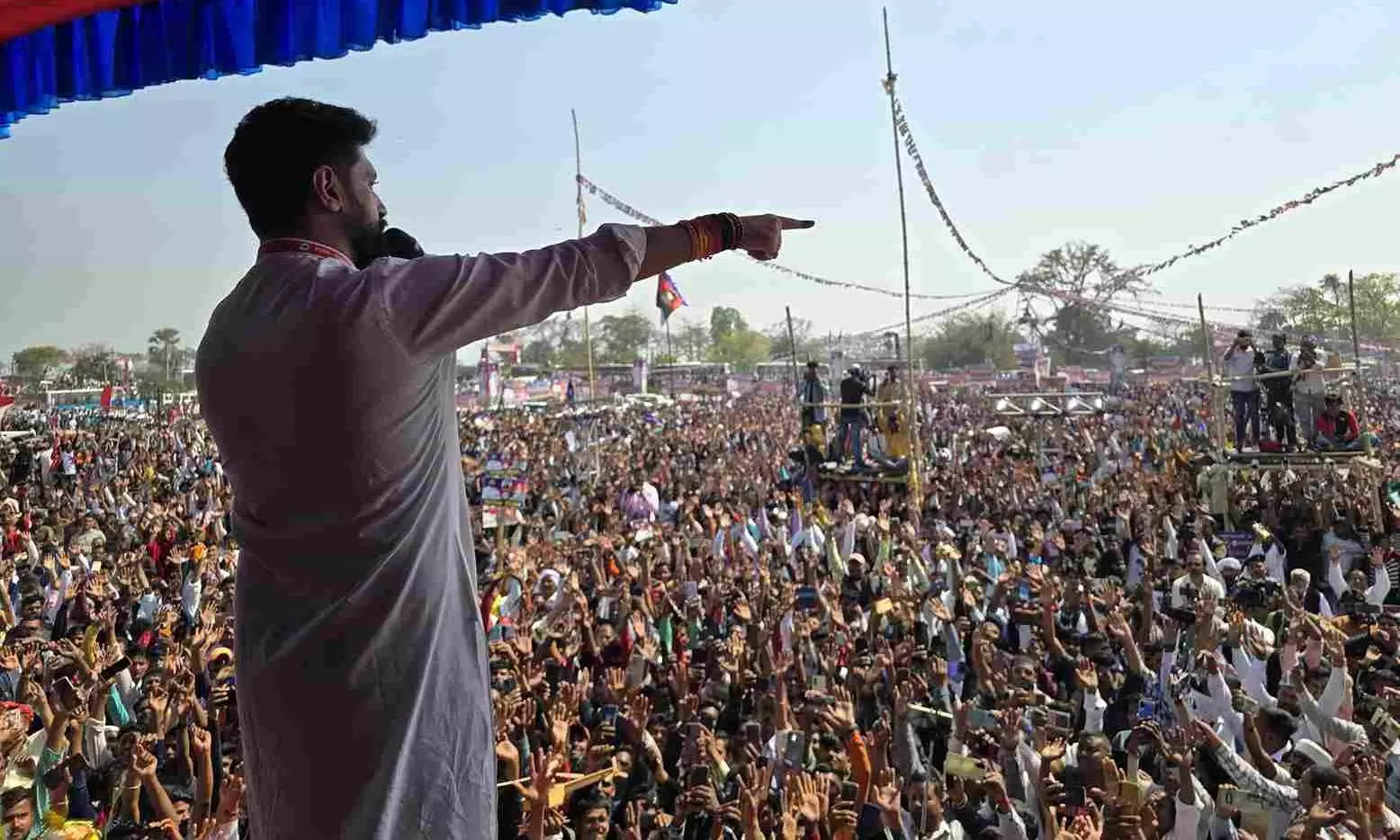
As the battle for Dalit voters intensifies ahead of the 2027 Uttar Pradesh Assembly elections, Union Minister and Lok Janshakti Party (Ram Vilas) chief Chirag Paswan has thrown his hat into the ring once again.
Paswan has declared his intention to contest all 403 Assembly seats, either independently or as an ally of the ruling Bharatiya Janata Party (BJP), provided his seat-sharing demands are adequately accommodated.
Paswan is banking on chipping away at a section of the non-Jatav Dalit vote, particularly among Pasis, the community he represents in neighbouring Bihar, and establishing his party’s foothold in a state from which the road to Delhi is not far off.
Can LJP find a foothold?
“Presently, our focus is primarily to strengthen our organisational base in the region. We are assessing the ground situation in almost all the regions, including Purvanchal and Awadh. We are holding various community-based programmes and testing waters. Final decision will be taken by the party in the coming months,” LJP (RV) national spokesperson Rajesh Kumar Bhatt told The Federal.
Also read | What Mayawati’s succession drama means for BSP’s future and Dalit politics
While some view the move as the BJP’s Plan B to arrest its steadily eroding support among non-Jatav Dalits, others see it as a manifestation of Paswan’s own ambition to break out of the confines of Bihar’s regional politics.
Beyond these competing interpretations and political conjectures, however, a more fundamental question looms over Paswan’s political foray: can he carve out a niche in a state where Dalit politics is far more complex than in Bihar, and where the precipitous decline of the Bahujan Samaj Party (BSP) has turned the contest for Dalit support into an increasingly crowded and fiercely fought battleground?
Political analysts and veteran journalists, meanwhile, remain sceptical of Paswan’s prospects in Uttar Pradesh.
“It’s a far-fetched idea for Paswan and his party to try and carve out a space in state’s Dalit political landscape. He’s a young and dynamic leader but he has no resonance among the voters in the state. What will he achieve from this, only time will tell,” Varanasi-based veteran political observer and scholar Surendra Dubey told The Federal.
A fragmented constituency
On the face of it, the LJP has reason to believe it may have an opening in Uttar Pradesh. Dalits constitute around 21 per cent of the state’s population, with Pasis accounting for roughly 3.5 per cent of the total population and 16 per cent of its Dalit population. The BSP’s steep decline has upended the caste arithmetic that once shaped electoral calculations. Its vote share plunged from 22.23 per cent in 2017 Assembly elections to 12.88 per cent in 2022 and 9.4 per cent in 2024 Lok Sabha elections.
Not surprisingly, all major parties are vying to capture the BSP’s scattered voter base and recalibrate their electoral coalitions.
“Perhaps, Paswan, too, sees an opportunity here. The LJP has been testing waters for the past few years in hope that even if a small chunk of that voter base comes to their side they can establish their foothold in Uttar Pradesh,” pointed out another Varanasi-based scholar, Dr Raj Kumar.
The scramble for BSP’s lost votes
This opening has since become a fiercely contested arena. The BJP was among the first to capitalise on Mayawati’s waning influence, reaching out to non-Jatav Dalit communities through a combination of welfare schemes, caste-based outreach and promises of political representation.
Yet this support proved far from secure. The 2024 Lok Sabha elections dealt a blow to the BJP, as the Samajwadi Party and Congress made significant inroads among non-Jatav Dalits through their broader PDA mobilisation. The Lokniti-CSDS post-poll survey estimated that 56 per cent of non-Jatav Dalits voted for the INDIA bloc, against 29 per cent for the NDA and 15 per cent for the BSP.
“Basically, the entire fight is to get hold of Mayawati’s vote bank that has drifted away from her. In 2017, when BSP’s vote share fell by roughly 4 percentage points BJP became the beneficiary. In 2022, when the party’s vote share fell by nearly 9% SP gained. SP, in fact, increased its gain in 2024,” political strategist and commentator Amitabh Tiwari told The Federal.
This fluidity has made the state’s political landscape more crowded and unpredictable.
Then there are smaller but consequential outfits, including the Nishad Party and Om Prakash Rajbhar’s Suheldev Bharatiya Samaj Party (SBSP), which have consolidated caste-based constituencies. Chandrashekhar Azad’s Azad Samaj Party (Kanshi Ram), meanwhile, signals the emergence of another pole of Dalit mobilisation.
Experts, therefore, caution the LJP against assuming that Chirag Paswan’s appeal among Dusadh-Paswan voters in Bihar will automatically translate into support among Uttar Pradesh’s Pasis.
LJP’s organisational weakness
The LJP’s electoral record in Uttar Pradesh does little to bolster Paswan’s ambitions. In the 2022 Assembly elections, the party contested independently after failing to reach a seat-sharing arrangement with the BJP. It failed to win a single seat and secured just 0.01 per cent of the vote.
Also read | Factionalism, ticket wars and poor turnout: Why Akhilesh’s Kannauj stronghold is fraying
The party, however, claims to have since strengthened its organisational base in the state. In recent months, it has organised community outreach programmes, including Vanchit Samaj Sammelans and Dalit Chaupals, across central and eastern Uttar Pradesh. It has also invoked Pasi icons such as Uda Devi and Maharaj Bijli Pasi in a bid to strike a chord with voters.
“We are finding out pockets where there’s good receptivity among the voters. We are also mobilsing voters and have been able to gather handsome crowd so far,” Bhatt maintained.
However, translating such symbolic mobilisation into a durable electoral constituency remains a formidable challenge, experts argue.
“Their organisation lacks the strength and resonance. Besides, people are watching that they show up only during elections. So, they know that they’d achieve nothing but only cut votes. And that, in turn, could lead to counter-consolidation of votes that may help SP more than any other party,” Dubey argued.
The BJP conundrum
Experts have also dismissed the suggestion that the LJP could serve as the BJP’s Plan B to win back the non-Jatav Dalit voters it lost in 2024. Dubey considers this a far-fetched proposition.
“A good chunk of Pasi voters have been with BJP for a long time now. And BJP itself have enough leaders and allies to mobilise that voter base. I don’t see how LJP can fit into that scheme at all,” Dubey noted.
Tiwari agrees with that assessment. He, however, believes the LJP could, at best, help the BJP avoid a bipolar contest, which could work to its advantage amid strong anti-incumbency and the anti-SIR wave.
“This election is all about mahaul (wave) and management. For BJP, the only help LJP can give is to splinter some votes and prevent SP gaining further from BSP’s decline. If there’s a direct bipolar contest, BJP would be in deep trouble this time,” Tiwari added.
For the BJP, however, that calculation comes with its own challenges. The LJP’s ambitions also present an awkward seat-sharing dilemma that the ruling party would rather avoid at this stage. The BJP already accommodates several regional allies whose political value rests on their influence among specific caste groups and in particular geographical pockets.
Paswan's UP push faces hurdles
Besides the Nishad Party and SBSP, it also has to accommodate Apna Dal (Sonelal) and the Rashtriya Lok Dal. Upsetting them could risk losing these allies, whose loyalties have previously proved fragile and flexible.
Also read | Amid changing political landscape, can Maya's BSP reclaim lost ground?
“Allocating even 10 Assembly seats to the LJP could therefore entail difficult compromises over the distribution of constituencies among existing partners. At best they can allocate them 2 seats,” Dubey argued. “And if he contests independently, it serves nobody,” he added.
For Paswan, therefore, the road into Uttar Pradesh is far from straightforward. The party will need more than caste-based outreach to make a dent in the state’s politics. Without a strong organisational network and leaders who can connect with voters on the ground, translating its ambitions into electoral gains could prove a Sisyphean task.
“As the 2027 Assembly elections approach, Paswan's Uttar Pradesh campaign may help him press his claim within the NDA and strengthen his national political profile. But making a cut in the fiercely contested Dalit political landscape of UP remains an altogether difficult proposition for him,” Tiwari added.