



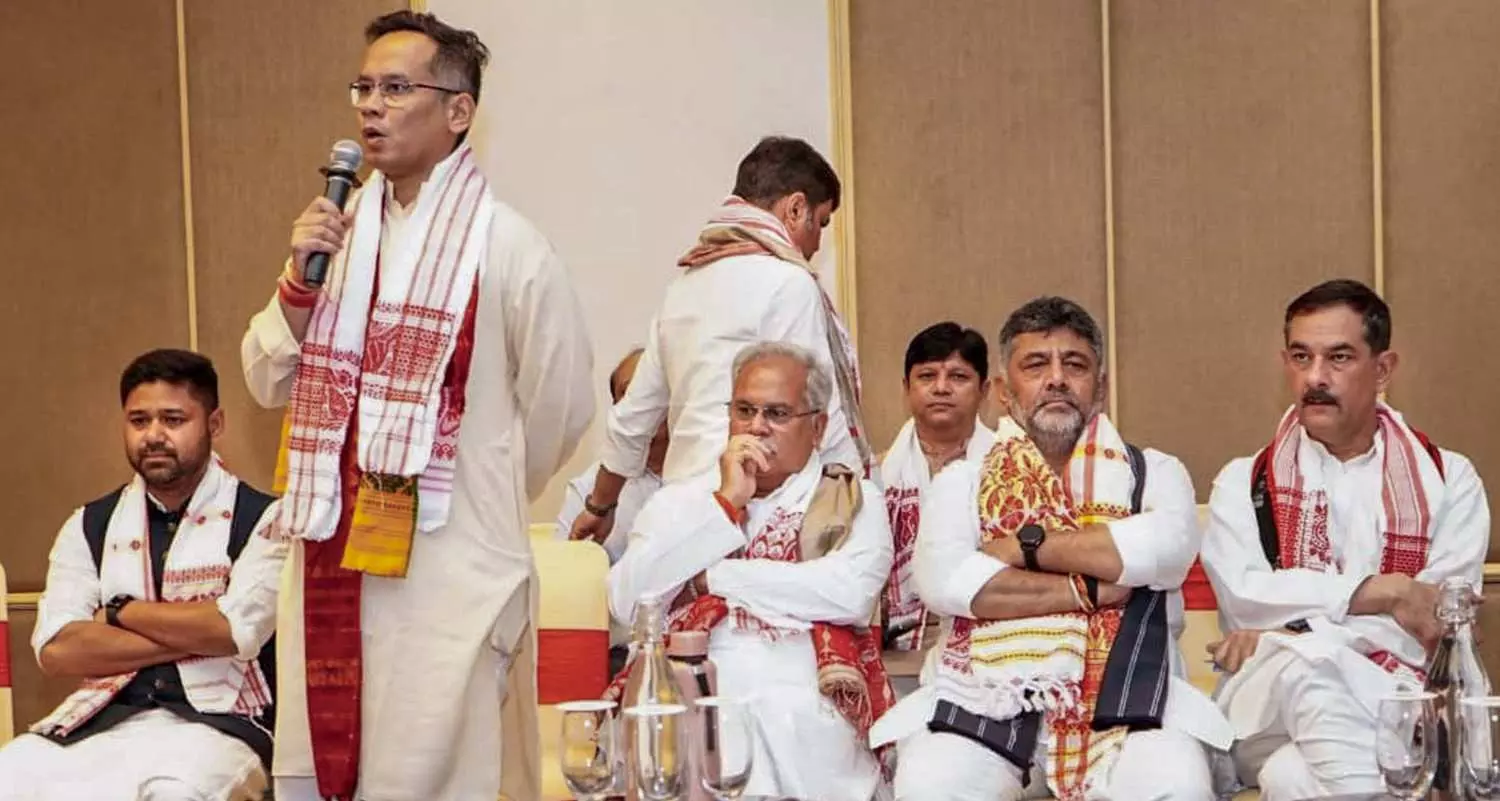
Assam Pradesh Congress Committee (APCC) president Gaurav Gogoi during the party observers’ meeting in Guwahati, Assam last week. Photo: PTI
Assam polls: Why Gaurav Gogoi suffered shock defeat in Jorhat
Perception gap about Gogoi, BJP’s strong grassroots mobilisation, and its welfare-driven narrative tilted key Assam battleground against Congress leader by almost 22,000 votes

In one of the most closely tracked contests of the Assam Assembly elections 2026, Gaurav Gogoi, president of the Assam Pradesh Congress Committee (APCC), suffered a decisive defeat from the Jorhat seat, losing by nearly 22,000 votes. The result comes even as the BJP stormed back to power with a commanding majority across the state.
Ground assessments by political consultancy 'Future Edge' point to a mix of local factors that shaped the outcome, many of which worked steadily against Gogoi through the campaign.
Perception gap
At the heart of the setback was a perception gap. Voters and even sections of party workers felt that Gogoi was not sufficiently accessible. His campaign was seen as less intensive than expected.
Pleading anonymity, a senior party leader said, “We felt he relied too much on legacy. People respect Tarun Gogoi, but elections need constant presence on the ground.”
Also Read: How Assam CM Himanta Biswa Sarma became the strategist who rewired the state’s politics
The reliance on emotional connect, particularly among Ahom voters, did not translate into sustained grassroots engagement.
BJP’s sharp counter-narrative
The BJP, meanwhile, crafted a sharp counter-narrative. Gogoi’s strong oratory and national visibility became a disadvantage.
Allen Brooks, former chairman of the Assam Minority Commission, said, “He speaks well, but Jorhat needs someone who will stay here and work every day. He is better suited for Delhi.”
This positioning subtly shifted voter perception, framing him as distant from local concerns.
Voting for continuity
Development remained a central plank. The BJP projected the election as a choice between continuity and disruption. Many voters appeared convinced that electing an opposition MLA could slow ongoing projects.
Mukul Phukan, a resident of Jorhat, said, “We wanted work to continue. There is a feeling that development will suffer if the ruling party candidate loses.”
Also Read: BJP claims Bengal, Assam surge shows ‘INDI Alliance’ has no future
Visible development work over the past five years added weight to this narrative. Roads, infrastructure, and local projects reinforced the BJP’s credibility, particularly in newly-added areas like Hulungapar Panchayat following delimitation. Once considered underdeveloped, the region has seen noticeable changes in recent years.
BJP’s strong grassroots work
The grassroots machinery also played a decisive role. BJP leaders maintained strong door-to-door outreach, ensuring consistent voter contact. At the same time, a section of younger voters, believed to favour Gogoi, were reportedly outside the constituency during polling, affecting turnout in his favour.
Another significant factor was the influence of Pabitra Margherita. Despite being a Rajya Sabha MP, he maintained a consistent presence in Jorhat and carried out extensive grassroots work, strengthening the BJP’s connect.
A local trader noted, “We see him regularly. He listens. That matters more than speeches.”
Shift in community voting patterns
Community voting patterns also shifted. During the Lok Sabha elections, sections of Bengali and Marwari voters had leaned towards the Congress due to concerns over the AT Road flyover construction impacting businesses. However, with the project completed and fears of long-term losses fading, support gradually returned to the BJP.
Also Read: Why Himanta-Gaurav clash is snowballing ahead of Assam elections
Dhanbar Deori, a resident of DCB Road, Jorhat, shared, “We were worried earlier, but business is stable now. So we changed our mind.”
Goswami’s approachable image
On the candidate front, BJP’s Hitendra Nath Goswami ran a measured and issue-based campaign. Avoiding aggressive rhetoric, he maintained a respectful tone throughout.
His image as a grounded and approachable leader resonated with voters.
The absence of a strong pro-Congress wave at the grassroots level further compounded Gogoi’s challenges, while the BJP’s organisational strength and steady campaign momentum ensured consolidation of support across segments. “Gaurav Gogoi is a capable leader at the national level, but Jorhat needs a local representative who is always present,” he said during the campaign.
Emotional undercurrent about Zubeen Garg
Several other factors also weighed on Gogoi’s defeat in Jorhat.
The Congress failed to tap into the emotional undercurrent following the mysterious death of cultural icon Zubeen Garg. Although the party had promised in its manifesto that “justice will be delivered in the Zubeen Garg case within 100 days of coming to power”, the issue never gained traction on the ground.
Also Read: Congress appoints Gaurav Gogoi as president of Assam unit
Gogoi himself struck a restrained note during the campaign, saying, “We will not do politics over Zubeen Garg.”
The stance, while cautious, meant the party could not convert public sentiment into electoral momentum.
Failure to counter BJP’s welfare narrative
At a broader level, the Congress struggled to present itself as a credible alternative to the BJP, despite visible pockets of anti-incumbency. The ruling party, on the other hand, continued to consolidate support through welfare initiatives such as the Orunodoi Scheme, which directly benefited economically-weaker sections.
Also Read: Cracks visible in Assam NDA despite projected landslide win: 'Fighting gaddars'
A voter summed up the mood, saying, “We saw schemes reaching people. Congress did not offer anything concrete for the poor.”
The absence of a strong, people-centric programme and a failure to counter the BJP’s welfare narrative contributed significantly to what turned into a humiliating defeat for the Congress in the constituency.
