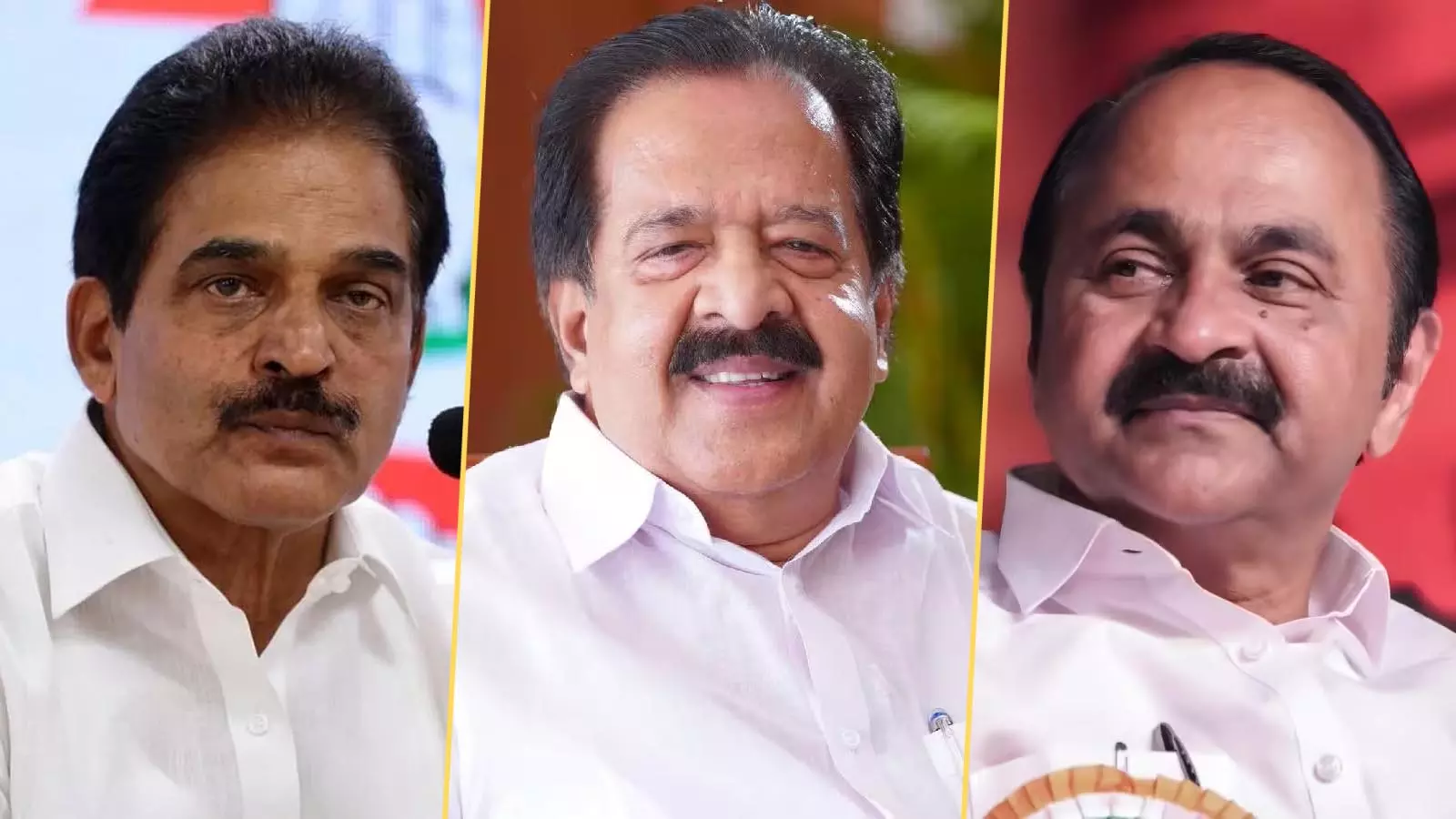
Three leaders, one chair: Congress’s Kerala CM test begins
Venugopal’s organisational clout, Chennithala’s seniority, Satheesan’s mass appeal converge into a leadership puzzle that the high command must carefully solve

On May 5, KC Venugopal was given a rousing welcome when he reached Delhi for his role as the “Chanakya” of the Congress-led UDF’s victory in Kerala. Inside and backroom accounts suggest that the reception was a carefully organised exercise, aimed at drawing the attention of the party’s first family and underlining his centrality to the win.
The optics were deliberate. In the Congress, where signals from Delhi often determine outcomes in the states, such moments are rarely incidental. Venugopal, who operates at the national level and enjoys proximity to the high command, appears to be converting his perceived strategic role into political leverage in the unfolding chief ministerial race.
Three contenders
The very next day, Ramesh Chennithala also received a workers’ welcome in Delhi. Like Venugopal, his presence in the capital was not without purpose. Chennithala has been a long-standing contender for the top post and his camp has been active in reinforcing his claim through organisational channels and personal networks.
Also read: UDF landslide in Kerala: The multiple factors that toppled Left
Unlike Venugopal, whose strength lies in his access to the high command and his reputation as an organiser, Chennithala’s pitch is built on seniority and experience. A former Leader of the Opposition and a familiar face in Kerala politics for decades, he has never hidden his ambition to become chief minister. Even now, he maintains that the post of Leader of the Opposition is not a guarantee for the chief ministership, but equally, it keeps him firmly in contention.
In contrast, VD Satheesan has been focusing on the ground in Kerala. His meetings continue to draw large crowds, evoking comparisons with the early 2000s phase of the CPIM strong man and former chief minister VS Achuthanandan, when mass appeal often cut through internal party complexities.
Three strategies
Satheesan’s strategy has been to build a visible public momentum. His supporters argue that he was the face of the Opposition throughout the campaign and that his connect with voters played a decisive role in the UDF’s victory. Yet, when asked whether he would be the next chief minister, Satheesan has maintained restraint. “The party will decide,” he said, avoiding any overt claim while keeping his position intact.
Venugopal, on the other hand, has hinted at a broader interpretation of eligibility, suggesting that an elected MLA need not necessarily be the chief minister. The remark has been read as a strategic signal, one that keeps his own prospects open despite his current role outside the assembly.
Also read: Kerala election results: What led to LDF's rout and what next for the Left?
Chennithala has taken a more direct line. He has not shied away from expressing his interest, even as he frames it within the party’s decision-making process. His approach reflects a belief that experience and continuity should weigh heavily in the final choice.
Voices from within the party
Amid these competing narratives, voices from within the party have begun to articulate sharper positions.
“The real foundation of the UDF’s victory in Kerala lies in the micromanagement strategies implemented by KC Venugopal. His large organisational capability, which guides the Congress at the national level, is what structured the election activities in Kerala so effectively. Without making any claims, he executed this campaign in a thoroughly scientific manner. This model of planning is a major lesson for students of politics. This new template of strategic excellence could also bring significant changes to governance in Kerala under KC Venugopal,” former MLA and Congress leader MP Vincent posted on social media.
At the same time, there is visible resistance within sections of the party. A former MLA, who now backs Satheesan, offered a sharply worded assessment:
“It is evident that Satheesan was the face of the Opposition throughout the campaign. He faced the wrath of the CPI(M) machinery and did all the hard work. Chennithala is a senior leader and we can understand his feelings. But what KC Venugopal is doing now is totally unwarranted. If at all he is imposed as the chief minister, he will have to face election. Which, knowing the Congress, I can say would not be a cakewalk for him, no matter where he fields himself.”
Challenge for high command
These contrasting views capture the essence of the triangular inner-party contest. Behind the scenes, the arithmetic of support is being worked out. Venugopal’s camp is said to be claiming the backing of around 43 MLAs, including a few who crossed over from the CPM during this election. Chennithala’s supporters insist that he too commands significant numbers within the legislature party. Satheesan, for his part, continues to build pressure through public mobilisation rather than immediate number counting.
Also read: Kerala polls: Between UDF-LDF’s usual vote exchange, a steady expansion of BJP base
The Congress high command now faces a delicate balancing act. With central observers Mukul Wasnik and Ajay Makan, headed to Thiruvananthapuram, they must weigh legislative support, public perception, organisational strength, and political messaging before arriving at a decision. Party insiders feel that the selection of observers, too, may prove advantageous for KC Venugopal. The choice will also signal the direction in which the party wants to move in Kerala, whether towards centralised control, experienced stewardship, or mass based leadership.
For the Congress in Kerala, this is a moment of both opportunity and risk. The electoral victory has opened up space for leadership renewal, but it has also triggered a contest that could test internal cohesion. The welcomes in Delhi, the crowds in Kerala, the statements and counter statements, and the steady consolidation of support all point to a race that is intense and far from settled.
The election may have been won, but within the Congress, the real contest has just begun.