Bengal, Assam exit polls spark fierce debate as experts question BJP-sweep predictions
Exit polls suggest major gains for the BJP but political analysts warn that voter sentiment, identity politics, and ground realities could still upend forecasts

The exit poll projection for the 2026 West Bengal Assembly election may be “technically correct but politically flawed”, according to political analyst Prof. Debashis Chakraborty, who argued that the dominant electoral issue—the Special Intensive Revision (SIR) of voter rolls—may not have been adequately captured by pollsters.
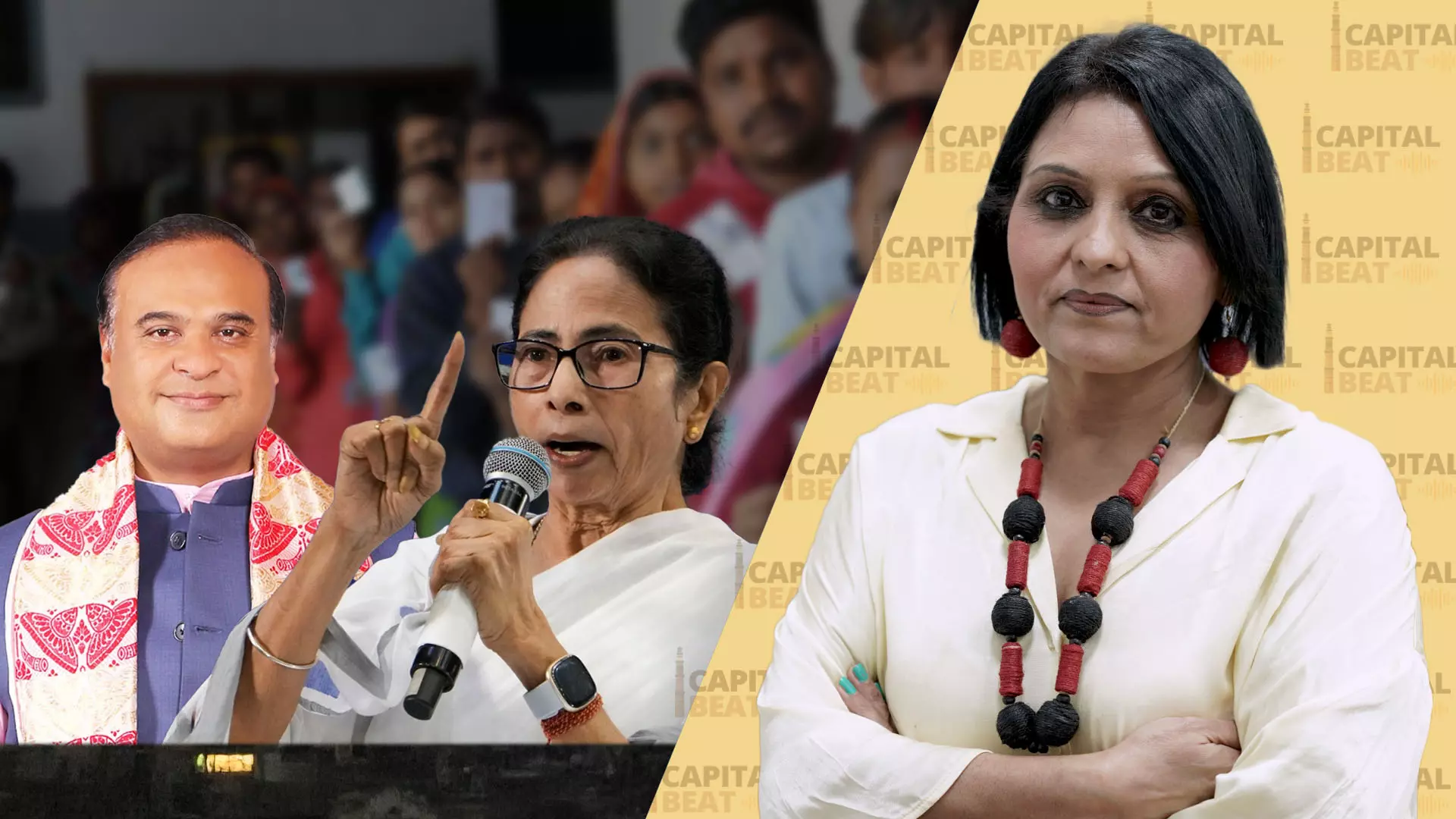
As West Bengal concluded voting on Wednesday (April 29) and the exit polls projected BJP wins in both Bengal and Assam, panellists on The Federal’s Capital Beat dissected whether the projected advances are real or overstated.
The Federal spoke to Prof. Debashis Chakraborty, political analyst from West Bengal, Sameer K Purkayastha, senior journalist covering the North East for The Federal; and Paramesh Malakar, Assam-based commentator, to understand the larger political undercurrents in two of India’s most closely watched state elections.
Divided picture
The exit polls presented a divided picture in West Bengal. While People’s Pulse projected the Trinamool Congress comfortably ahead with 177–187 seats, other agencies such as Poll Diary, Matrize, and P-Mark suggested a tighter race or even a BJP edge.
Also read: Exit polls reflect Bengal uncertainty; most give BJP the edge
Chakraborty strongly cautioned against taking these projections at face value. He argued that the SIR process, which reportedly led to large-scale voter roll deletions, had become a central emotional and political issue for voters.
According to him, public anger over electoral deletions and fears around voting rights may significantly alter final outcomes beyond what standard polling methodology can measure.
SIR factor
Chakraborty maintained that Bengal’s unusually high voter turnout reflected not necessarily anti-incumbency, but rather a mobilization driven by fears of disenfranchisement.
He suggested that voters were determined to protect democratic participation, especially amid allegations that millions of names were removed from electoral rolls. This, he said, could create a political backlash against perceived external interference.
He also argued that Mamata Banerjee’s positioning as a defender of Bengali identity and voting rights may strengthen her despite anti-incumbency and corruption allegations against her government.
Mamata versus BJP
The Bhabanipur contest between Mamata Banerjee and BJP’s Suvendu Adhikari emerged as a symbolic battle.
Also read: How SIR row reshaped EC's Bengal poll process | Om Prakash Mishra
While acknowledging anti-incumbency against the TMC, Chakraborty said BJP’s dependence on central leadership and Hindi-centric campaigning may limit its resonance with Bengali voters.
He argued that Bengali political consciousness, shaped by decades of ideological struggles, could resist simplistic welfare or nationalist appeals if voters perceive them as culturally disconnected.
Minority calculus
Senior journalist Sameer K Purkayastha highlighted the importance of minority and women voters in Bengal’s outcome.
He noted that Muslim voters, who form a significant electoral bloc, may determine whether TMC retains dominance or whether fragmented voting benefits BJP.
Purkayastha also emphasized the enduring influence of welfare schemes like Lakshmir Bhandar among women voters, while noting BJP’s strategic shift from criticizing welfare politics to offering competing benefits.
Assam equation
In Assam, most exit polls gave BJP a commanding lead, with projections ranging from 65 to over 100 seats.
Also read: Resign if TMC wins in Bengal polls: MP Derek O'Brien dares PM Modi
However, Paramesh Malakar expressed scepticism, citing strong grassroots dissatisfaction with Chief Minister Himanta Biswa Sarma’s governance style.
He suggested rising debt, authoritarian perceptions, identity concerns, and emotional resonance around the death of singer Zubeen Garg may have created stronger anti-incumbency than polls suggest.
Himanta under scrutiny
Malakar argued that while BJP may still emerge as the largest force, the scale of victory predicted by exit polls could be exaggerated.
He described widespread resentment over governance, evictions, and perceived erosion of Assamese identity.
Additionally, speculation persists that even if BJP returns to power, the central leadership may reconsider Himanta Biswa Sarma’s continuation as chief minister.
Social engineering
Purkayastha explained BJP’s resilience in Assam through strategic coalition-building among non-Assamese Hindu communities, tribal groups, and tea tribes.
Also read: SIR, anti-incumbency, resurgent Left-Cong make Bengal polls a nail-biter
This social engineering, he said, may offset dissatisfaction among Assamese-speaking voters and preserve BJP’s broader electoral advantage.
Still, both analysts agreed that Assam’s final result may be closer than projections indicate.
Exit polls under lens
Across both states, panellists repeatedly stressed caution in interpreting exit poll data.
While TV coverage amplifies projections due to public interest, ground realities—identity politics, voter suppression concerns, welfare schemes, and leadership perception—could significantly alter outcomes.
The true verdict, of course, will only emerge on counting day, May 4.
(The content above has been transcribed from video using a fine-tuned AI model. To ensure accuracy, quality, and editorial integrity, we employ a Human-In-The-Loop (HITL) process. While AI assists in creating the initial draft, our experienced editorial team carefully reviews, edits, and refines the content before publication. At The Federal, we combine the efficiency of AI with the expertise of human editors to deliver reliable and insightful journalism.)