How SIR row reshaped EC's Bengal poll process | Om Prakash Mishra
Voter deletions, security surge, and central oversight—has Bengal election changed the rules of the game? Political scientist Mishra's exclusive interview

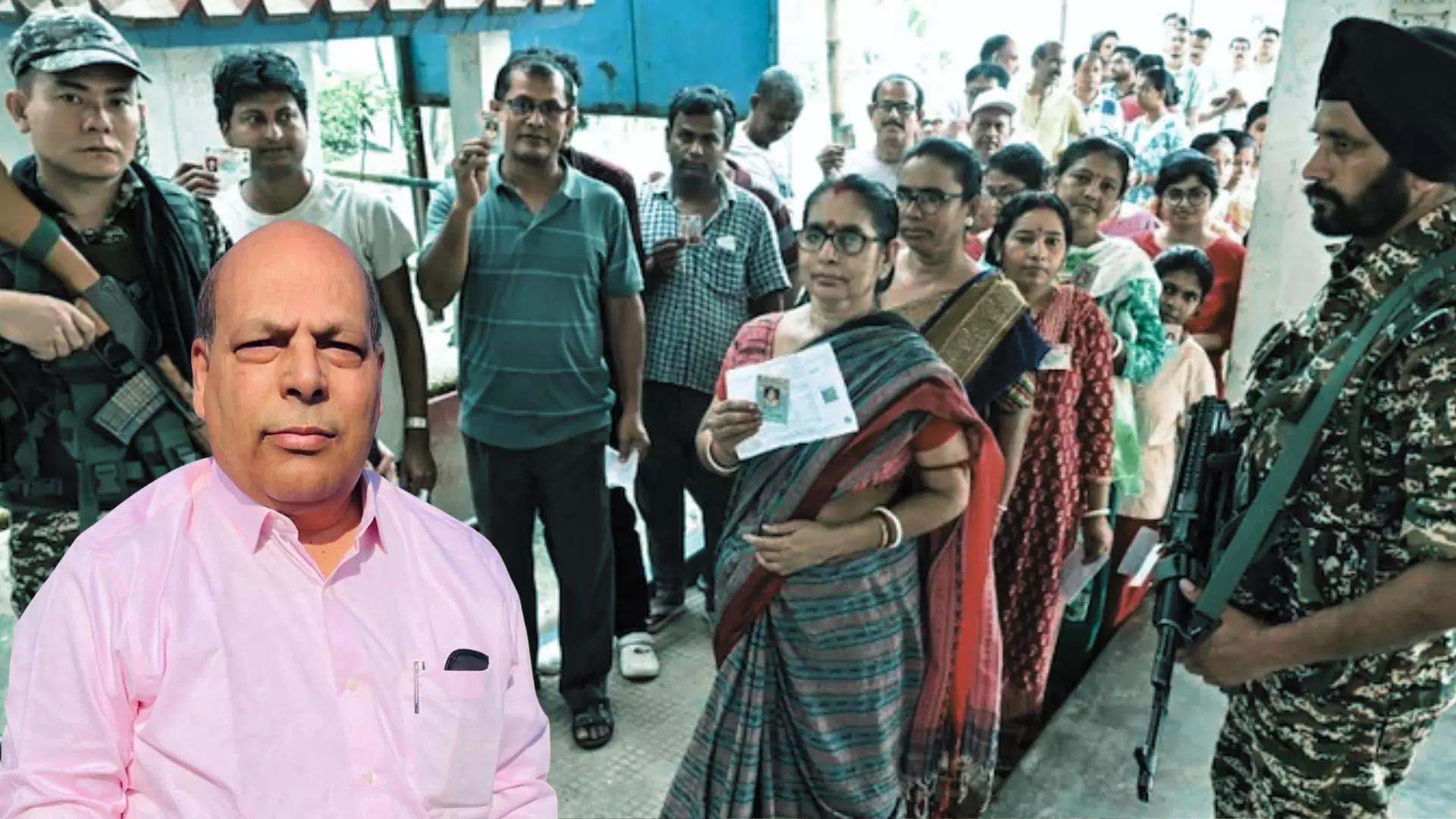
Allegations of large-scale voter exclusion and a calibrated electoral process have cast a shadow over the 2026 West Bengal Assembly election, with concerns ranging from last-minute revisions of voter rolls to unprecedented deployment of central forces. The debate around the Special Intensive Revision (SIR) has become central to the political contest.
The Federal spoke to Prof Om Prakash Mishra, former Vice Chancellor of the University of North Bengal and president of the Institute of Development Studies, Kolkata, on the implications of these developments for electoral integrity and democracy.
How has the continuous revision of voter lists till the last days before polling affected the conduct of elections?
Electoral rolls are dynamic, with new voters being added and names of those who have moved or passed away being removed. That is normal. But what is happening in the name of Special Intensive Revision is atrocious. It is not about inclusion or expanding the democratic base. It is being carried out in an exclusionary fashion to decide who gets to vote.
Instead of people electing a government, voters themselves are being chosen. This is unprecedented, borderline illegal, and unconstitutional. The Supreme Court has not clearly ruled on its validity, and the process has become a political instrument of exclusion that is dividing society and directly assaulting people’s rights.
What is this logical discrepancy being cited for voter deletions? Can you explain with examples?
There is nothing called logical discrepancy. If there is a discrepancy, it cannot be logical. This is an invention of the Election Commission. It is a last-ditch attempt to satisfy certain political expectations based on flawed assumptions about West Bengal’s demography.
Instead of people electing a government, voters themselves are being chosen. This is unprecedented, borderline illegal, and unconstitutional."
I can give you many examples. My wife has been a voter for over 30 years, yet her name was flagged under this so-called discrepancy and only restored in the supplementary list. Even family members of a judge faced similar issues.
Minor spelling differences—like Ahmed or Ahamed, Chattopadhyay or Chatterjee—are being used as grounds for exclusion. This has created a complete mess. It appears they first decided how many people to exclude and then used procedures to justify it.
Has this process disproportionately affected certain communities or sections?
The initial intent may have been to target certain communities, but it has affected everyone—especially poorer and marginalised groups, including Matua, Adivasi, and Rajbanshi communities. Around 60 lakh people were flagged, and while some were restored, nearly 27–28 lakh remain excluded.
These are citizens whose right to vote has been taken away. We cannot call ourselves a democracy when such large numbers are denied participation.
If voter data in West Bengal is already highly accurate, what is the need for such an exercise?
The data shows that West Bengal’s voter-to-population ratio is consistent with other states, even better in some respects. But Bengal has been singled out and projected as problematic. We demonstrated this with experts like Yogendra Yadav and others.
The narrative of irregularity is not supported by evidence. When the original justification did not hold, logical discrepancy was introduced to continue the exclusions.
How do you explain the concept of unmapped population being used as a concern?
The Election Commission said voters linked to the 2002 rolls or their parents were considered mapped. But when they found that mapping levels were high even in districts they were focusing on, their assumptions fell apart. That is when they introduced logical discrepancy.
Common variations in names or documentation are being treated as grounds for exclusion. Even people with passports and long voting histories have been removed. There is also a possibility—though I cannot prove it—that technology is being used to infer political orientation, making the exclusions appear less random than they seem.
How are people reacting to these deletions on the ground?
There is not much confusion among people about what is happening. It is widely understood that this was intended to benefit one political side but has not succeeded. These exclusions have affected families across communities, and in many cases, one or two members per family have been removed. At the micro level, this has created a strong negative sentiment.
Civil society and opposition parties have been vocal, and the credibility of the Election Commission is already being questioned.
What about the large deployment of central forces and officials? Does it reassure voters?
Security deployment is not new in West Bengal. But the scale this time is unprecedented—almost 60% of central forces in the country are here. This raises questions. It appears more like psychological pressure than necessity.
While Bengal does have a history of political violence, the situation has not been as extreme as portrayed. Despite this, voter turnout is likely to be very high because people are determined to protect their vote.
How do you view the role of the Supreme Court in this process?
The Supreme Court has maintained that the Election Commission is independent, but it has intervened inconsistently. It has not addressed the central question of whether SIR is mandatory. In some ways, this has allowed the process to continue. The Court has provided partial relief but avoided decisive rulings. This creates an impression of inconsistency and raises concerns about accountability.
Do you see the 2026 Bengal election as a turning point in how elections are conducted in India?
This election has serious implications. It reflects a broader shift away from constitutional and federal principles. West Bengal could become a test of democratic resilience. If such processes continue unchecked, it could fundamentally alter how elections are conducted. However, if people respond strongly, Bengal could also set an example of resistance and reaffirm democratic values.
What about the 27 lakh people who could not vote? What impact does that have?
They have become the most active campaigners against the BJP. Many of them were not politically active earlier, but this experience has mobilised them. This unintended consequence has actually worked against those who designed the process.
The content above has been transcribed from video using a fine-tuned AI model. To ensure accuracy, quality, and editorial integrity, we employ a Human-In-The-Loop (HITL) process. While AI assists in creating the initial draft, our experienced editorial team carefully reviews, edits, and refines the content before publication. At The Federal, we combine the efficiency of AI with the expertise of human editors to deliver reliable and insightful journalism.