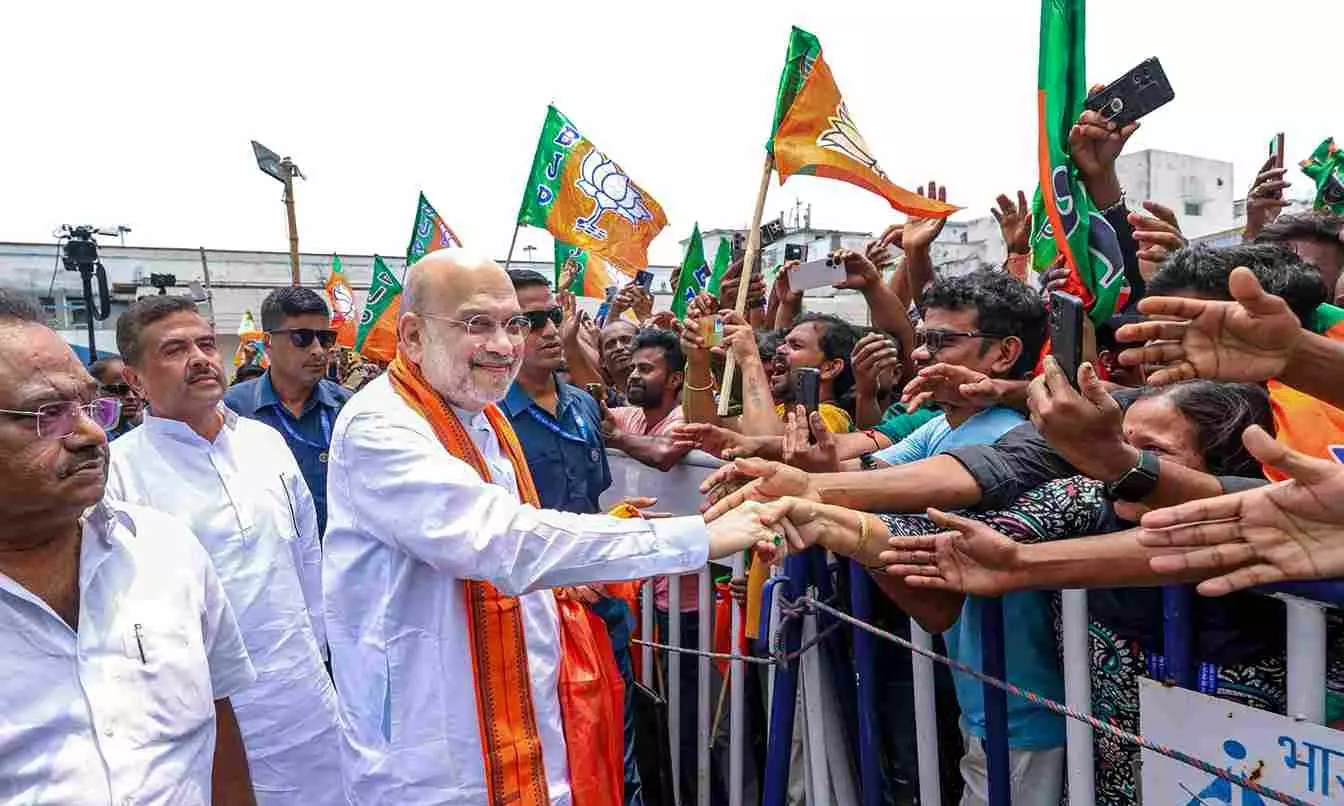
Union Home Minister Amit Shah greets supporters upon his arrival at the airport ahead of the BJP legislature party meeting, in Kolkata. BJP leader Suvendu Akhikari and party state president Samik Bhattacharya are also seen. Photo: X|@AmitShah via PTI
Bengal still in a state of flux as Amit Shah lands in Kolkata
Amit Shah arrives in Kolkata to finalise historic transition of power as a legal vacuum deepens over dissolution of the assembly and ongoing political violence

Union Home Minister Amit Shah arrived in Kolkata on Friday (May 8) to oversee the selection of West Bengal’s first Bharatiya Janata Party chief minister after the party’s historic election victory.
The selection will set the ball rolling for the formation of the new government, even as a constitutional grey zone deepened over who is technically running the state following governor R N Ravi’s dissolution of the assembly a day earlier amid ongoing post-poll violence.
Legal experts and political observers remained divided over the implications of Thursday’s dissolution of the assembly.
Unusual situation
One section argued that Mamata Banerjee continued as a caretaker chief minister because the governor had not explicitly withdrawn the constitutional “pleasure” under which a chief minister holds office. Others contended that with the assembly dissolved and no alternative ministry sworn in, the state was effectively under a form of President’s Rule in practice, even without a formal proclamation or a written notification.
“The Constitution is silent on such an extraordinary situation,” said a Kolkata-based constitutional expert Arindam Das. He was referring to the unusual sequence in which an elected chief minister refused to resign after losing power and the governor dissolved the assembly without any formal communication to the outgoing chief minister to continue until a new government is sworn in.
“Different institutions are interpreting the vacuum differently. What is unfolding is essentially a game between the lines of the Constitution,” he added.
Also read: Bengal violence raises questions over Election Commission's accountability | AI With Sanket
The uncertainty cast an unusual backdrop to the BJP’s transition to power, after it won 207 seats out of the 293 constituencies where polling was completed, ending more than a decade of Trinamool Congress rule and paving the way for the saffron party’s first government in Bengal. A re-poll in the Falta assembly constituency has been scheduled for May 21.
Oath-taking ceremony
Shah landed in Kolkata around midday and was scheduled to hold a series of meetings with senior BJP leaders and legislators to finalise the party’s choice for chief minister and cabinet formation. With his arrival the BJP’s preparations for government formation gathered pace ahead of Saturday’s oath-taking ceremony at Kolkata’s Brigade Parade Ground.
Leader of Opposition Suvendu Adhikari, who defeated Mamata in the election and led the BJP campaign in large parts of the state, remained the frontrunner in internal discussions, although party leaders said the central leadership had not yet formally conveyed its decision. The BJP was also considering appointing two deputy chief ministers to balance regional and caste equations, according to party sources.
The oath-taking ceremony, scheduled for Saturday morning, is being projected by the BJP as both a political and symbolic event.
The ceremony will coincide with Rabindra Jayanti, the birth anniversary of Nobel laureate Rabindranath Tagore, and will be held at the historic Brigade Parade Ground rather than the Raj Bhavan, breaking with convention.
Prime Minister Narendra Modi, Shah and chief ministers of BJP-ruled states are expected to attend.
Organisers said more than 50,000 seats were being arranged and thousands of special invitations issued. Several leading industrialists of the country are also reportedly among those invited to attend the swearing-in ceremony. Officials were also preparing for a symbolic shift in the seat of power.
Also read: What happens if Mamata does not resign? West Bengal drama hots up
The incoming BJP chief minister is expected to briefly visit the colonial-era Writers’ Buildings after the swearing-in before beginning official work from a temporary chamber there. The party has decided to revive a structure long associated with Bengal’s political history before the Mamata Banerjee government shifted administrative operations to Nabanna in Howrah.
Sporadic clashes
Even as the BJP prepared for its formal assumption of office, tension and sporadic clashes continued in several districts following the election result.
In Howrah’s Shibpur area, clashes broke out late Thursday between BJP and TMC supporters, with both sides accusing each other of attacks and intimidation. Crude bombs were allegedly hurled during confrontations in the Chaora Basti area, prompting police deployment. Local residents described an atmosphere of fear amid continuing political hostilities.
The violence came amid a broader churn in local institutions following the BJP victory.
In another sign of the changing political balance, the BJP-backed panel reportedly took control of the employees’ association at the Howrah Municipal Corporation, a body long considered aligned with the TMC. The development is seen as an early indicator of shifting loyalties within civic and administrative institutions after the election outcome.
Meanwhile, district authorities increased patrols, deployed rapid response teams and conducted meetings with political parties in sensitive areas to prevent retaliatory attacks. Sources said police had warned local leaders across party lines against attempts to seize party offices or organise victory processions without permission.
For ordinary residents, concerns over law and order and incidents of political reprisals remained immediate worries after one of the most polarised elections in the state’s recent history.
Growing unease within TMC
The political turbulence also exposed strains within the defeated TMC.
The party on Friday issued show-cause notices to five spokespersons and leaders for making public comments deemed detrimental to the party line after the election defeat. The notices were linked to criticism of the party leadership and remarks questioning organisational failures during the campaign, TMC sources said.
Also read: SIR didn't cost Mamata Bengal, women's anger did, says Yashwant Deshmukh | AI With Sanket
The disciplinary action reflected growing unease within the TMC as leaders privately debated the reasons for the party’s defeat after more than a decade in power. Some leaders have raised questions over candidate selection, allegations of corruption and the handling of the controversial Special Intensive Revision (SIR) of electoral rolls that became a dominant issue during the campaign.