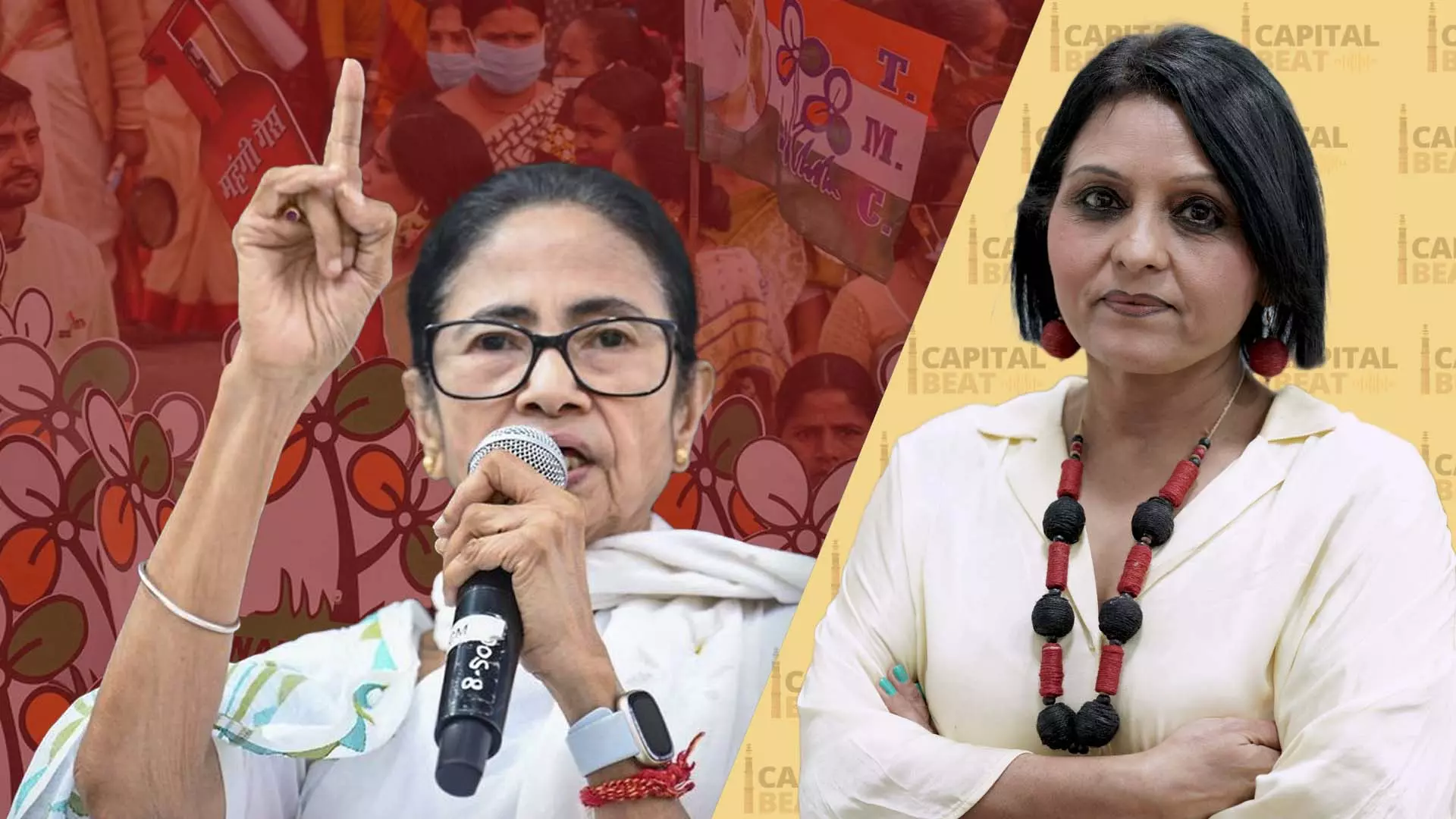
What happens if Mamata does not resign? West Bengal drama hots up
After election loss, Mamata claims 'moral victory', blames the Election Commission, and signals a national political role amid post-results violence and opposition outreach

Mamata Banerjee’s declaration that she “will not resign” and has “morally won the election” despite official results has triggered sharp political debate and raised concerns about a possible constitutional standoff in West Bengal. In this episode of Capital Beat, Neelu Vyas spoke to senior journalist Shikha Mukherjee, political analyst Saminur Rahaman, and Samir K Purkayastha from The Federal, who weighed in on the implications of her stance and the evolving political situation in West Bengal.
Mamata, addressing her first press conference after the results, dismissed the idea of stepping down or visiting Raj Bhavan, asserting that the election outcome was manipulated. She alleged that the Election Commission played a “villainous” role and claimed that her party had been forcibly defeated.
Refusal to resign
Mamata categorically ruled out resignation, stating that “the question doesn’t arise". She maintained that while the Election Commission may have officially declared her party’s defeat, “morally we have won the election".
Her remarks came amid reports of post-poll violence across West Bengal, including vandalism of Trinamool Congress offices and alleged attacks on party workers. She also claimed she was manhandled and pushed out of a counting centre during the election process.
Also Read: Bengal's Didi shield cracks: How Mamata Banerjee lost the state she dominated
According to Mukherjee, Mamata's stance appears to be political posturing rather than a permanent refusal.
“At some point, better sense will prevail, and she will resign as per institutional practice,” she said, noting that the transition of power requires the outgoing chief minister to step down.
Political messaging
Panellists suggested that Mamata's strong rhetoric is aimed at energising her party cadre, which appears demoralised after the defeat. Professor Rahman noted that Mamata is returning to her earlier image as a “fighter", reminiscent of her days as an opposition leader.
“She needs to boost the confidence of TMC workers who are feeling vulnerable amid reports of violence,” he said. “Her aggressive posture is a way to signal that the fight is not over.”
Mamata also announced the formation of a 10-member fact-finding committee to investigate alleged post-result violence and irregularities. She reiterated claims of voter list deletions, EVM tampering, and “captured” counting centres.
Allegations and violence
The discussion highlighted multiple reports of violence following the election results. Visuals circulating on social media show vandalised party offices and provocative imagery targeting Mamata, though their authenticity could not be independently verified.
Journalist Sameer pointed out that while some videos remain unverified, there are confirmed incidents of attacks on party workers and offices.
“Post-poll violence is an unfortunate but recurring feature of Bengal politics,” he said.
Also Read: What explains Bengal’s saffron shift? 6 reasons why Mamata was decimated
He added that despite calls for change in political culture, the ground reality shows little shift.
“Only the colour has changed; in many cases, the actors remain the same,” he observed, referring to allegations that local political loyalties have shifted opportunistically.
Constitutional questions
Mamata's refusal to resign has raised questions about a potential constitutional crisis. Under established convention, a chief minister must step down once the term ends, allowing the governor to facilitate the formation of a new government.
Professor Rahman explained that if Mamata does not resign voluntarily, the governor may have to dismiss her. This could lead to a brief period of central rule until a new government is sworn in.
“With the swearing-in expected around May 9, there may be a short interim period where governance arrangements need to be clarified,” he said.
National ambitions
Mamata's statements also indicate a shift towards national politics. She thanked leaders such as Sonia Gandhi, Rahul Gandhi, and Akhilesh Yadav, indicating renewed alignment with the INDIA bloc.
Mukherjee noted that Mamata is likely to leverage her position as a “wronged leader” to build a broader narrative against the BJP at the national level.
Also Read: Mamata warns of ‘tampering’ as tensions mount ahead of Bengal counting on May 4
“She is positioning herself as a victim of systemic manipulation and could use this to rally opposition forces,” she said.
Rahul Gandhi’s tweet supporting Mamata's claims and warning about threats to democracy further underscores the possibility of a unified opposition strategy.
Party cohesion
A key challenge for Mamata will be maintaining unity within the Trinamool Congress. Reports of defections and pressure on party members have added to concerns about internal stability.
Rahman pointed out that the party heavily depends on Mamata's personal charisma.
“Her leadership will determine whether the party can hold together in this phase,” he said.
He also noted that fears among party workers could lead to shifts in allegiance, especially in a volatile political environment.
What lies ahead
With the BJP expected to form the next government and speculation around the chief ministerial candidate, the political landscape in West Bengal remains fluid. The proposed swearing-in date of May 9, which coincides with Rabindranath Tagore’s birth anniversary, adds symbolic significance to the transition.
Also Read: Full list of CMs, ministers who lost elections across TN, Bengal, Kerala
As Mamata signals both resistance and reinvention, the coming days will determine whether her stance leads to institutional confrontation or a strategic repositioning in national politics.
(The content above has been transcribed from video using a fine-tuned AI model. To ensure accuracy, quality, and editorial integrity, we employ a Human-In-The-Loop (HITL) process. While AI assists in creating the initial draft, our experienced editorial team carefully reviews, edits, and refines the content before publication. At The Federal, we combine the efficiency of AI with the expertise of human editors to deliver reliable and insightful journalism.)