No invite for Vijay's TVK: Why experts say TN Governor is overstepping
Legal experts say the Governor's insistence on 118 letters of support before swearing in Vijay runs counter to settled constitutional practice, and could face judicial scrutiny.

Tamil Nadu’s political deadlock has triggered a larger constitutional debate over the Governor’s powers in a hung Assembly, with legal experts questioning whether Governor Rajendra Vishwanath Arlekar can insist on proof of majority before inviting TVK chief Vijay to form the government.
With no rival coalition formally staking claim yet, the focus has shifted to whether the Governor should allow the single largest party to take the floor test route instead of demanding written support from 118 MLAs.
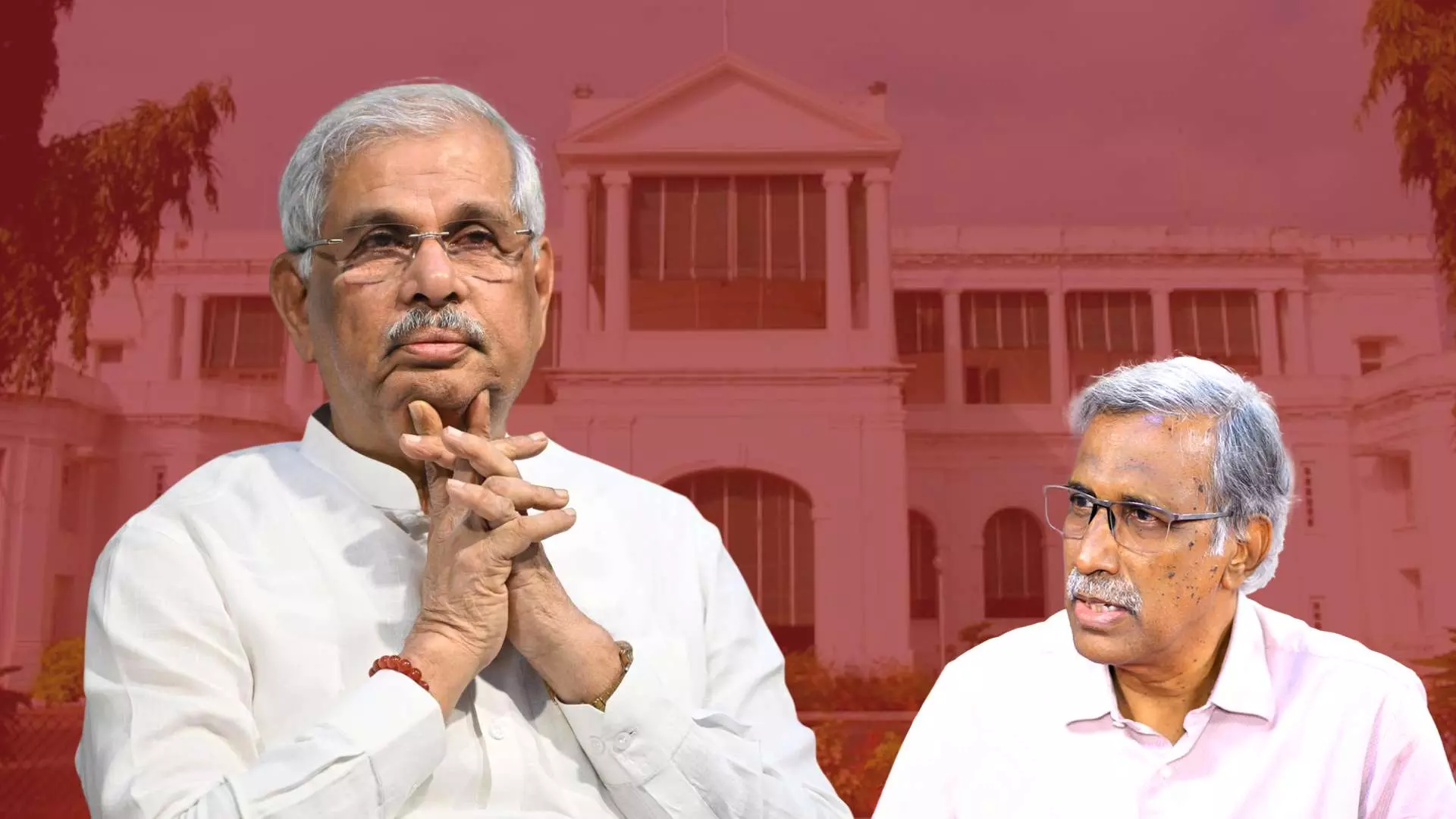
The Federal spoke to PDT. Achary, former secretary- general of the Lok Sabha, and V Venkatesan, senior legal journalist, on the evolving constitutional and political situation in Tamil Nadu.
More than 48 hours after Tamilaga Vettri Kazhagam emerged as the single largest party in Tamil Nadu with 108 seats, the Governor has still not invited Vijay to form the government. The TVK leader reportedly met the Governor twice seeking an invitation to form the ministry, but was asked to establish majority support first.
The key constitutional question now is whether the Governor can insist on proof of majority before swearing in a Chief Minister, or whether that test should happen only on the floor of the Assembly.
Also Read: TN hung Assembly: What Governor can do, and what he can't
Achary said the Governor’s constitutional duty was to facilitate the formation of a stable government in the state. He pointed out that the Sarkaria Commission guidelines, later endorsed by the Supreme Court, laid down an order of preference in hung Assembly situations.
According to him, the Governor must first look for a pre-poll alliance with a majority. If that does not exist, the next option is a post-poll alliance. If neither exists, the single largest party gets the opportunity.
Governor’s role
Achary noted that TVK had quickly secured Congress support after the results and was also attempting to gather support from smaller parties. In that context, he said the Governor had to decide whether the emerging alliance could provide a stable government.
Since TVK was the single largest party and no other post-poll coalition had formally emerged, the Governor had no constitutional alternative but to invite Vijay to form the government and seek a confidence vote within a reasonable time
He stressed that this was one of the rare situations where the Governor exercised discretion because there was no Council of Ministers to advise him. Drawing comparisons from history, Achary referred to former President Shankar Dayal Sharma inviting Atal Bihari Vajpayee to form the government in 1996 despite lacking a majority. Vajpayee was then asked to prove his majority in the Lok Sabha, though the government lasted only 13 days.
He also cited the 1998 example when President KR Narayanan demanded letters of support from NDA allies before inviting Vajpayee to form the government. Achary described that moment as a major constitutional template for future Governors and Presidents.
At the same time, Achary maintained that nothing prevented Governor Arlekar from inviting Vijay immediately and asking him to prove majority on the Assembly floor later.
“He should certainly give an opportunity to this young man to form the government because he is closer to the majority and there is no other viable option now,” Achary said.
Floor test
Venkatesan, however, took a stronger view against the Governor’s current approach. He argued that the Governor could not decide whether a future government would be stable because that determination belonged exclusively to the Assembly through a floor test.
He said the Supreme Court had repeatedly clarified that majority could only be tested on the floor of the House and not inside Raj Bhavan.
According to him, since TVK was the single largest party and no other post-poll coalition had formally emerged, the Governor had no constitutional alternative but to invite Vijay to form the government and seek a confidence vote within a reasonable time.
Venkatesan also rejected the idea that a minority government was unconstitutional. He pointed to several historical examples, including the P.V. Narasimha Rao government at the Centre, which functioned without an outright majority.
“If he fails, he falls. What is wrong in that?” Venkatesan asked, arguing that constitutional practice already recognised minority governments.
He said courts had repeatedly shortened the time available for confidence votes in similar situations but had not blocked Governors from inviting single largest parties to form governments.
Judicial review
The discussion also turned to whether the Governor’s refusal could face judicial scrutiny.
Venkatesan argued that the present situation was unprecedented because previous court cases largely involved disputes over inviting the “wrong” claimant. Here, he said, the issue was the Governor refusing to invite the single largest party itself.
He maintained that insisting on written support from 118 MLAs before extending an invitation was constitutionally unsound.
“As of now there is no rival claimant apart from Vijay. Nothing prevents the Governor from extending the invitation,” he said.
According to him, Vijay could immediately approach the Supreme Court if the Governor continued to delay a decision.
Venkatesan clarified that while Governors enjoy constitutional immunity and cannot personally be issued notices, courts can still examine whether gubernatorial discretion was exercised properly.
He cited the Rameshwar Prasad case linked to the dissolution of the Bihar Assembly in 2005, where the Supreme Court strongly criticised the Governor’s actions.
Political process
Both panelists agreed that political negotiations could still alter the situation significantly over the next few days.
Achary said the Governor could also choose to wait for alternative post-poll coalitions if he believed they had the ability to form a stable government. However, he cautioned that the constitutional process could not remain indefinitely stalled because the outgoing government could only function in a caretaker role for a limited time.
Venkatesan warned against the Governor pre-empting possible “horse trading” as justification for delaying government formation. Referring again to Supreme Court rulings, he said apprehensions alone could not be grounds to recommend President’s Rule or deny a claimant the opportunity to prove majority.
“The Governor has to give space to the political process rather than pre-empt all that,” he said.
He added that political parties might still choose to abstain, walk out, or extend issue-based support during a confidence vote, possibilities that the Governor could not predict in advance.
President’s Rule
The possibility of President’s Rule was also discussed during the conversation. Achary said that if no viable government emerged, the Governor could eventually recommend President’s Rule and keep the Assembly in suspended animation while political negotiations continued.
However, both panelists indicated that such a step should come only after all options for government formation had been exhausted.
For now, the central constitutional question remains unresolved: whether the Governor’s insistence on written majority support before swearing in Vijay amounts to a reasonable exercise of discretion or an unnecessary departure from established parliamentary convention.
The content above has been transcribed from video using a fine-tuned AI model. To ensure accuracy, quality, and editorial integrity, we employ a Human-In-The-Loop (HITL) process. While AI assists in creating the initial draft, our experienced editorial team carefully reviews, edits, and refines the content before publication. At The Federal, we combine the efficiency of AI with the expertise of human editors to deliver reliable and insightful journalism.