Hung Assembly in Tamil Nadu: what the Governor can and cannot do
Five precedents and a settled Supreme Court line constrain Governor Arlekar’s choices in the next fortnight

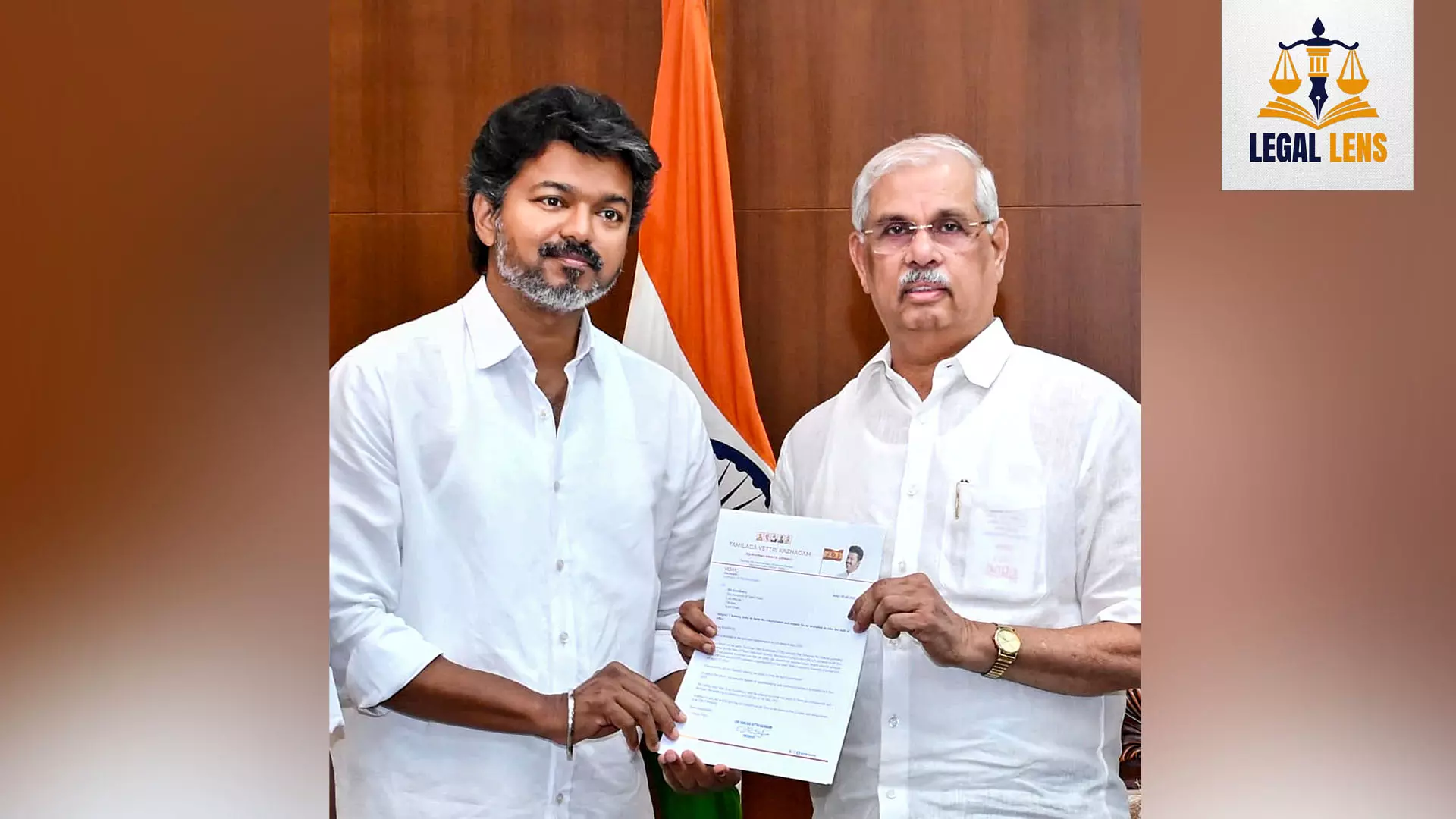
Joseph Vijay, the actor whose Tamilaga Vettri Kazhagam (TVK) took 108 of the 234 seats in the Tamil Nadu Assembly election, met Governor Rajendra Arlekar today (May 6). He wrote to Raj Bhavan staking claim to form the government. He has asked for two weeks to demonstrate his majority on the floor of the House. The majority mark is 118. The TVK is 10 seats short.
This is the first hung Assembly in Tamil Nadu’s history. The constitutional question now turns on what Governor Arlekar may do, and what he may not. The answer is not, as it might seem, a matter of his own judgement. A commission headed by former Supreme Court judge RS Sarkaria laid down an order of priority in 1988. A second commission headed by former Chief Justice MM Punchhi affirmed it in 2010. Five Supreme Court judgements, beginning with the well-known Bommai case of 1994, have converted that convention into a rulebook. The rulebook is binding.
What the rulebook says
The Sarkaria order of priority runs as follows. The Governor first looks for an alliance of parties that was formed before the election and that holds a majority. (A pre-poll alliance is one declared before voters cast their ballots. A post-poll alliance is stitched together after the results.) If no such pre-poll alliance has the numbers, the Governor turns to the largest single party. That party may stake a claim with the declared support of others. If that fails, he looks at a coalition assembled after the election in which all partners join the government. Last comes a coalition in which some parties are in government and others extend support from outside.
Follow post-election updates LIVE
Three rules apply throughout. The first comes from the Bommai judgement. A government’s majority is tested only on the floor of the Assembly, never in Raj Bhavan. The Governor cannot decide on his own assessment whether a leader has the numbers; he must let the Assembly decide. The second is that the floor test must be held at the earliest practicable date. The Court has, in case after case, compressed timetables that Governors have stretched. The third is that the Governor’s choices are open to judicial review. Article 361 of the Constitution gives the Governor personal immunity from being sued, but his actions can be set aside by the courts.
Five precedents, in chronological order, illustrate how the rulebook has worked.
Bihar, 2005: The cautionary precedent
The Bihar Assembly election of February 2005 produced a hung verdict. Lalu Prasad’s Rashtriya Janata Dal was the largest single party with 75 seats. Nitish Kumar’s Janata Dal (United) took 55. The Bharatiya Janata Party took 37. Ram Vilas Paswan’s Lok Janshakti Party took 29 and refused to support either bloc. The majority mark was 122. No combine reached it.
Governor Buta Singh did not invite any leader to test strength on the floor. He sent a series of reports to the Centre alleging that legislators were being bought to engineer a majority. On May 22, 2005, the Union Cabinet recommended dissolution of the Assembly. The proclamation issued the next afternoon. The Assembly had not met even once.
In its judgement of January 24, 2006, in Rameshwar Prasad v. Union of India, the Supreme Court struck down the dissolution as unconstitutional. The five-judge Bench held that the Governor’s report rested on his own assertion, unsupported by evidence. Defection, it held, was a matter for the Speaker under the anti-defection provisions in the Tenth Schedule of the Constitution. It was not the Governor’s job to police it. The floor of the House remained the only legitimate forum for testing majority. Buta Singh resigned within days of the judgement.
Also read: Vijay's TVK falls short of 118; where do 10 seats come from?
Bihar 2005 is the warning. A Governor cannot pre-empt government formation by recommending dissolution on a horse-trading hypothesis.
Goa, 2017: Largest party loses by inaction
The Goa Assembly election of February 2017 returned 17 Congress legislators in a 40-member House. The BJP took 13. The Maharashtrawadi Gomantak Party took three. The Goa Forward Party took three. Two independents won. The majority mark was 21.
The Congress, as the largest single party, did not file a claim with Governor Mridula Sinha. The BJP did. It produced an arithmetic of 21, drawing the MGP, the GFP and two independents into a post-poll combine. The Governor invited Manohar Parrikar, who was sworn in on March 12, 2017. The Congress moved the Supreme Court the next morning.
In Chandrakant Kavlekar v. Union of India, the Court declined to stay the swearing-in. It compressed the Governor’s 15-day window to a single-agenda floor test on March 16. Parrikar prevailed by 22 to 16. The Court did not adjudicate the contested support letter. The floor was the only competent forum.
Karnataka, 2018: Largest party invited, timetable compressed
The Karnataka election of May 2018 gave the BJP 104 seats. The Congress took 78. The Janata Dal (Secular) took 37. Three seats went to others. The majority mark was 112. The Congress and the JD(S) declared a post-poll coalition and presented Governor Vajubhai Vala with letters from 117 legislators.
Also read: Understanding the Vijay phenomenon in Tamil Nadu politics
The Governor instead invited BS Yediyurappa as leader of the largest single party. He gave him 15 days to prove the majority. The Congress and the JD(S) moved the Supreme Court the same night. A vacation Bench of three judges sat at midnight. It declined to stay the swearing-in. But it fixed the floor test for May 19, less than 36 hours away. Yediyurappa resigned without facing the vote.
Karnataka 2018 is the cleanest illustration of two principles. The Governor may invite the largest single party. The Court will not let him buy time for that party to assemble its numbers.
Meghalaya, 2018: Second-placed combine invited
In Meghalaya in March 2018, the Congress emerged as the largest single party with 21 seats in a 60-member House. The National People’s Party was second with 19. Smaller parties and an independent accounted for the rest. The majority mark was 31.
Governor Ganga Prasad invited Conrad Sangma of the second-placed NPP. Sangma had assembled letters of support from 34 legislators. They came from the United Democratic Party, the People’s Democratic Front, two BJP legislators, an independent, and others. The Congress had not assembled comparable numbers. Sangma was sworn in on March 6, 2018. The Congress did not move court.
Meghalaya is the textbook case for one of the lower priorities in the Sarkaria order. Where the largest party has not assembled a majority, a smaller post-poll coalition with the numbers may be invited.
Maharashtra, 2019: Timetable, resignation, and second invitation
The Maharashtra Assembly election of October 2019 returned the BJP with 105 seats in a 288-member House. The Shiv Sena took 56. The Nationalist Congress Party took 54. The Congress took 44. The pre-poll alliance of the BJP and the Shiv Sena had crossed the majority mark of 145. But it broke down over the question of who would be chief minister.
Also read: Vijay doesn't have to 'prove' his majority since Constitution never asked him to
Three weeks of negotiations followed. The Centre then imposed President’s Rule on November 12, 2019. Eleven days later, in the early hours of November 23, the proclamation was revoked. Governor Bhagat Singh Koshyari administered oath to Devendra Fadnavis as chief minister. Ajit Pawar was sworn in as his deputy. The basis was a letter from Pawar claiming the support of NCP legislators. Several of those legislators disputed his right to represent them.
In Shiv Sena v. Union of India, a three-judge Bench ordered a floor test within 24 hours, by open ballot, with an interim presiding officer. Fadnavis and Pawar resigned on November 26, before the floor opened.
What followed is the part of the story that bears most directly on Tamil Nadu now. The Shiv Sena, the NCP and the Congress had by this stage formed a post-poll alliance called the Maha Vikas Aghadi, with a combined strength of 154. The Aghadi staked claim. Uddhav Thackeray was sworn in as chief minister on November 28. He won the floor test on November 30 by 169 votes to none, the BJP staging a walkout.
Maharashtra 2019 carries two lessons. The Court will compress any timetable that Raj Bhavan stretches. And where a first invitation collapses, the Sarkaria sequence resumes. The next-best claimant gets a turn. The Governor does not move directly to dissolution.
What this means for Tamil Nadu
Apply the Sarkaria order to the present numbers. A pre-poll alliance with a majority is unavailable; no combine crossed 118. The next priority is the largest single party staking a claim with the support of others. The TVK occupies that position. Vijay has staked a claim. The Congress, with five seats, has signalled through its general secretary KC Venugopal that the mandate is for what he called a secular government. That language places those five seats in play.
The Goa precedent and the Karnataka precedent both authorise the invitation that Vijay seeks. The Court has, in those cases, held that an invitation to the largest single party with declared post-poll support is constitutionally orthodox. The further requirement is that the floor test must follow at the earliest practicable date.
Also read: How Vijay glided effortlessly from Kodambakkam to Fort St George
Three points of constitutional concern deserve flagging.
First, the form of the invitation. If the Governor invites Vijay with a window of seven to 15 days to demonstrate the majority, the precedents are met. If he asks Vijay to first produce 118 letters of support before issuing the invitation, that inversion is open to challenge. The Goa case upheld the sequence of invitation followed by floor test, even where the support claim was disputed.
Second, the length of the window. A window beyond a fortnight will read, on the Maharashtra precedent, as facilitation of cross-voting. Where the largest party is itself a debutant, the temptation to tilt the timetable is real. Since the Maharashtra judgment, the Court has treated 24 to 48 hours as the constitutional default once a claim is made.
Third, the question of President’s Rule. Should the TVK fail to produce the numbers, the Sarkaria sequence requires the Governor to invite the next-best claimant before recommending President’s Rule. The DMK, with 59 seats and five Congress allies, falls short of 118. The AIADMK, with 47, is no closer. But the Maharashtra story shows that a fresh post-poll combine can emerge after a first attempt collapses. The Governor cannot skip the next-claimant step. Were he to recommend that the Assembly be dissolved or kept dormant, the Bihar 2005 judgment would supply the petitioners’ brief verbatim.
The narrow latitude
The five precedents, read together, leave the Raj Bhavan less room than the headlines suggest. Bihar 2005 closes off pre-emptive dissolution. Goa 2017 and Karnataka 2018 supply the working template at the moment of formation. Invite, swear in, and hold the floor test on the earliest practicable date. Meghalaya 2018 covers the case of a smaller post-poll combine with the numbers. Maharashtra 2019 shows that delay will be compressed. It also shows that the Sarkaria sequence resumes if a first invitation fails. The doctrinal centre of all five is the Bommai rule. Majority is for the floor, not the Raj Bhavan.
Also read: Whom did Vijay’s TVK hurt more? DMK or AIADMK?
Whether the TVK can in fact assemble 118 is for Vijay and his prospective allies to settle. Whether the Governor lets that political process run its course is for Raj Bhavan, and ultimately, if Raj Bhavan errs, for the Supreme Court.