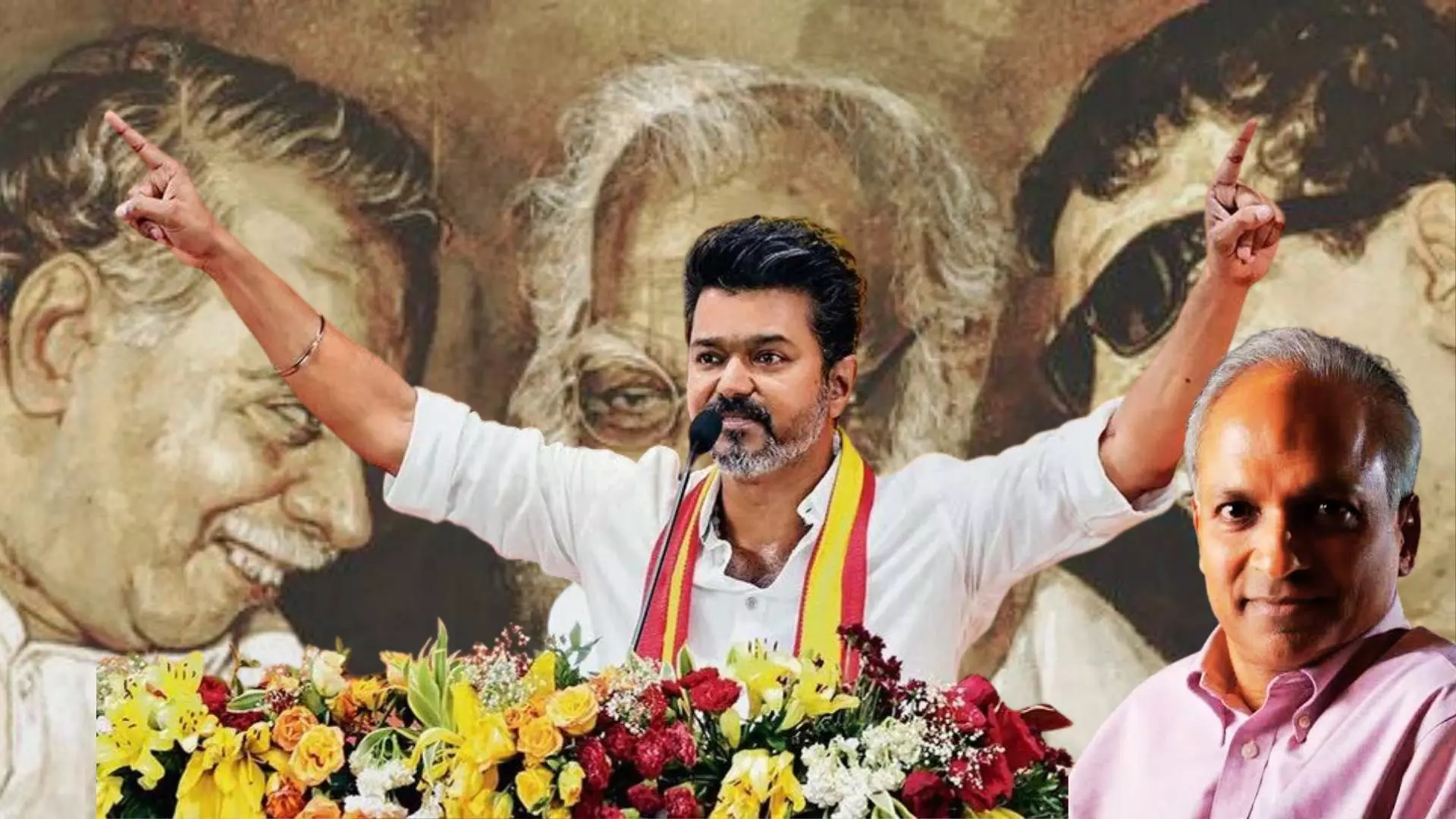
Vijay wave reshapes Tamil Nadu
Nobody knew TVK candidates, they voted for Vijay: Political analyst R Kannan
R Kannan says Vijay’s victory marks a generational shift driven by youth aspirations, demand for change and an end to ideology driven political establishment

Actor-politician Vijay’s Tamilaga Vettri Kazhagam (TVK) victory is “completely untainted” and marks the first time in decades that a party has come to power in Tamil Nadu “without paying for a single vote”, says author and political analyst R Kannan.
Calling the result a “political tsunami”, Kannan argues that the mandate reflects a massive anti-establishment mood and a desire among young voters for change beyond Tamil Nadu’s long-standing political binaries.
As TVK emerged with 108 seats on its own, questions have also arisen about whether Vijay’s politics signals a redefinition of Dravidian politics, the role of ideology in the state, and the challenges before a first-time political force. The Federal spoke to R Kannan, author and political analyst, about the reasons behind TVK’s rise, the collapse of established parties, and the expectations from Vijay’s government.
What are the factors that contributed to TVK’s big victory?
Oh, there’s a long laundry list if I go into each of these details.
We must welcome this. This victory is completely untainted. In the last 30 years, this must be the first time a political party has risen to power without paying for a single vote. Reports indicate that in two constituencies, TVK candidates did join the fray and paid voters. But other than that, this is a political tsunami that has felled even some good trees. Good, competent ministers have lost out. Veteran politicians have lost out.
Also read: Hung Assembly in Tamil Nadu: what the Governor can and cannot do
This vote is an anti-establishment vote. It is against the veterans because people wanted to feel fresh. For over 60 years, Tamil Nadu politics has been a binary. If you look at the 1952 elections in the composite Madras state, it was Congress versus the Communists. From 1957, the binary became Congress versus the DMK. From 1972, the binary became DMK versus the AIADMK. People decided that this binary should change.
When actor Vijayakanth floated his party in 2005, there was overwhelming support for him in rural areas. An estimated five lakh people showed up at the launch of his party. But he quickly exhausted the goodwill he had because of public outbursts, inconsistent political decisions, and later ill-health.
People have always looked for a third alternative. Political pundits in Tamil Nadu usually say there is no room for a third alternative because Vijayakanth tried it, Vaiko tried it, the Makkal Nala Kootani tried it, and all of them failed.
But this time, all these factors resonated because there is a generational anxiety. There is a new crop of young people. Around 2.5 crore of the 5.67 crore voters are below the age of 40. Every year, seven lakh students graduate from professional colleges, arts colleges, liberal arts colleges, and other disciplines in Tamil Nadu. We don’t have jobs for all of them.
They go out in search of jobs while we continue to trumpet the Dravidian model. Yes, Tamil Nadu’s growth statistics are better than many states, but our comparison has been with poorer Hindi belt states like Bihar, Madhya Pradesh, and Uttar Pradesh. We should instead be looking at Vietnam or Singapore because we have the manpower and the resources.
There was a desire for change. The established order was in everybody’s face. The DMK was ubiquitous, omnipresent, omnipotent. There was hardly any area where the DMK was not manifest. So, essentially, this is a vote against the established order. Vijay invoked leaders such as Periyar, Ambedkar, Annadurai, MGR and others during his campaign.
Can Tamil nationalism and Dravidian politics coexist?
I don’t think he means Tamil nationalism in the way that Seeman does.
Firstly, there is no need for ideology in Tamil politics. I want to reiterate what the youth want. Those who stood behind him and made this ascent possible without spending money want jobs. They want a happy, simple life. They want systems that work. They don’t want to be stonewalled at every turn. That is what they want. They do not want ideology.
Do you think TVK wants to redefine Dravidian politics?
No, not at all. There is no question of redefining models or ideology.
Even when the DMK came to power, there was not much ideology because ideology is essentially framed in economic terms. These are not economic experts or Marxists or Leninists. The Congress itself believes in democratic socialism.
These parties believe in a watered-down socialist enterprise while also allowing room for private enterprise. Without private enterprise, how can the state provide jobs for everyone? That model has failed everywhere.
Also read: Vijay’s TVK single largest party in TN but falls short of majority; now what? | AI With Sanket
So, what we have is a mixed economy, especially after liberalisation in the 1990s. Apart from some remaining doctrinaire Leftists, ideology does not play a major role anymore. The fact that Vijay brought together this pantheon of leaders simply shows he is inclusive and accommodative. He wants to cover all his bases.
Is there any contradiction between Tamil nationalism and Dravidian politics?
Tamil nationalism, as I understand it, suffered a major defeat this time. I had predicted this in interviews two months ago because a force like Vijay changes the political landscape. In the absence of someone like Vijay, Seeman would gain traction. But now everybody has fallen by the wayside. Chief ministers have fallen, Thol Thirumavalavan has fallen, others have fallen.
This is a victory for film glamour, for youth, for change. Most importantly, this is an opposition vote.
Did voter fatigue contribute to this victory?
No, this is not voter fatigue because people came out in large numbers to vote. Voter fatigue is when people stop showing up.
Whether there is fatigue with the Dravidian parties is still too early to conclude. The DMK has come back like a phoenix many times in the past. During the Emergency, it was written off. After Rajiv Gandhi’s assassination, it was reduced to just one seat. Yet, it returned.
What are the major challenges Vijay will face in forming and running the government?
Usually, the civil service takes care of day-to-day governance. Political leadership makes the larger political decisions. Bureaucrats marshal facts and guide decision-making, but ultimately political leaders have to live with the consequences of those decisions.
The bigger challenge is fulfilling promises. Every party has made tall promises, and translating those promises into reality is difficult because you need resources.
I am not very worried about day-to-day functioning, government formation, or ministry allocation. He just needs around 10 or 11 more members, and I think he can get them from across the aisle. Exploratory talks are already on.
Also read: Tamil Nadu verdict 2026: Will TVK chief Vijay form government with Congress?
The real challenge is the enormous expectation people have from him. There is so much hope and goodwill at the moment. Maintaining that goodwill will be a Herculean task.
What kind of Assembly will emerge with many first-time MLAs from modest backgrounds?
You are placing too much emphasis on legislators and legislative work. In India, parliamentarians and legislators are different from senators and Congressmen in the United States.
Here, their primary role is service delivery — ensuring systems work, ensuring pensions are delivered on time, helping people navigate bureaucracy.
Policy framing will not drastically change. As I said earlier, ideology is not that important. People want jobs and a smooth life. They don’t want power cuts, dysfunctional government offices, or administrative stonewalling.
Many of the winning candidates are genuine political upstarts. In Royapuram, a simple auto driver defeated a four-time minister and another powerful candidate. Elsewhere, a chauffeur’s son defeated a DMK candidate.
This reminds me of 1967 when the DMK first came to power. Ordinary people from modest economic backgrounds defeated powerful Congress leaders. The sitting chief minister Bhaktavatsalam lost to a simple farmer in Poonamallee. That election triggered a social revolution.
The DMK brought social mobility to sections of society that had never reached those heights before. Then MGR created another wave in 1977 by fielding ordinary people like tailors and young graduates.
MGR used to tell candidates, “Nobody is voting for you. They are voting for me.” That is exactly what has happened now. Nobody knew most of these TVK candidates. People voted for Vijay. There were also many Dalit candidates, and I am told the Dalit vote swung strongly towards Vijay.
Of course, not everyone comes from a modest background. Someone like Aadhav Arjuna comes from a well-to-do family. Some candidates also came from other parties, like Babu, who defeated the chief minister was originally a DMK MLA.
But most of the candidates are simple people who saw hope in Vijay and invested their political future in him. On polling day, I saw people dressed like Vijay in khaki trousers and white shirts across Chennai. The organisation compensated for shortcomings in the campaign.
Honestly, I expected a good performance. I expected Vijay to become a kingmaker. I never expected him to become the king himself. If not for Vijay’s entry, an entire Gen Z population that was indifferent to politics and public life would have remained disengaged. They have now been energised. They may not yet be politically aware, but over time they will evolve and become more politically advanced.
At the moment, there is tremendous enthusiasm and energy, and that energy should carry them forward.
The content above has been transcribed from video using a fine-tuned AI model. To ensure accuracy, quality, and editorial integrity, we employ a Human-In-The-Loop (HITL) process. While AI assists in creating the initial draft, our experienced editorial team carefully reviews, edits, and refines the content before publication. At The Federal, we combine the efficiency of AI with the expertise of human editors to deliver reliable and insightful journalism.