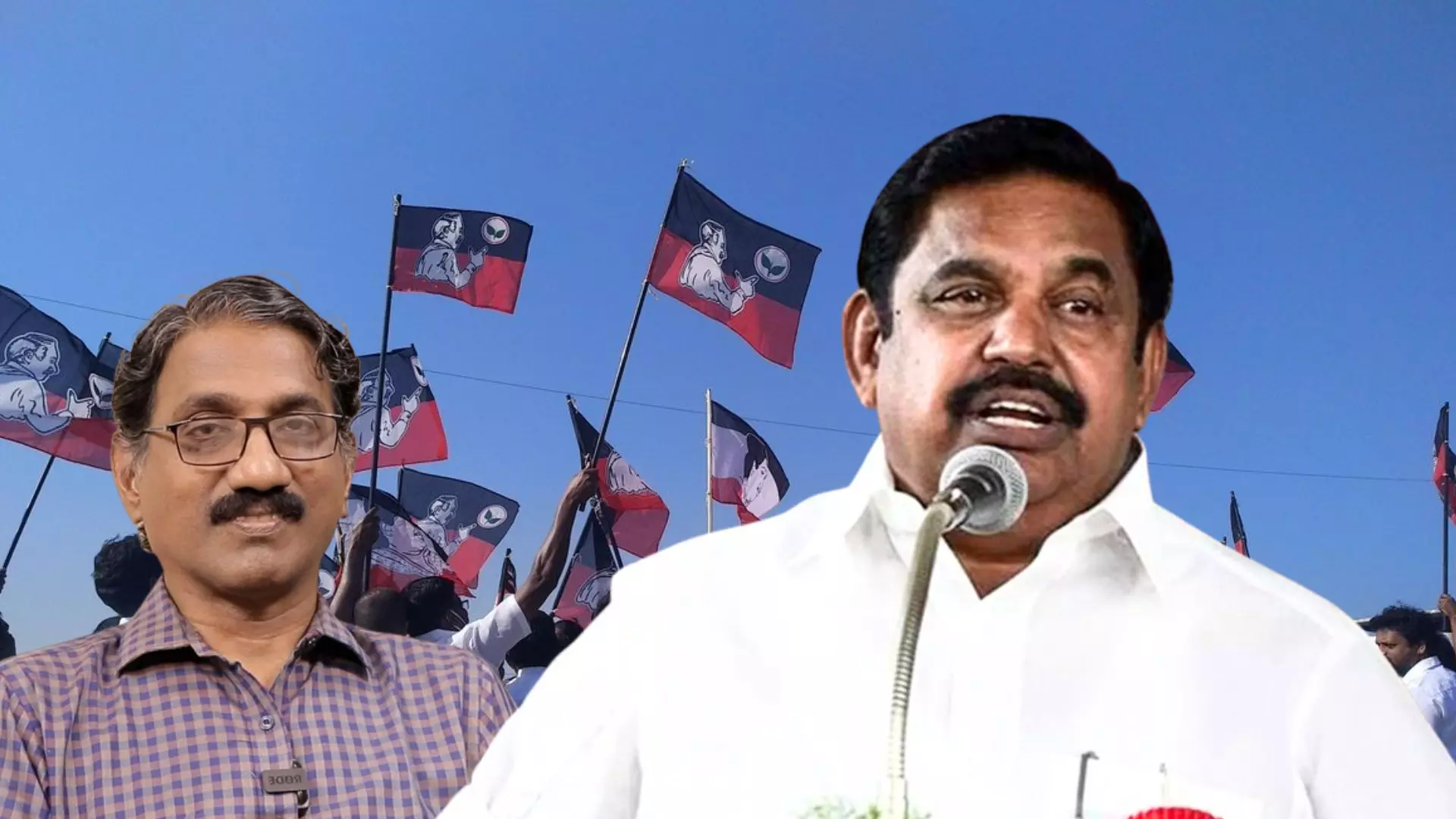
Can anti-incumbency alone bring AIADMK back to power in Tamil Nadu?
Senior political analyst T Ramakrishnan decodes DMDK’s shift to the DMK alliance, Congress seat-sharing dynamics, Vijay’s emerging role, and battle shaping TN election

“AIADMK seems to believe anti-incumbency alone will bring voters back — but there is no such guarantee,” stated senior political analyst T Ramakrishnan, bluntly assessing the Opposition’s strategy, ahead of the 2026 Tamil Nadu Assembly election.
However, Tamil Nadu's political landscape is in a state of flux, with shifting alliances as the DMDK joins the DMK fold, Congress negotiates seat-sharing, and actor-politician Vijay seeks to position himself as an alternative force. The Federal spoke to senior political analyst T Ramakrishnan to decode the evolving electoral arithmetic and strategic manoeuvring in the state.
Congress is reportedly demanding more seats from the DMK this time. Do you think the DMK will accommodate that?
Congress may have lost power almost 60 years ago, but it still retains some presence — small or big, but it is there. Otherwise, why would Mr Stalin engage in discussions with leaders like KC Venugopal? He could have easily told them to walk away. It wouldn’t take a minute. But he hasn’t done that. That shows he does not want them to leave.
They have a certain vote share, and that vote share is significant. Everyone knows Congress’ presence is largely limited to southern districts, particularly among minorities — Christians and certain sections of Scheduled Castes. Even in the 2014 elections, they secured about 4 per cent statewide, but in southern districts, they got around 6 to 7 per cent.
Why do people continue to support Congress even after 50 or 60 years out of power? Compare this with Uttar Pradesh or Bihar, where they lost power only in the late 1980s or early 1990s. There, the party is far weaker than in Tamil Nadu. There appears to be some sentimental attachment among Tamil Nadu voters toward Congress — whether one agrees with it or not.
Also read: Congress set to gain extra Rajya Sabha seat from DMK, drops power-sharing push
Mr Stalin understands their utility value. If he wants 100 per cent minority support, why should he let Congress go? All these calculations would have been made. He leads a major party and has been Chief Minister for five years in a large state like Tamil Nadu. That is not a small thing.
As long as Sonia Gandhi remains influential in Congress, she will not allow the party to leave the DMK fold. Many leaders may have different opinions — that is common in Congress — but the central leadership would prefer to stay aligned with DMK.
There were discussions within Congress about possibly aligning with Vijay’s TVK. Was that a serious option?
In 2021, the objective was clear: ensure the DMK returned to power after being out for 10 years. There was convergence of thought. Nobody wanted to rock the boat for one or two extra seats. The aim was to send AIADMK out of power, and they succeeded.
Now it is five years later, and DMK clearly has an edge over AIADMK. The 2021 and 2024 elections, and even local body elections, show that DMK has maintained its lead.
Vijay entered the scene and offered not just seat-sharing but power-sharing. That is a tempting offer. But no party will align with him just because of an offer. That would be an empty promise if he cannot win seats or capture power.
DMK and AIADMK, as principal Dravidian parties, can ensure victory in many seats for their allies. That guarantee does not exist with Vijay. He is an untested force. If he himself fails to win, what is the point for others?
People are not enamoured merely by optics. Politics requires substance. You may not have great substance, but you must have some. Perhaps parties are not confident yet.
Also read: AIADMK falters, DMK gains as DMDK and Vijay shake up alliances ahead of TN elections
After this election, if Vijay proves he is a force to reckon with, many may join him. But for now, he is seen as a vote-cutter. Tamil Nadu has seen such experiments before.
Vijay recently spoke about upgrading primary health centres and touring villages. How do you assess his political messaging?
He is showing some signs of forward movement. I won’t call it improvement yet, but there is some progress. Let us give him time.
I think his understanding of Tamil Nadu’s complexities is limited. If he says he will go around the state, that is expected of any politician — whether in power or not. That is basic politics. You cannot remain a distant figure and expect people to accept you.
Improving primary health centres is fine. But if you look at government hospitals today, physical infrastructure has improved substantially over the years. They are cleaner and better equipped than before. I am not giving certificates to any regime, but that is the reality.
He appears to be a well-meaning person. But good intentions alone are not sufficient in politics. People expect more.
He is quite new and raw. Let us give him time. Some sections see him as an alternative to DMK and AIADMK. But he needs to do much more homework. His talks are still rudimentary. Perhaps his perception of Tamil Nadu is rooted in the 1970s or 1980s.
But 2020s Tamil Nadu is far more developed. He needs to understand that better.
DMDK has moved from the AIADMK-NDA bloc to the DMK alliance. Who benefits from this shift?
DMDK founder Vijayakanth still enjoys considerable goodwill. You can see that from the number of people who visit his mausoleum in Coimbatore — about 200 to 300 daily, despite it being in a remote part of the city.
That goodwill forms the basis of DMDK’s existence. I hope Premalatha Vijayakanth and the party’s followers utilise it better.
“The party’s strength may not be measurable in tangible terms — you cannot say they bring 5 or 10 per cent vote share. But in closely fought constituencies, their presence can make a difference. They provide an edge.
“In 2024, the DMK front secured about 47 per cent vote share. With anti-incumbency, it may fall — perhaps by up to 7 percentage points, bringing it to around 40 per cent. If DMDK adds even 1 or 1.5 per cent, that edge matters.
In 2024, DMDK secured about 2 per cent vote share. They may retain most of that. Generally, cadres follow their leader’s decision. For AIADMK, the loss is perceptible. DMDK draws support from sections of the Naidu community. AIADMK has not traditionally had strong Naidu leaders. So DMDK’s shift creates a disadvantage for AIADMK.
“Their strength is intangible but makes a qualitative difference.”
Is AIADMK doing enough on the ground to retain its vote bank?
AIADMK seems to believe that because of anti-incumbency, people will naturally support them. But there is no such guarantee — especially, with new players like TVK and Seeman in the fray.
I do not see much ground-level action from AIADMK in many parts of the state. In Chennai, they have been very weak. Over the last five years, I have not seen serious efforts to change that.
In the composite Kanchipuram region, they lost all constituencies in 2016 itself. In 2021 and local body polls, they fared badly. In the Delta districts, I did not see even a single AIADMK propaganda vehicle during my visits.
They may be relying on Edappadi K Palaniswami’s statewide tour, but that is not enough. You cannot depend only on one leader’s programme. The organisation must independently gear up. They do not give the impression of a party preparing to capture power. They claim to be active on IT and social media, but I do not see much visible presence.
In that sense, DMK is fortunate to have such a weak opposition.
The content above has been transcribed from video using a fine-tuned AI model. To ensure accuracy, quality, and editorial integrity, we employ a Human-In-The-Loop (HITL) process. While AI assists in creating the initial draft, our experienced editorial team carefully reviews, edits, and refines the content before publication. At The Federal, we combine the efficiency of AI with the expertise of human editors to deliver reliable and insightful journalism.