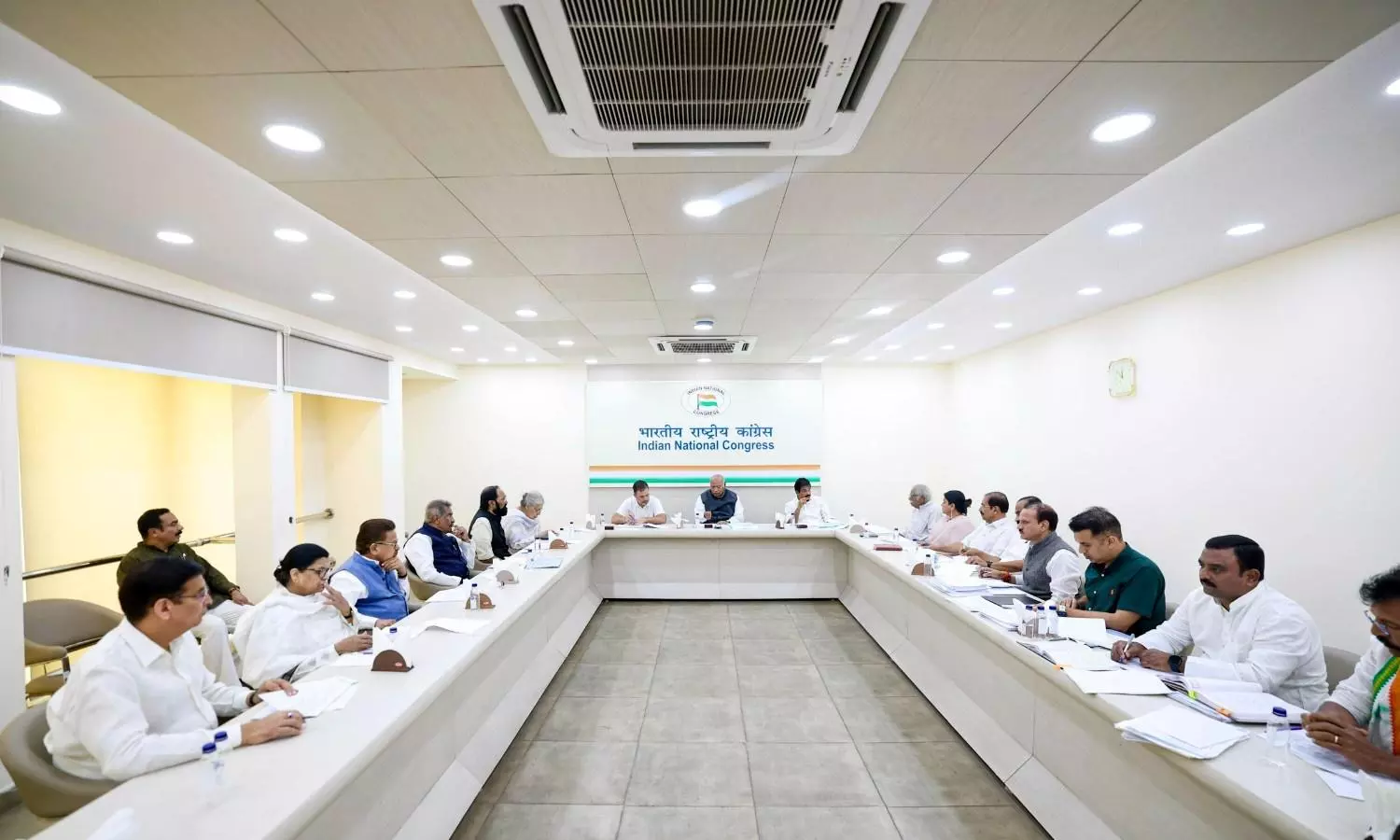
Congress President and LoP in the Rajya Sabha Mallikarjun Kharge, with LoP in the Lok Sabha Rahul Gandhi, party MP KC Venugopal, and others, during a Congress Central Election Committee (CEC) meeting for Kerala, in New Delhi, on Monday (March 17). (AICC via PTI Photo)
Kerala elections | Cong's candidate crisis: Internal tussle stalls final list
The release of a partial list of 55 candidates, largely confined to constituencies with little or no internal contestation, has done little to clear the confusion

Finally, after a topsy-turvy 48 hours following the election declaration, the Congress has come up with a list of 55 candidates for the Kerala Assembly elections, that too only after its key ally, the Indian Union Muslim League (IUML), went ahead and announced 25 candidates, leaving two seats vacant of their 27.
The delay that followed the confident claims of swift candidate selection has once again exposed the internal churn within the Congress-led United Democratic Front (UDF) in Kerala, even as the ruling Left Democratic Front (LDF) moved with striking speed and clarity.
Rare instances of dissent
The LDF has already finalised 132 candidates for the 140-member Kerala Assembly, with the Communist Party of India (Marxist) and the Communist Party of India (CPI) announcing their nominees almost in parallel with the Election Commission’s (EC) press conference declaring the poll dates.
Also read: Twenty20 fields film and TV stars in Kerala Assembly elections
Despite witnessing rare instances of dissent within both parties in a few constituencies, the process was largely swift and coordinated. Other LDF allies quickly followed suit, releasing their own candidate lists. The remaining seats have been deliberately left vacant, with the front waiting to gauge the moves and candidate choices of the UDF before taking a final call.
Unresolved factional negotiations
Leader of the Opposition VD Satheesan had publicly asserted that the UDF would finalise its candidate list within 24 hours of the election announcement. Earlier, there had been an even more ambitious internal benchmark: that the list would be ready before the party’s ‘Puthuyuga Yatra’, a campaign march that covered the entire state and was led by the Leader of Opposition, reached Thiruvananthapuram in the first week of March. Neither deadline was met.
Also read: Ahead of Kerala Assembly elections, EC orders transfer of officials
The release of a partial list of 55 candidates, largely confined to constituencies with little or no internal contestation, has done little to clear the confusion. The absence of nominees in key battleground seats underscores the unresolved factional negotiations within the party.
Sudhakaran issue
The most visible flashpoint in this ongoing tussle is K Sudhakaran. The former Kerala Pradesh Congress Committee (KPCC) president, currently a Member of Parliament, is adamant about contesting the Assembly election from Kannur. His insistence has complicated the party’s strategy on multiple fronts.
First, there is the broader question of whether sitting MPs should be fielded in Assembly elections. Allowing MPs to contest could open the floodgates for similar demands, potentially weakening the party’s parliamentary presence. At the same time, denying a leader of Sudhakaran’s stature risks internal backlash.
Second, Kannur itself is a politically sensitive district, traditionally seen as a stronghold of the Left. Fielding a heavyweight like Sudhakaran could signal an aggressive push by the Congress, but it also raises questions about internal consensus about the change of guard in the party.
Efforts to persuade him to reconsider are understood to have failed so far. With Sudhakaran in Delhi along with other senior leaders, discussions have moved to the national level, further delaying the finalisation process.
What KPCC president said
“We will handle this in a day,” said Sunny Joseph, the KPCC president. “K Sudhakaran is not a leader who will enable the LDF to win once again. As a democratic party, this is all routine. There is nothing to worry. We will come up with a strong lineup when it matters,” he added in Delhi.
The tussle between the two dominant leaders with chief ministerial ambitions, Satheesan and Ramesh Chennithala, has intensified the process. Both are seen to be pushing for maximum representation of their loyalists in the final list. The stakes go well beyond candidate selection, as in the event of a UDF victory, the number of MLAs aligned to each camp could prove decisive in determining the chief minister. This internal arithmetic has turned ticket distribution into a prolonged negotiation rather than a straightforward electoral exercise.
Another factor is the intervention of AICC general secretary (organisation) KC Venugopal, along with pressure from sections of the Sree Narayana Dharma Paripalana Yogam to field Sudhakaran and Adoor Prakash. This has made it harder for the high command to arrive at a decision. If MPs are allowed to contest, Venugopal himself could come into consideration, even though he has said he does not intend to enter the fray.
“KC is virtually the high command as far as Kerala is concerned. Whether he contests or not, he can emerge as a chief ministerial candidate at any stage. It would not be surprising if that happens. If we come to power this time, both Ramesh Chennithala and VD Satheesan will have to sweat it out for it,” said a senior Congress leader who is not in the fray this time.
Congress’s core lineup
However, the first list does offer a glimpse into the Congress’s core lineup. Sitting MLAs and prominent faces have been retained in several constituencies. Satheesan himself will contest again from Paravur, while senior leader Chennithala has been fielded from Haripad and PCC president Joseph from Peravur. Veteran leader Thiruvanchoor Radhakrishnan will retain his seat at Kottayam.
In Thrikkakara, Uma Thomas continues, and in Puthuppally, Chandy Oommen remains the candidate, carrying forward the legacy of the late Oommen Chandy. Other notable names include K Muraleedharan from Vattiyoorkavu, TJ Vinod from Ernakulam, Mathew Kuzhalnadan from Muvattupuzha, and Shanimol Usman from Aroor. Youth leaders such as VT Balram in Thrithala, Roji M John in Angamaly, and PC Vishnunadh in Kundara also feature in the list.
In north Kerala, candidates such as T Siddique (Kalpetta), Sajeev Joseph (Irikkur), Abdul Rasheed (Dharmadam), and Aryadan Shoukath (Nilambur) indicate an attempt to consolidate organisational strength in regions where the party has struggled in recent elections.
Yet, the limited scope of the list only reinforces the deeper issue, which is the unresolved power struggle within the party.
This uncertainty stands in sharp contrast to the approach adopted by the ruling Left. The CPI(M) and CPI announced their candidates within minutes of the election declaration, projecting an image of cohesion and preparedness. The Left’s early announcement has allowed it to move quickly into campaign mode, while the Congress continues to grapple with internal negotiations.
Party faces key questions
The optics of this contrast are significant. In a tightly contested election, organisational clarity and early momentum can shape the narrative in the initial phase of campaigning. The Congress’s delay risks reinforcing a perception of disunity, even before the campaign fully unfolds.
The delay also has implications for allies within the UDF. Seat-sharing arrangements and candidate coordination depend on the Congress finalising its list. Prolonged uncertainty could affect the alliance’s overall campaign planning as well.
“I am not authorised to negotiate on this issue, but we should not lose the opportunity to dethrone the LDF government, which the people of Kerala very much want. It is the senior leaders who must keep this in mind,” said Rajmohan Unnithan, the Congress MP from Kasaragod.
As negotiations continue in Delhi and Thiruvananthapuram, the key questions remain unresolved. Will MPs like Sudhakaran be allowed to contest? How will the balance between the Satheesan and Chennithala camps be struck?