



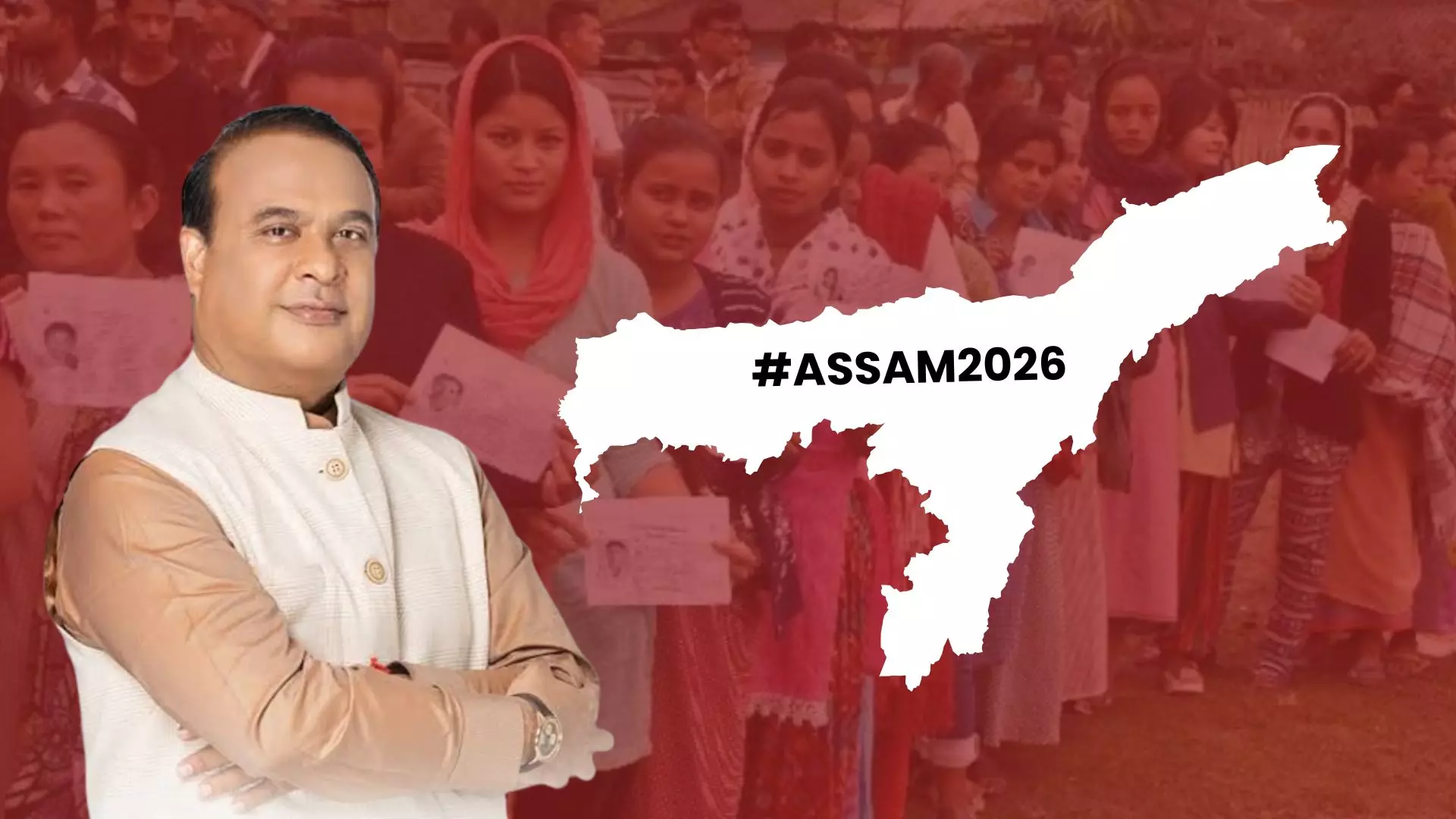
Since taking charge as Chief Minister in 2021, Himanta Biswa Sarma has projected himself as a high-energy, interventionist administrator.
Delimitation confusion looms large over 2026 Assam election battle
It's map vs mandate, as redrawn constituencies in Guwahati leave voters unsure of their seats and candidates—will delimitation reshape Assam’s political outcome?

As Assam heads into the 2026 elections, voter confusion has emerged as a major issue in Guwahati, with many unsure about their constituencies and candidates despite multiple awareness drives.
The Kamrup Metropolitan district alone has over 10 lakh voters spread across five constituencies—Dispur, Dimoria, New Guwahati, Guwahati Madhya Central, and Jalukbari. Yet, many residents say they still don’t fully understand the newly-drawn boundaries.
This confusion stems largely from the recent delimitation exercise, where constituency borders were redrawn, names changed, and several localities reassigned. While this exercise was intended to ensure fair representation, the process has left voters disoriented.
Delimitation impact
Officials say awareness campaigns are ongoing, but ground reports suggest otherwise. With voting just days away, delimitation—not speeches or manifestos—may be the most decisive factor in this election.
Also read: Rahul tears into CM Himanta in Assam, says BJP turned state into 'land ATM' for corporates
The issue has become one of the most debated yet least understood aspects of Assam’s politics, with implications extending beyond the state.
To understand the current scenario, one must look back at the Assam agitation between 1979 and 1985, driven by concerns over illegal immigration and its electoral impact. The last delimitation before this was based on the 1971 census and frozen in 1976, leaving constituency boundaries unchanged for nearly five decades.
Historical context
Over time, this freeze led to significant political and administrative imbalances. In December 2022, the government led by Himanta Biswa Sarma merged four newly-created districts back into their parent districts, just before the Election Commission began delimitation.
The timing drew political scrutiny. The exercise was conducted using the 2001 census, as required by law, but Opposition parties questioned why more recent data was not used.
The 2011 census recorded a 3.3 per cent growth in the Muslim population in Assam. Critics argue that using 2001 data effectively ignored these demographic changes when drawing new boundaries.
Data debate
Political commentator Debojit Goswami pointed to technical concerns in the process.
“They have divided the districts into three categories based on population density… but this is not reflected properly in the delimitation process,” he said.
Also read: Rebel BJP veteran Jayanta Das makes high-stakes Dispur battle triangular
He also highlighted gaps in public consultation. “Around 1,200 applications were submitted… however, only 45 per cent were answered and 55 per cent were left unanswered.”
Some leaders argued that the changes could alter the political balance, especially in areas with large minority populations. The ruling party, however, maintained that the exercise was necessary to correct long-standing imbalances.
Seat changes
In August 2023, the Election Commission released its final order, keeping most of the draft unchanged. The total number of assembly seats remains 126, but constituency boundaries have shifted significantly.
Reserved seats have increased, with Scheduled Tribe seats rising from 16 to 19 and Scheduled Caste seats from 8 to 9. Meanwhile, Muslim-majority seats have declined to around 22–24 from about 35 after delimitation.
Some analysts believed these changes may have altered the composition of several constituencies, potentially reducing minority influence in certain areas. However, there is no official classification based on religion.
Political effects
In constituencies like Dhubri, the electorate size has grown larger compared to others, raising concerns about balance. The Election Commission maintains that such variations remain within permissible limits.
Also read: No clear anti-incumbency, yet Assam elections may be closer than they look for BJP
The political impact is already visible. Leaders like Badruddin Ajmal, whose party draws significant support from Muslim voters, now face a changed electoral landscape.
While elections depend on multiple factors, delimitation has clearly emerged as a crucial one.
Larger questions
Assam’s experience is now being closely watched across India, especially with a nationwide delimitation exercise expected after the next census.
The situation raises key questions: Can delimitation ever remain purely technical, or does it inevitably carry political consequences? And how can fairness and public trust be ensured?
As Goswami noted: “The delimitation exercise should be done based on the most recent census data… and it should be technically error-free.”
This will be Assam’s first election fought on the new map. When voters head to the polls, they are not just choosing candidates—they are testing a new political geography.
The real impact of delimitation will only become clear once results are declared. But one thing is certain: in politics, maps can matter just as much as mandates.
The content above has been transcribed from video using a fine-tuned AI model. To ensure accuracy, quality, and editorial integrity, we employ a Human-In-The-Loop (HITL) process. While AI assists in creating the initial draft, our experienced editorial team carefully reviews, edits, and refines the content before publication. At The Federal, we combine the efficiency of AI with the expertise of human editors to deliver reliable and insightful journalism.


