Congress CM race in Kerala enters final stretch as Satheesan builds civil society momentum
Satheesan, Ramesh Chennithala, and KC Venugopal remain in contention — but the leadership battle is being shaped not just by MLA numbers, but by narrative, alliances, and public backing

The race for the chief minister’s post in Kerala has now moved into its decisive phase. With the United Democratic Front securing a clear mandate, the focus has shifted entirely to the Congress high command, where the final call will be made after a round of structured consultations.
AICC observers Ajay Maken and Mukul Wasnik have finished meeting MLAs and key allies, and are expected to brief the leadership in Delhi on Friday (May 8). The decision on who will lead the government is likely to follow soon after, with Sunday (May 10) or Monday (May 11) emerging as the most probable window.
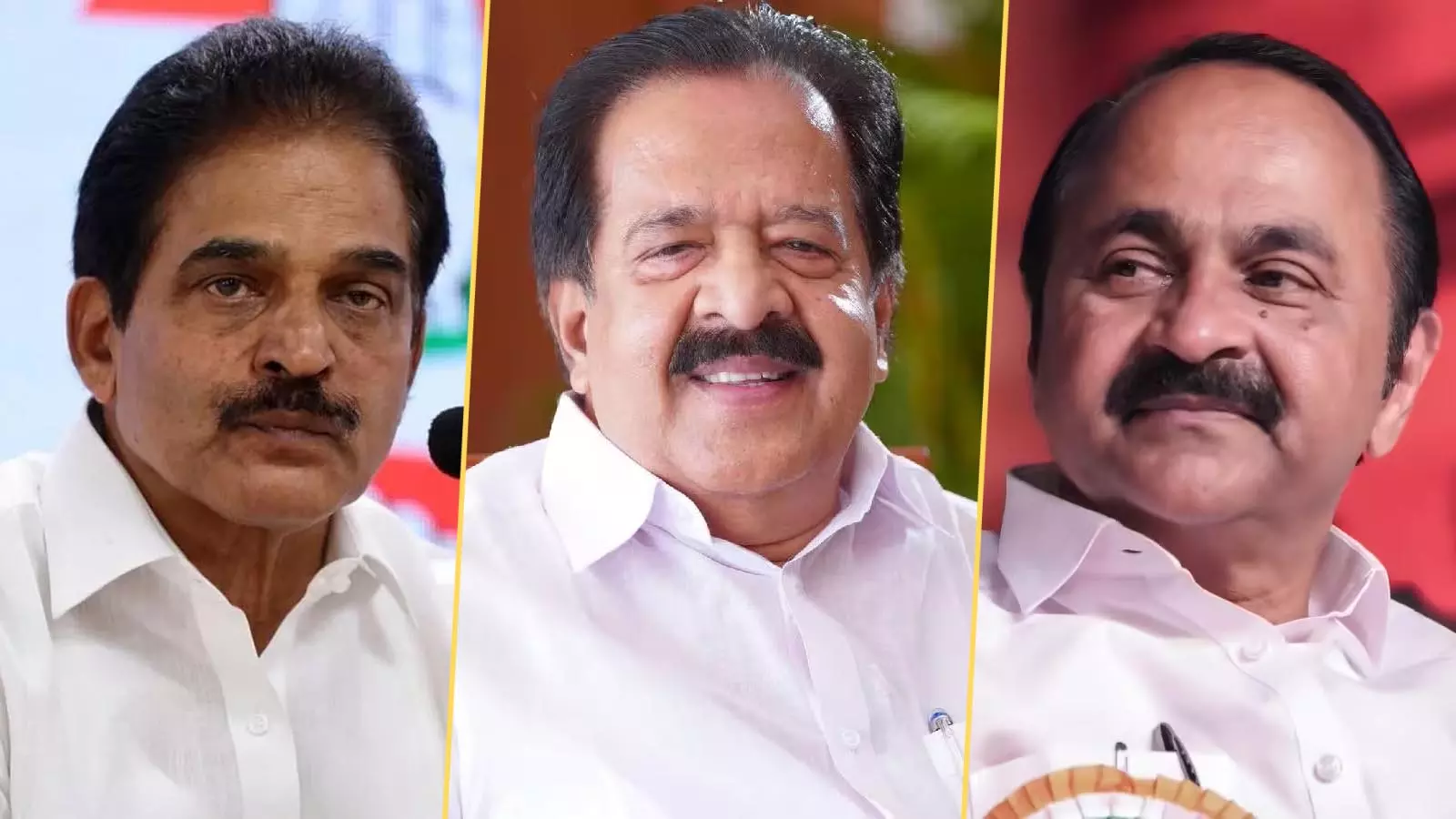
On the surface, the contest remains a familiar three-cornered one. VD Satheesan, who led the Opposition and fronted the campaign. Ramesh Chennithala, asserting his seniority and administrative experience. And KC Venugopal, widely believed to have the backing of a significant number of MLAs and strong equations with the central leadership.
Satheesan’s playbook
But even as this formal process plays out, a parallel political signal has been building outside the party structure, as Satheesan is deploying a playbook that goes beyond MLA arithmetic. Drawing from former Chief Minister and CPI(M) stalwart, the late VS Achuthanandan’s 2006 model and Mamata Banerjee’s post-Singur mobilisation, Satheesan is building external legitimacy through civil society backing.
Activists, many once aligned with the Left, are rallying behind him, framing him as the face of political renewal. This parallel narrative seeks to raise the cost of ignoring him, turning a closed-door leadership choice into a broader question of mandate, momentum, and moral authority.
Also Read: Kerala polls: How secular consolidation defeated the Left's social engineering gambit
This can be clearly read from an unlikely place, the comment thread under a Facebook post by Rahul Gandhi. His message, thanking the people of Kerala for the UDF’s victory, drew the expected responses at first. But it soon turned into a space where civil society voices began coalescing around a single name, Satheesan. Activists, actors, academics, and other public figures, many of whom had once been aligned with or sympathetic to the Left, openly endorsed him. That pattern is not incidental. Several among these voices were part of the broader civil society mobilisation that once rallied behind Achuthanandan during his internal battles within the CPI(M). Some had also been active during the factional phase between Achuthanandan and Pinarayi Vijayan.
Their re-emergence now, in support of a Congress leader, points to a larger political churn. Disillusionment with the Pinarayi Vijayan government has pushed sections of this ecosystem to seek a new political anchor, and Satheesan, through his tenure as Leader of the Opposition, appears to have built that bridge.
This is where his playbook begins to stand apart.
Wider narrative of legitimacy
While Chennithala is leaning on seniority and Venugopal on organisational strength and legislative backing, Satheesan is attempting to shape a wider narrative of legitimacy. Through sustained engagement with civil society, he has positioned himself not just as a party leader, but as a figure around whom a broader coalition of support can form.
It is a strategy that echoes earlier political moments. In 2006, Achuthanandan drew strength from a similar groundswell that extended beyond party lines, making it difficult for the CPI(M) to ignore his candidature. Later, in West Bengal, Mamata Banerjee transformed post-Singur and Nandigram protests into a wider civil society-backed movement that reshaped the state’s political landscape. Satheesan’s current positioning carries elements of both these playbooks.
Also Read: Protest rally for V D Satheesan as Congress CM race intensifies in Kerala
“This has been a planned move by VD Satheesan from the start. He has relied on outside support, including Left-leaning voices who have had an axe to grind with Pinarayi Vijayan and the CPI(M), as well as groups like Jamaat-e-Islami. They backed him on social media and in public debates. But comparing him to VS Achuthanandan is a stretch. VS had a long track record and a natural mass base, something hard to see now. Maybe only Oommen Chandy had that kind of connect on our side,” said a leader who is said to be inclined to the Venugopal camp.
Open letters to Rahul Gandhi
Open letters addressed to Rahul Gandhi by sections of civil society have reinforced this narrative. They credit Satheesan with building an inclusive political space that enabled activists to move from protest to participation during the election. At the same time, they caution against any move to bring in a chief minister from outside the elected MLAs (read KC Venugopal) pointing out that the high command had already rejected demands from MPs to contest the Assembly polls to avoid unnecessary by-elections.
The leadership choice, in their view, must reflect both the mandate and the momentum built on the ground. Whether that momentum can outweigh the internal arithmetic of the Congress legislature party remains to be seen. Venugopal’s reported support among MLAs is a significant factor, and Chennithala’s experience continues to carry weight. Ultimately, the decision will rest with the high command.
Chennithala could become compromise choice
However, a section of party leaders believes that if the contest between camps backing Venugopal and Satheesan escalates further and begins to look unmanageable, the Congress high command could fall back on a compromise formula. In such a scenario, Ramesh Chennithala is seen as a safe, stabilising choice.
Also Read: Poll results show ‘Kerala story’ that communalists should note: Tharoor
The argument within the party is that Chennithala, by virtue of his seniority and long administrative experience, carries fewer factional edges compared to the other two. While he may not currently command the same visible momentum or organisational backing, he is viewed as someone acceptable across camps, which could help contain internal dissent at a delicate moment.
UDF partners’ support for Satheesan
“I am not aware of the number game the media is attributing to MLAs and their preferences. One thing, however, is clear. Satheesan enjoys greater support among UDF partners. Leaders from both the Indian Union Muslim League and the Kerala Congress have conveyed this in one-to-one meetings, and are expected to communicate the same to Rahul Gandhi or Mallikarjun Kharge if required. He also has the backing of minority leaders, including sections of church denominations and Jamaat-e-Islami,” said a Congress leader close to the Leader of the Opposition.
Also Read: Pinarayi calls LDF defeat a ‘new beginning’, flags threat to Kerala’s secular fabric
IUML’s support to Satheesan is another key factor, and the second-largest partner of the UDF is eyeing the post of the deputy chief minister. Though the party has not said anything in public, sources indicate that PK Kunhalikkutty, who met the AICC observers, has conveyed their party’s choice of Satheesan.
Layered contest
But as the observers prepare to report back and the final call draws closer, what is evident is that this is no longer just a routine leadership selection. It has evolved into a layered contest, where numbers, hierarchy, and narrative are all competing for influence.
And if the early signals from something as simple as a Facebook comment thread are any indication, the political conversation in Kerala has already moved well beyond closed-door consultations.