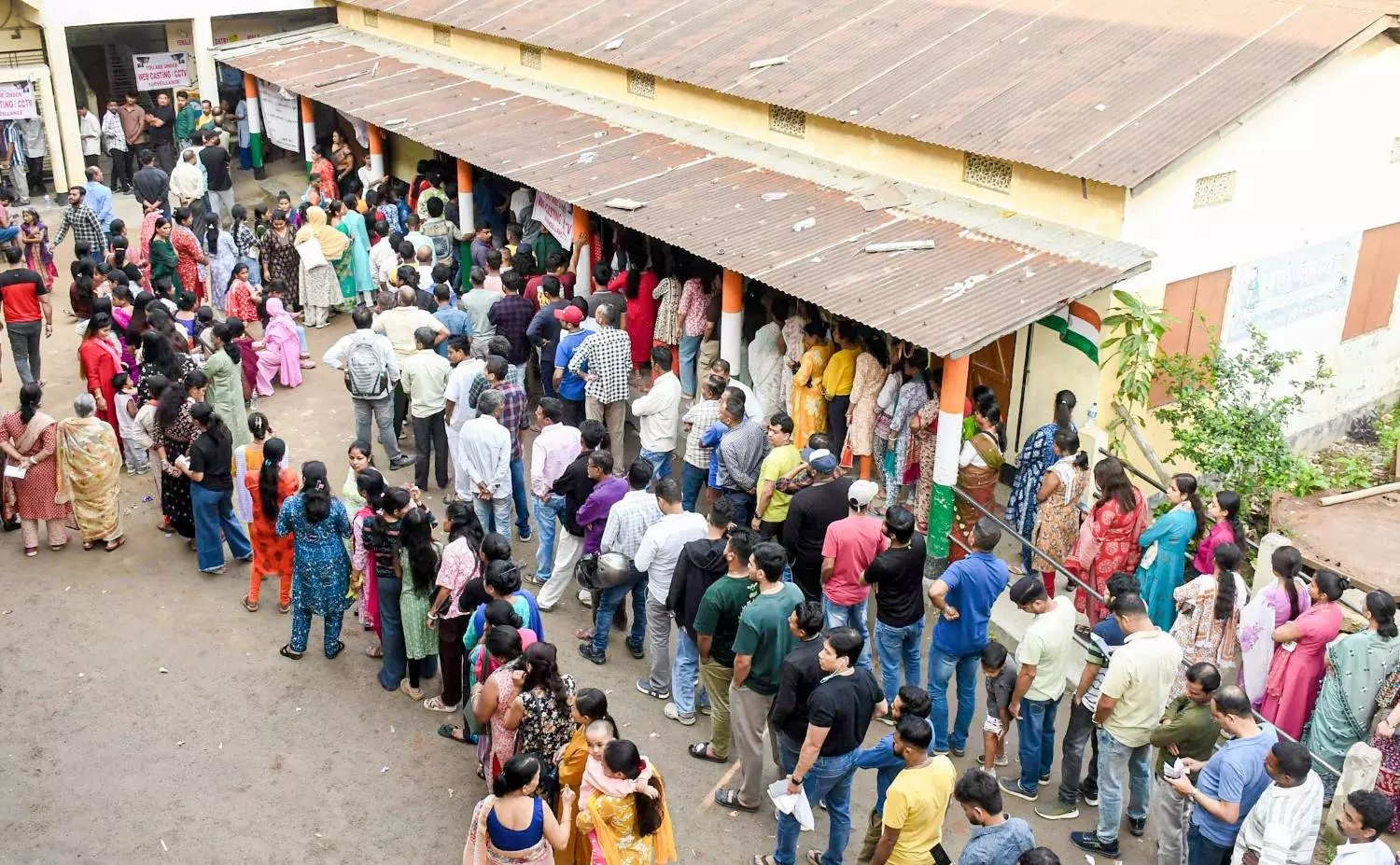
People wait in queues before casting their votes in the Assam Assembly elections, at a polling station in Guwahati, Thursday, April 9. PTI
Assam polls: Record turnout, Pawan Khera row make 25 seats too close to call
The ruling party sees the high turnout as an endorsement of its governance, while Opposition reads it as a sign of rising discontent and push for change

A late political flashpoint triggered by Congress leader Pawan Khera, coupled with a record voter turnout, has made the electoral outcome uncertain in at least 25 Assembly constituencies across Assam, turning what was expected to be a largely predictable contest into a closely fought battle in several pockets.
With counting scheduled for May 4, both the BJP and the Congress-led Opposition are interpreting the developments in sharply different ways. While the ruling party is reading the high turnout as a vote of confidence in its governance, the Opposition believes it reflects growing dissatisfaction and a desire for change.
Over 85 per cent voter turnout
Assam recorded 85.38 per cent voter turnout in the single-phase Assembly elections held on Thursday (April 9) — the highest in the state’s electoral history since 1951. The figure shows a steady rise over the years, from 76.04 per cent in 2011 to 84.72 per cent in 2016 and 82.42 per cent in 2021. Despite rain and overcast conditions in several districts, voters turned out in large numbers across both rural and urban areas. Women’s participation was particularly notable, with many constituencies reporting higher turnout among women than men.
Also read: Telangana HC grants anticipatory bail to Pawan Khera over FIR by Assam CM’s wife
Polling in Assam took place alongside elections in Kerala and Puducherry. While Puducherry recorded around 89 per cent turnout, Kerala saw about 78 per cent, placing Assam in a strong position in terms of voter participation.
A closer look at constituency-wise figures shows exceptionally high turnout in several minority-dominated seats, adding another layer of complexity to the electoral arithmetic. Dalgaon recorded the highest turnout at 94.57 per cent, followed by Srijangram (94.33 per cent), Jaleswar (94.31 per cent), Chenga (93.83 per cent), Mandia (92.45 per cent), Pakkabetbari (93.24 per cent), Samaguri (91.31 per cent), East Goalpara (92.79 per cent), Parbatjhora (90.49 per cent), Darrang (90.34 per cent), Rupahihat (92.74 per cent) and Abhayapuri (90.28 per cent).
At the district level, Barpeta crossed the 91 per cent mark, while Bongaigaon recorded 91.77 per cent. Bajali stood at 86.89 per cent. South Salmara-Mankachar district maintained a high turnout trend from the early hours, pointing to strong mobilisation in rural belts.
What political parties said
The BJP has sought to project the high turnout as a positive sign. Assam BJP president Dilip Saikia said the party expects to gain in at least 25 constituencies. “A large section of people has rejected the Opposition’s narrative. This turnout will help us improve our position,” he said.
Also read: Congress accuses Assam CM's wife of holding multiple foreign passports: What rules say
However, the Congress and its allies are drawing a different conclusion, especially from the voting pattern in minority-dominated areas. Congress leader Bhaskaran Gohain said the high turnout in such constituencies is unlikely to favour the BJP. “High turnout in minority-dominated seats will not help the BJP. The advantage will naturally go to the Congress,” he said.
Leaders from regional parties allied with the Opposition also pointed to structural reasons behind the surge in turnout. Ananya Saikia of Assam Jatiya Parishad (AJP) said the unusually high percentage can partly be attributed to the Election Commission’s (EC) recent revision of electoral rolls, which removed duplicate and deceased entries.
According to her, the participation of young voters and women has also played a crucial role. “There is a visible increase in first-time voters and youth participation. Many of them are coming out with specific concerns, such as jobs, floods, and daily governance issues. It is not just about traditional political loyalties anymore,” she said.
Khera’s allegations against CM’s wife
The political narrative took a sharp turn in the final days of campaigning after Khera levelled a series of allegations against Chief Minister Himanta Biswa Sarma’s wife, Riniki Bhuyan Sarma. The allegations relate to foreign assets, multiple passports, and undisclosed business interests.
Also read: What high voter turnouts in Kerala, Assam, Puducherry mean | Capital Beat
The Chief Minister and his family have strongly denied the charges, calling them fabricated and politically motivated. Riniki has filed an FIR in Guwahati, and the matter has moved into the legal domain. Khera has approached the Gauhati High Court seeking anticipatory bail.
The situation escalated further when Assam Police, along with Delhi Police, visited Khera’s residence in the national capital. He was not present at the time. The development triggered a fresh political confrontation, with the Congress accusing the BJP of using state machinery to intimidate Opposition leaders during the election period.
The BJP, on the other hand, has maintained that the allegations are based on fake documents and that legal action is being taken accordingly. At the same time, the party has attempted to play down the political impact of the controversy.
Legal voices question handling of Khera row
Despite these claims, the issue gained traction quickly, particularly on social media platforms where the allegations were widely circulated in the run-up to polling. Opposition leaders say the controversy disrupted the BJP’s campaign narrative at a crucial stage.
“There is an impact. People are aware of what has happened and will respond through their votes,” Gohain said.
Some observers believe the ripple effect may be visible in parts of Upper Assam, which has traditionally been considered a BJP stronghold. Senior journalist Niranjan Mahanta said that while mainstream media focused more on the Chief Minister’s response, the allegations themselves spread extensively through digital platforms and local discussions.
Legal voices have also questioned the manner in which the case is being handled, particularly in the context of the Model Code of Conduct. Some experts argue that allegations of this nature require an independent probe rather than an investigation by the state police.
The BJP, however, remains firm that the controversy surfaced too late to significantly influence voter behaviour. Party spokesperson Amal Narayan Patowary described it as a last-minute attempt by the Opposition to create confusion.
“This issue came just a few days before polling. There was no time for it to be verified or to shape public opinion in a meaningful way. People have already made up their minds based on development, welfare schemes and other long-term concerns,” he said.
Outcome difficult to predict
Beyond the political sparring, the record turnout itself has become a major point of discussion. Many observers believe it reflects a highly engaged electorate rather than a one-sided wave.
Retired IPS officer Harekrishna Deka struck a cautious note, saying that high voter turnout does not always lead to a change in government. “One has to wait for the results. High turnout can go either way,” he said.
He also stressed the need for vigilance in the period between polling and counting, calling for public awareness to ensure that the integrity of EVMs is maintained while they remain in strong rooms.
As things stand, the electoral contest in Assam appears finely balanced in several constituencies. The combination of a record turnout and a late political controversy has made the outcome difficult to predict, particularly in the 25 seats where margins are expected to be narrow.