- Home
- India
- World
- Premium
- THE FEDERAL SPECIAL
- Analysis
- States
- Perspective
- Videos
- Sports
- Education
- Entertainment
- Elections
- Features
- Health
- Business
- Series
- In memoriam: Sheikh Mujibur Rahman
- Bishnoi's Men
- NEET TANGLE
- Economy Series
- Earth Day
- Kashmir’s Frozen Turbulence
- India@75
- The legend of Ramjanmabhoomi
- Liberalisation@30
- How to tame a dragon
- Celebrating biodiversity
- Farm Matters
- 50 days of solitude
- Bringing Migrants Home
- Budget 2020
- Jharkhand Votes
- The Federal Investigates
- The Federal Impact
- Vanishing Sand
- Gandhi @ 150
- Andhra Today
- Field report
- Operation Gulmarg
- Pandemic @1 Mn in India
- The Federal Year-End
- The Zero Year
- Science
- Brand studio
- Newsletter
- Events

Why CM Suvendu seems not to have factored in the Bengali disconnect with 'Sahitya Samrat' Bankim
Demanding that Congress leader Sonia Gandhi apologise for her alleged objection to the singing of the full version of ‘Vande Mataram’ at an Independence Day event, West Bengal chief minister Suvendu Adhikari claimed the people of Bengal regard the composer of the song, Bankimchandra Chattopadhyay, as 'Sahitya Samrat'. What the CM missed, however, was that while Bankim may still be ruling the realm of literature, he seems to have receded significantly from popular Bengali consciousness.

Attacking Congress leader Sonia Gandhi for her alleged objection to the singing of the full version of ‘Vande Mataram’ at an Independence Day event earlier this month, West Bengal chief minister Suvendu Adhikari claimed that the people of Bengal were deeply offended by Gandhi, as she showed “disrespect to the national song”.Adhikari added: “The people of West Bengal regard...
Attacking Congress leader Sonia Gandhi for her alleged objection to the singing of the full version of ‘Vande Mataram’ at an Independence Day event earlier this month, West Bengal chief minister Suvendu Adhikari claimed that the people of Bengal were deeply offended by Gandhi, as she showed “disrespect to the national song”.
Adhikari added: “The people of West Bengal regard Bankimchandra Chattopadhyay as ‘Sahitya Samrat’ (literally, emperor of literature), and he composed Vande Mataram.”
It is one thing to insult Bankimchandra, another thing to offend Bengalis. Adhikari is not clear about which Bengal he is talking about. In the Bengal that appears to exist now, people are far more offended by Bharatiya Janata Party (BJP) state government’s demolition drives (purportedly anti-encroachment drives) that have razed their houses or shops, Akhil Bharatiya Vidyarthi Parishad (ABVP, the students’ arm of the Rashtriya Swayamsevak Sangh which is the ideological fountainhead of the BJP) members “going on a rampage at Kolkata’s Jadavpur University campus” last week and allegedly destroying its emblem, and rising prices. Jadavpur University was founded during the Swadeshi movement, as an alternative to colonial education.
Adhikari was obviously trying to pad up his speech and whip up Hindu Bengali pride, but this pride may not exactly rest on Bankimchandra at the moment. He may still be ruling the realm of literature, but the “Sahitya Samrat” seems to have receded significantly from popular Bengali consciousness. Whatever Gandhi did or did not, Bengal did not seem that concerned about Bankimchandra’s wellbeing.
It has not in a visible way for long. If anything, the first reaction of many contemporary Bengali readers to him is one of fear. At the rate the number of such Bengalis is growing, Bengali Mount Everest climbers may soon outnumber Bankimchandra readers.
Also read: Why legal experts, activists are critical of PM Modi’s call to ‘identify and isolate Dimagi Naxals’
The writer who is credited with shaping the modern Bengali novel — and shaping modern Bengali prose — is now considered to have crafted a language that is insurmountably difficult. “Stop being a Bankimchandra,” a Gen Z marketing executive, a Bengali, admonished her cousin in the family WhatsApp group. The cousin had dared to use the word “gabaksha” (window). “Bankim is khotomoto, we have to admit,” a teacher of Bengali at a renowned government college in Kolkata admitted frankly. She will not be named, not because she has called Bankimchandra “khotomoto” (difficult in a bombastic way), but because she will not talk about the national song, to stay out of trouble.
A senior citizen, a Bengali who studied at Visva Bharati, the university Rabindranath Tagore had established in Santiniketan in Bengal, reacts vociferously to Bankim. “Daant bhenge jaye, (literally Bankim breaks your teeth, a typical Bengali usage which means the language is difficult),” she exclaims.
All that really remains of Bankim now, at a popular level, is the phrase “Vande Mataram”. It was a clarion call for Indians from the days of Swadeshi to join the Indian freedom movement, meaning “I worship you, my mother(land).” The song was originally a standalone piece and was later included by Bankimchandra in his novel ‘Anandamath’ (1882). But the writer and the novel have almost been forgotten, even as now ‘Vande Mataram’ the song is being reiterated by the Indian government. India has had a long tradition of singing the first two stanzas alone, as the following stanzas contain references to Hindu goddesses.
So despite the current popularity of the ‘Vande Mataram’ song, Bankimchandra himself may have been quite surprised to know that the people of Bengal still regard him as “Sahitya Samrat”. Rabindranath and Saratchandra Chattopadhyay (the writer of the much-adapted Devdas and Parinita), the two best-known Bengali writers who were born only a few decades after Bankim, have fared better than him, because, among other things, their language is thought to be much more accessible. Rabindranath, of course, enjoys an unparalleled status in the Bengali — even Indian — world of culture. Bankimchandra and Michael Madhusudan Dutt (the writer of the epic poem Meghnadbadh Kavya and play Neel Darpan), a generation older than Bankim, have both been consigned to relative oblivion because of the perceived difficulty of their language.
A young Bankim. Photo: Wikimedia Commons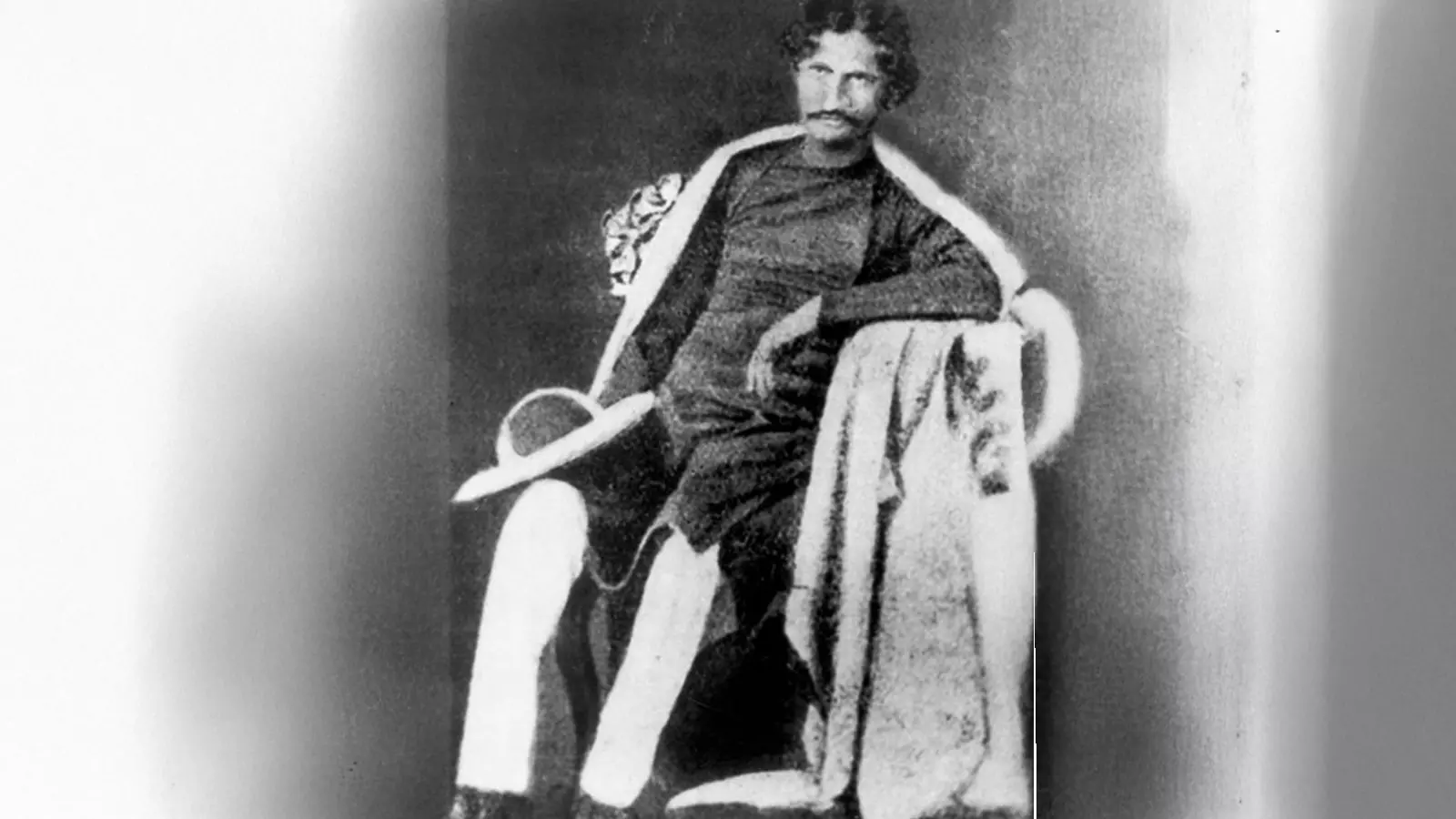
How is Bankim difficult?
“Nineteenth-century Bengali is heavily Sanskritised or derived from Sanskrit. It is indecipherable for Gen Z. Given the shabby way Bengali is taught at primary and secondary levels, understanding Bankim would be like decoding an encrypted code,” says Kanishka Roy, editor at a new Bengali publishing house. He had studied Bengali literature as an undergraduate and had worked as a private tutor, teaching Bengali to high-school students.
“One of my students had the essay ‘Biral’ by Bankimchandra in her syllabus. The essay had words such as ‘marjari’ [a female cat], ‘nimilitalochane’ [with eyes closed or half-closed] or ‘nyayalankar’ [an expert of Nyaya, the brand of Indian philosophy]. These were like foreign words to my student,” says Roy.
The predominance of polysyllabic and conjunct consonants is an inhibiting factor for today’s Bengali reader, who tends to find the meaning of such words in phonetic resonance rather than through etymology. “My student thought ‘marjari’ had something to do with the English word ‘merger’,” says Roy.
Roy’s observation is validated by the experience of a Bengali undergraduate student wanting to take up English as major at a private university: “Since I got stuck at juktakkhor [consonant conjuncts] in class II, because they were taught in such a hurry, I developed a fear of Bengali. I could never bring myself to read any Bengali book by myself. I only read what was in the syllabus.” A former student at one of Kolkata’s most renowned schools, she adds: “I have never read Bankimchandra. I have not even read Rabindranath outside the syllabus. I cannot understand Bengali words as their meaning remains distant”. She did not know the connection between Vande Mataram and Anandamath and in Bengali literature, only enjoys the writings of Sukumar Ray, the great humourist and father of celebrated filmmaker Satyajit Ray. “He is mind-blowing and does not use difficult words. “One day, maybe, I will begin to discover Bengali,” hopes the undergraduate student.
Bankimchandra has not become irrelevant, but a few features of his works have made him a little remote, feels Roy. The students who have no acquaintance with Sanskrit in the lower classes feel overwhelmed when Bankim is “imposed” on them in high school. “It’s a systemic failure,” says Roy. “I doubt many of those who are trying to turn ‘Vande Mataram’ into a political weapon and are destroying a university’s emblem even know the origin of the words,” says Roy.
Sudhangshushekhar Dey of Dey’s Publishing, a leading publisher of Bengali books, says Bankinchandra’s books have not stopped selling. But Rabindranath and Saratchandra’s books sell more. He doesn’t, however, share sales figures.
“You cannot compare anyone with Rabindranath, because apart from everything else, look at how much he has written. Bankimchandra’s novels, however, particularly Durgeshnandini (1865), Kapalkundala (1866) and Anandamath (1882), are still in demand,” says Dey. He feels that Bankimchandra deserves a special edition for children. “An edition of his novels rewritten for adolescents by Amitrasudan Bhattacharya was well received,” says Dey.
“How can Bankimchandra’s legacy be dead?” asks the teacher of Bengali at the government college. His contribution to the novel, to the Bengali language and to the spirit of the freedom movement is immeasurable. “Let’s face it. Generally people read much less. Why single out Bankim and why blame Gen Z alone?” she asks.
Besides, not all of his works are written in a similar style. His sharp, satirical works on life and society around him, Muchiram Gurer Jibancharit (1884) and Kamalakanta (1885), which are also uproariously funny, are written in simpler language.
It is extremely ironic, however, that Bankimchandra will be accused of using difficult language. When he was starting out as a writer, in the 1860s — Bankimchandra, a brilliant student, was one of the first two graduates of Calcutta University, and was appointed as a deputy magistrate at the age of 20 — Bengali prose, newly introduced to the language in which literary works had mainly been in poetry, was shaping up in “two divergent styles”, writes distinguished scholar and teacher of Bengali, Pabitra Sarkar, in an essay dated February 26, 2023, in ‘The Daily Star’, published from Bangladesh. “…one, the highly Sanskritized diction of Mrityunjay Vidyalankar (c. 1762-1819) continued through Vidyasagar and others, and the saucy and popular style…particularly in the so-called naksha (sketches) literature,” says Sarkar.
“This probably led some to fear that the ‘pure’ Bangla prose was being ‘contaminated’ with Perso-Arabic elements, and Bangla should be rid of them,” continues Sarkar. Eminent literary personalities, starting with Raja Rammohun Roy, had engaged with it.
Finally, Bankimchandra, “then the reigning authority of Bengali literature”, became the arbiter, says Sarkar. “…in his famous article Bangala Bhasha, (he) ruled in 1878 that one's subject and intention would determine one's vocabulary and style. No word, be it Arabic, Persian, rustic, bucolic — would be rejected if it served the author's purpose rightly,” Sarkar adds.
And here comes the most ironic bit. “Bankim's favourite word was saralata (simplicity). One's style should communicate easily to the reader. Beauty comes next. In his Sahaj Rachana Siksha, he recommends ishtehar [advertisement] in preference to bijnapan [same meaning]. In his English article Bengali Literature, he decries the ‘dull, pompous array of high-sounding Sanskrit words’ of Sanskrit College authors, not excluding that of Vidyasagar,” Sarkar concludes.
It is doubly ironic, then, that Bankimchandra is read little because of being difficult and is being appropriated by Hindu nationalism. His difficulty is not one of ideas, though he presents complex characters and motives, in response to the demands of the novel. In his day, his prose was considered beautiful, well-crafted, capable of being the vehicle of profound thought — and lucid. He is difficult now because the Bengali language has changed, as languages do, and we have allowed some of its older registers to get lost, as it has happened with much of Bengal heritage.
Bankimchandra Chattopadhyay. Photo: Wikimedia Commons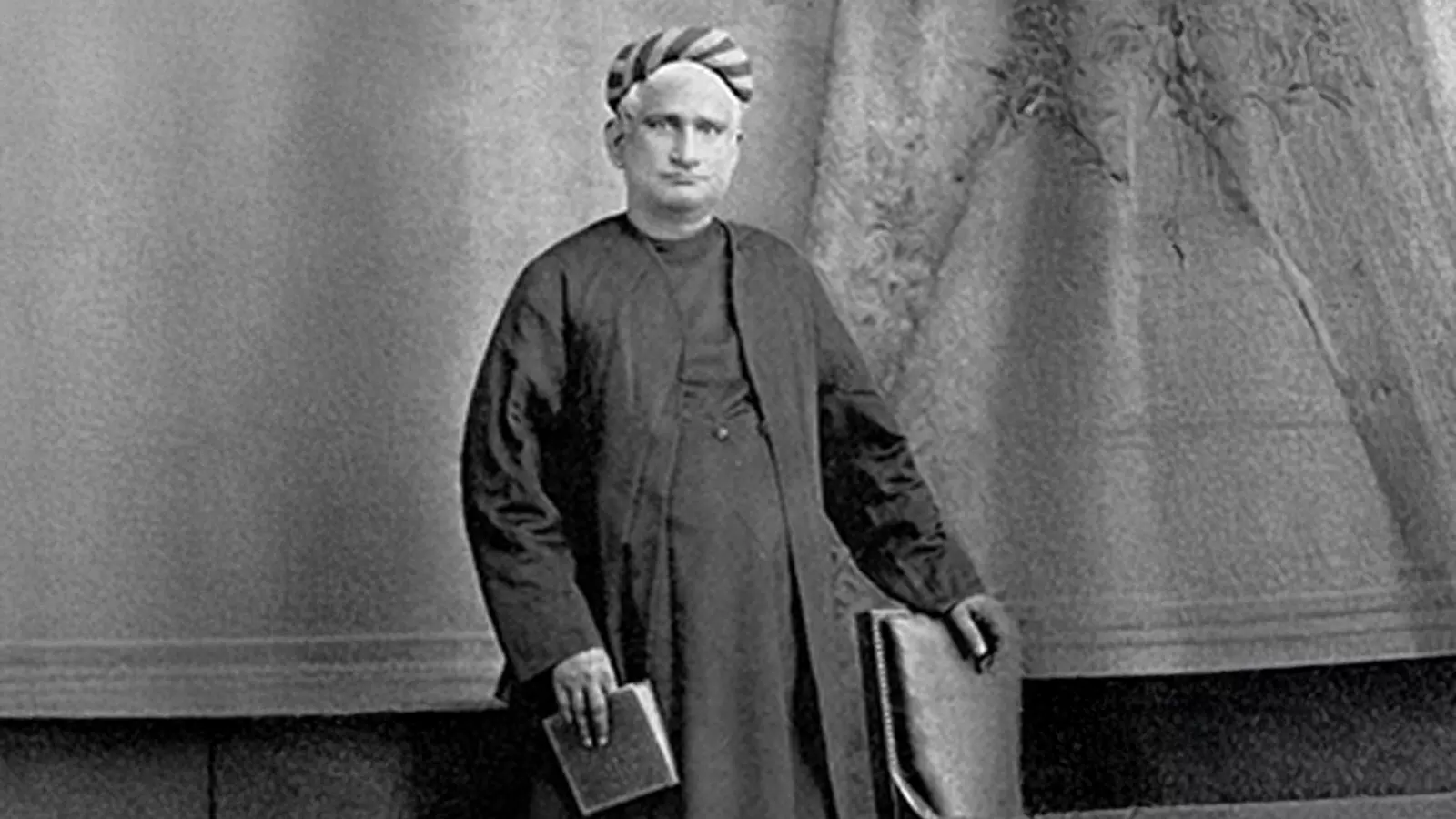
His appropriation by the Hindutva ideology, though, cannot be wished away, despite his views on “Perso-Arabic” words. As many of his critics feel, Bankimchandra’s nationalism is problematic and had fed Hindu nationalism from the start. The song ‘Vande Mataram’ was set to music by Rabindranath in 1896 and the two words got transformed into a major impulse behind the Swadeshi movement that started in 1905. But the mother that the song envisages is imagined to be like a Hindu goddess (Abanindranath Tagore’s famous painting Bharat Mata, inspired by the Swadeshi movement, evokes the same idea). After the two stanzas that describe the beauty of the motherland, the song specifically mentions Hindu goddesses, the reason the Congress — and others — have reservations about the entire song. The Congress said that the first two stanzas had been adopted for rendition at the party’s functions on the advice of Rabindranath.
Something else in Bankimchandra may alienate the contemporary critical reader: his ideas on gender equality, individual choice and personal freedom, particularly for women. Why is Kundanandini, the stunning, seductive young widow in Bishabriksha (1873), who has an affair with a married man, blamed squarely for the “lapse”, asks Roy. “The contemporary reader may see a gendered moral judgement in it,” he says.
A writer is who he is and has to be read against his time. A great writer, too, will have his blind spots. Good teaching would place his works in their context, and talk about their power, beauty and shortcomings. But how many study Bengali literature now? How robust is Bengali contemporary writing? When a language itself is disempowered, its history is not likely to be cherished. Maybe that is what Bengal’s concern should be, instead of claims about a “Sahitya Samrat”.
Also read: Why Ramayana row, demand for pre-release preview raise questions over our engagement with our epics
Gen Z, however, did what Gen Z does. A random survey of six young undergraduates threw up some surprises. Bankimchandra did not appear to be completely uncharted territory. Out of the six Bengali-speaking Gen Z undergraduates, five were from English-medium backgrounds. Three had not read anything by Bankimchandra, but three had. One said she had read ‘Rajmohan’s Wife’ (1864), Bankimchandra’s first novel, which was written in English; one had read ‘Anandamath’ and ‘Biral’, the latter being a part of the syllabus; and the third said that she tries to read Bankimchandra to understand the roots of Bengali literature.
The telling word here is perhaps “tries”. The prevailing perception of Bankimchandra’s work in the present would then be the one forwarded by the Gen Z whose only experience of his writing is restricted to ‘Rajmohan’s Wife’. Fluent in Bengali, the Gen Z, an undergraduate student at Jadavpur University, says she would even participate in Bengali recitation contests and plays as a child and read Bengali literature. “But Bankimchandra in the original proved too difficult”.